
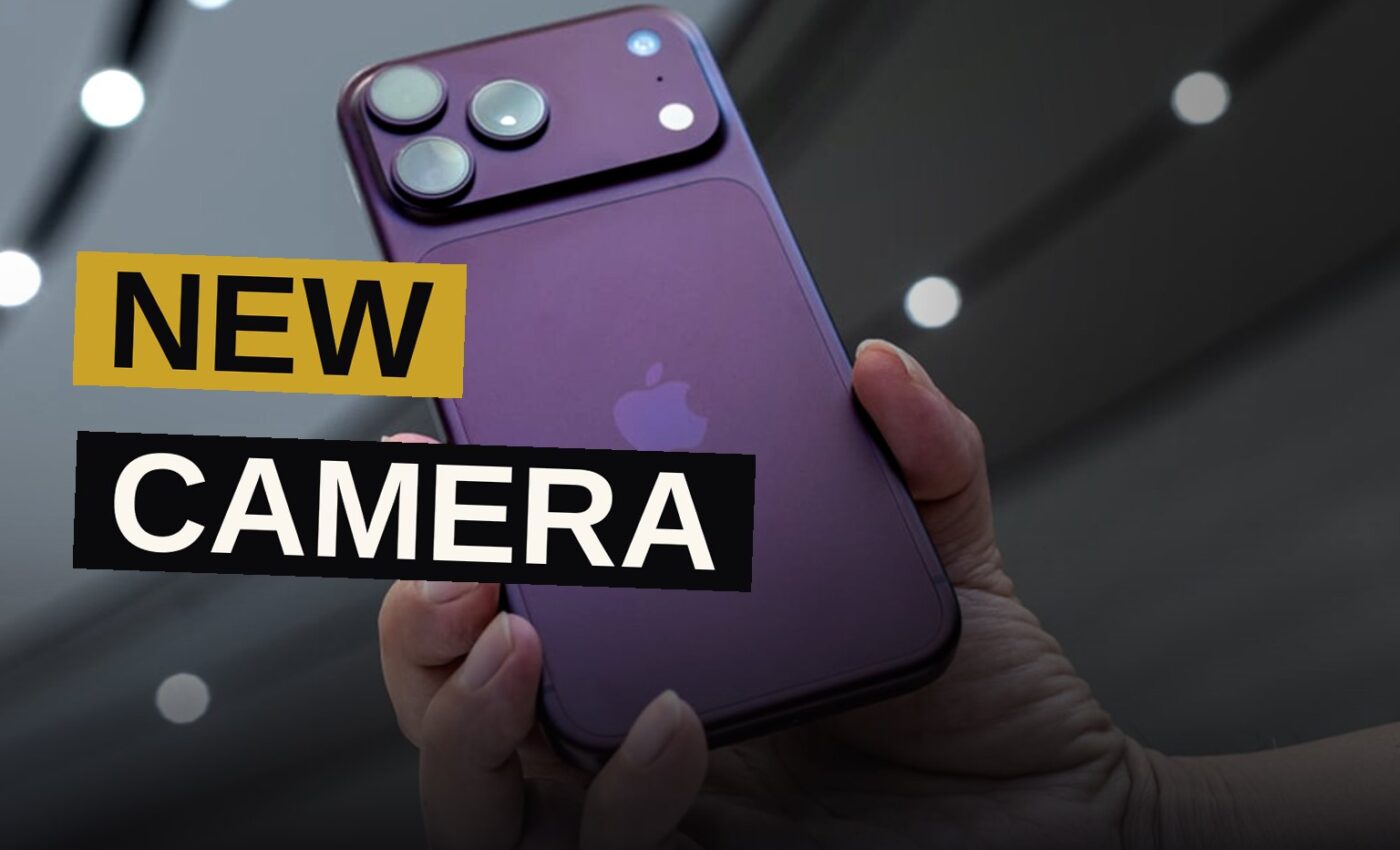
Apple’s September event brought the Duo to the stage, but the second-biggest news was tucked inside the iPhone 18 Pro lineup: the company’s first-ever variable aperture, paired with manual controls, upgraded video tools, and a new photo authenticity feature. It is arguably the most substantial camera overhaul Apple has shipped in years.
The presentation kicked off with cinematic footage captured on the iPhone 18 Pro. The device’s adjustable aperture, manual shutter speed, manual focus, and live histogram point to it being essentially an entry-level DSLR that can still make calls and send texts to your friends. This change in what Apple envisions for the iPhone is plain to see in the demo itself.
Manual Controls in the Camera App
Those who prefer to adjust their shots instead of leaving the phone to handle everything now have a dedicated “Pro controls” panel built directly into the Camera app. It brings forward the aperture setting, shutter speed, white balance, and a histogram for finer control.
A histogram is a tiny chart showing how exposed an image is. When the bars pile up on the left side, the picture tends to be too dark. When they bunch up on the right side, the photo is likely overexposed and too bright. It appears complex at first glance, but its meaning is easy to grasp.
How long the sensor sits open to light is set by shutter speed. A quicker setting stops motion, while a longer one adds blur or gathers more light. White balance is what corrects colors so whites appear true under indoor lamps or take on a bluish tone in shadow.
Smarter Tracking and Sharper Video
Apple has reworked what it calls the “computational imaging pipeline” to produce cleaner, more detailed images. Smartphone photos are normally heavily processed by algorithms — merging multiple exposures, reducing noise, sharpening detail — rather than being raw, untouched captures.
The app’s preset feature now covers more than just color and mood settings for photos; it also handles texture and grain adjustments. In video work, users can now apply Cinematic effects to footage captured at up to 60 frames per second. Time-lapse videos are now compatible with 4K resolution and Dolby Vision HDR. The audio processing has also gotten an upgrade, with improved algorithms that make voices sound clearer and separate background music from the rest of the mix better.
A new smart focus system has been added, one that uses AI to lock onto and track a single moving subject through a frame. This feature should prove useful when photographing subjects that won’t hold still, such as children or pets.
The Variable Aperture Feature
The standout feature is a 48MP main camera with a mechanically adjustable aperture. In a camera, the aperture is the opening in the lens through which light travels to reach the sensor. A larger opening admits more light, which works well in dark rooms or at night. It also softens the background. A smaller opening admits less light but holds more of the scene in sharp focus, which comes in handy outdoors or when shooting group photos where you need every face to be clear.
A typical smartphone camera has a fixed opening that stays at one size. The iPhone 17 Pro used a ƒ/1.78 opening that did not change. Apple explains that the opening on the 18 Pro and Pro Max is made up of six thin blades cut by lasers, and these blades can actually be moved to create four different sizes of opening, adjusting themselves automatically based on how much light there is and what distance the shot requires.
The company claims the adjustment delivers better low-light images and sharper background detail in group shots, alongside a degree of manual control that was not previously available on the device.
Why Variable Aperture Is a Risk
Variable aperture settings have existed before, though they tend not to last. The main reason is durability and production. There is a great deal of delicate moving hardware involved, and it has to fit inside a device that regularly gets dropped, tossed in bags, and generally treated worse than a dedicated camera ever would be.
Current-generation stabilization systems can still act without warning after a rough fall, and adding a mechanical aperture adds another part that could go wrong.
Eight months ago, there were rumors that the Galaxy S27 would get a variable aperture system. Now, reports from August say Samsung scrapped those plans. The reason was that the feature made the phone bulkier and was expensive to add for what Samsung judged to be “minor image-quality gains.”.
Whether Apple’s engineering proves more durable than Samsung’s, or whether variable aperture quietly disappears from the iPhone lineup a generation or two from now, remains an open question.
The Digital Negative Inside Your Photos
Apple Reference Image stands out as an unusually remarkable addition to the lineup, one that addresses a need for trust in a digital age. The feature draws on the Main camera’s newly revised sensor, giving users a new way to verify the authenticity of images.
When a photo is taken in the new “Reference” capture mode, the sensor’s data is cryptographically signed and processed through Apple’s Private Cloud Compute into an unalterable reference version of the image. In short, it is a digital negative.
The normal shot is displayed next to the reference photo inside the Photos app, allowing a side-by-side comparison against the final image to determine if it has been altered. Alongside this, image metadata and planned support for the SynthID watermarking standard, which marks AI-generated or AI-edited images, work together to provide additional verification.
The company is pitching the feature as a means for both professional photographers and regular users to confirm that a photo matches its stated content, amid a growing difficulty in telling apart AI-altered and AI-created images from genuine ones.
“It’s a digital negative.”
What We Make of This Overhaul
This story honestly positions the iPhone 18 Pro as an entry-level DSLR, thanks to its manual controls and variable aperture. It is a meaningful reaction. The device has always produced good photos, yet the underlying hardware was fixed. Now it is adjustable and tunable, built for people who want to make their own choices.
The variable aperture is the riskiest move. Samsung’s experience shows the feature is expensive and bulky to add, and it does not deliver obvious gains in image quality. Apple’s engineering will be tested in the field, and the durability question is open.
The verification feature operates quietly yet holds the potential to become the most significant addition. It addresses a problem that worsens daily, with Apple treating it as a central feature instead of an afterthought. Its success hinges on whether users trust both the digital signature and the cloud processing that underpins it.
This camera setup pays off for those willing to wait. It offers manual controls for anyone who wants them, and its video improvements are modest yet genuine. The aperture highlight is the main draw, though it is also the one that might vanish.
For now, the iPhone 18 Pro is a camera worth watching.
See the video the story is built around at Mashable.