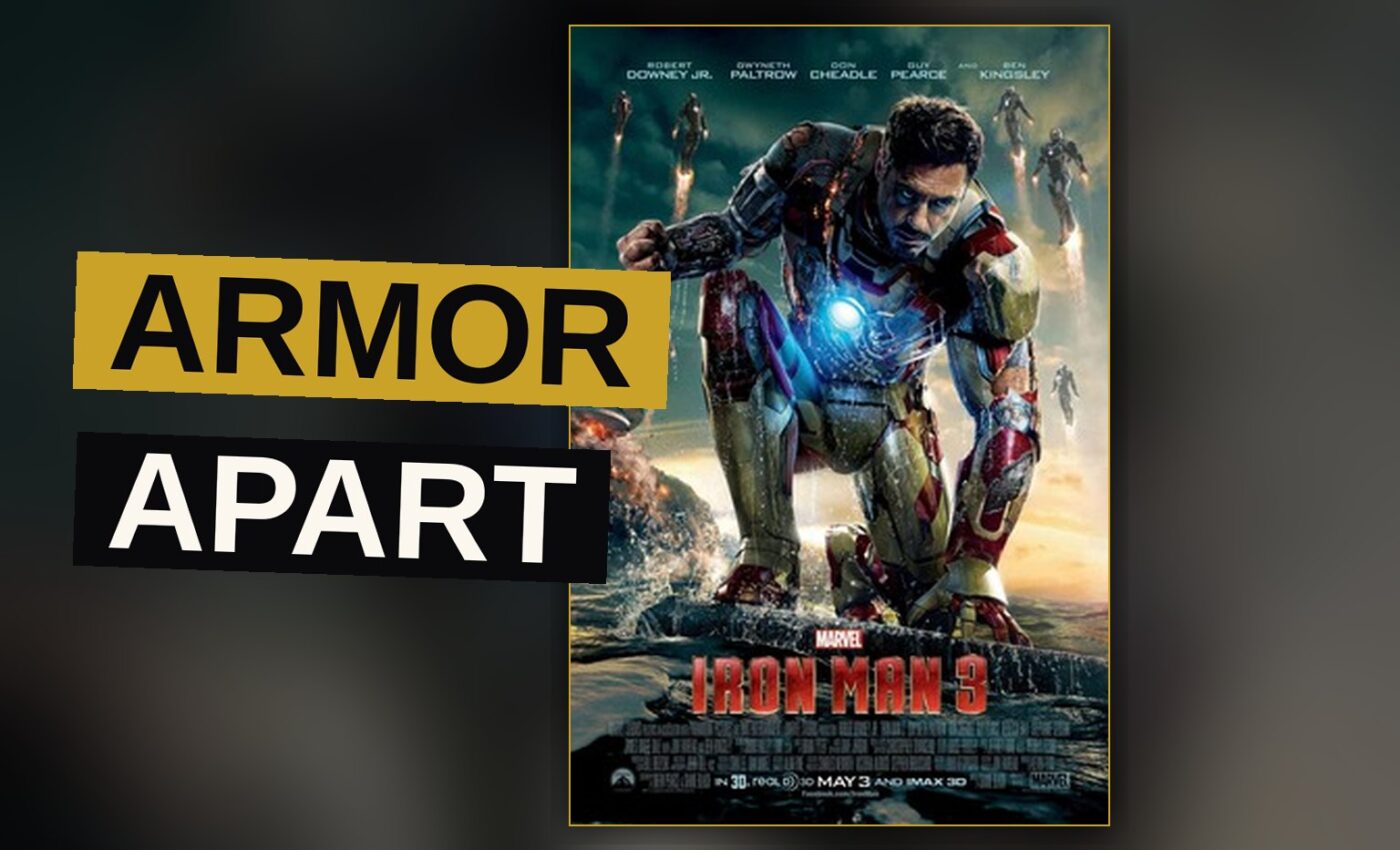
Iron Man 3 is a strange blockbuster. It is loud, fast, and funny, yet seems almost embarrassed by its own premise, spending much of its runtime tearing down the very idea of superhero spectacle only to rebuild it in the final act with a parade of exploding armor suits. That contradiction mostly works, because the man at the center is having so much fun playing a character who is falling apart.
The film opens with Tony Stark in a bad way. He has not slept in days, is having panic attacks, and builds suits at three in the morning because he cannot sit still. The events of The Avengers have left him rattled, and director Shane Black uses that trauma as a springboard for a story less about saving the world and more about a man figuring out who he is without the machine strapped to his chest.
That is the smartest thing about Iron Man 3: it is a superhero movie about the guy inside the suit, and it is willing to make that guy a mess. Robert Downey Jr. delivers his best performance as Stark, trading the cocky swagger of the earlier films for a jittery, exhausted energy. He is still quippy, but the jokes feel defensive now, a way to keep the world at arm’s length.
Trailer, via Marvel Entertainment.
The Mandarin Twist
The villain situation is complicated. The Mandarin, played by Ben Kingsley, is introduced as a terrifying terrorist mastermind who records propaganda videos, speaks in a grave, theatrical tone, and seems to be the master of a string of bombings that have left the country in fear. Kingsley is magnetic in these scenes, all menace and controlled fury.
Then the twist: the Mandarin is not real. He is an actor named Trevor Slattery, a washed-up thespian hired to play a role. The real villain is Aldrich Killian, a biotech entrepreneur played by Guy Pearce, who has developed a regenerative serum called Extremis and uses the Mandarin as a distraction while he manipulates the government and the media.
It is a bold subversion, and it works thematically: fear is manufactured, terrorism is a construct, and the real threat is often a man in a suit making deals in a boardroom. But it also deflates the movie. Kingsley is so good early on that his reveal as a buffoon feels like a letdown.
The comedy that follows—Trevor Slattery in his underwear, complaining about his career—is funny, but it undercuts the tension. Killian never feels as threatening as the fake villain did. He is a standard-issue tech bro with anger issues, and Pearce plays him with a sneer that does not quite land. The film wants to mock the idea of a comic-book villain while also delivering one.
A Christmas Story
The film is set at Christmas, and that is not incidental. Shane Black, who wrote Lethal Weapon and Kiss Kiss Bang Bang, has a thing for holiday settings. The snow, lights, and carols give Iron Man 3 a cozy, almost nostalgic texture that contrasts sharply with the violence.
The best scene is a quiet one. Stranded in rural Tennessee after his mansion is destroyed, Stark takes shelter with a single mother and her young son, Harley, a sharp kid who helps him fix his suit. Their banter is warm and funny, giving the film a human center that the explosions lack.
Stark even builds Harley a gift, a little improvised glove that shoots a tiny missile. It is a sweet moment that says more about Stark than any of his big speeches: he shows love through invention. The setting also allows the film to play with iconography. Stark’s armor is red and gold, and at one point he crashes through a window wearing a suit that looks like a holiday ornament.
Suits and Their Limits
The central tension is Stark’s relationship with his armor. At the start, he is obsessed with building more suits—dozens of them, stored in a hidden garage, each designed for a specific purpose. They are a security blanket, a way to feel safe in a world that has shown him he is not.
The film’s thesis is that the suit is a crutch; Stark has to learn to be the hero without it. That is why the climax is so pointed. After a mid-air rescue, Stark calls down all his suits and has them fly in formation, attacking Killian’s forces while he faces the villain on the ground. The suits are a distraction, a fireworks show. The real fight is between two men in a burning dockyard.
It is a satisfying message, but the execution is messy. The final battle is a blur of CGI, suits exploding and reassembling in ways that defy physics. It is hard to tell what is happening, and the stakes feel lower because the suits are disposable. Stark destroys them all at the end in a grand gesture of self-liberation, has the shrapnel removed from his chest, and throws the arc reactor into the sea. It is a clean break, a symbolic ending for a character defined by his hardware—but it also feels like a cheat. The movie gets to have its spectacle and then pretend it was all a mistake.
Extremis and Body Horror
The Extremis virus is the film’s other big idea: a biological agent that rewrites the host’s DNA, granting superhuman strength and the ability to heal from almost any wound. It also makes people dangerously unstable—if they get too hot, they explode. The film uses this for some genuinely unsettling imagery. Killian’s henchmen glow from within, skin cracking like embers, and when they die, they detonate in showers of orange light.
This is body horror in a Marvel movie, and it is surprisingly effective. The threat is not just violence but the loss of control over one’s own body, echoing Stark’s panic attacks, another form of bodily betrayal. The film is interested in the fragility of the human form, whether a billionaire with a heart condition or a test subject whose cells are burning from the inside.
Extremis also raises the stakes without alien invasions. The threat is domestic, corporate, and personal. Killian is not trying to conquer the world; he is trying to own it through fear and technology—a more grounded enemy, even if the execution is a bit over-the-top.
Politics and Media
A subplot involves the President of the United States, played by William Sadler. The Mandarin’s attacks are aimed at the highest levels of government, and the President becomes a target—standard action-movie stuff, handled with a light touch. The President is not a major character, just a plot device: he gets kidnapped, and Stark has to save him. The politics are vague, which is probably for the best.
More interesting is the media. The film opens with talking heads and news clips speculating about the Mandarin—a pointed commentary on how fear is manufactured and sold. The Mandarin is a media creation, a face for a threat that does not exist; the news cycle is a machine that produces monsters. It is not a subtle point, but it is a timely one.
| Element | Iron Man 3 | Typical Marvel Film |
|---|---|---|
| Villain | Fake terrorist, real businessman | Alien warlord or rogue agent |
| Setting | Christmas, rural Tennessee | Urban metropolis or space |
| Theme | Man vs. his own technology | Man vs. external threat |
| Tone | Self-aware, comedic | Earnest, dramatic |
The Supporting Cast
Gwyneth Paltrow returns as Pepper Potts and gets more to do this time. She is not just the love interest but a capable executive, and she even gets a hero moment at the end, using her own Extremis powers to save Stark from Killian. It is a nice reversal, but it feels rushed—her transformation is a plot convenience rather than a character arc. She is infected, cured, and suddenly a superpowered fighter.
Don Cheadle is back as James Rhodes, now flying his own armor as the Iron Patriot. The name is a joke—the government painted the suit red, white, and blue for PR purposes—and Cheadle plays it with a dry exasperation that works. He is the straight man to Stark’s chaos, and their banter is one of the film’s pleasures. But Rhodes is underused, disappearing for long stretches, and his role in the climax is mostly as a pilot.
“You know who I am. You don’t know where I am. And you’ll never see me coming.”
That line, delivered by the Mandarin in one of his propaganda videos, is the film’s best—a perfect piece of menace that sets up the mystery driving the first half. It is also a lie, because the Mandarin is not real. The line works on two levels, and that is the kind of cleverness the film pulls off at its best.
Action Sequences
The action is a mixed bag. The early scenes, like the attack on Stark’s mansion, are kinetic and inventive: Stark fights without his suit, using improvised gadgets and his wits. The film is at its best showing Stark as a resourceful survivor rather than an invincible machine. The scene where he is trapped in a collapsing building, using a single glove to blast his way out, is tense and exciting.
The mid-air rescue, where Stark saves a group of falling passengers from Air Force One, is the film’s set piece—a long, complicated sequence of Stark in his full suit, flying at high speed to catch people before they hit the ground. It is thrilling, but it highlights the film’s visual limitations. The CGI is good, not great; the suits move with a weightless quality that undercuts the physicality.
The climax is a mess. The battle between Stark’s suits and Killian’s Extremis soldiers is hard to follow, the suits destroyed and reassembled so quickly they lose their impact. It is a fireworks display, not a fight. A smaller, more intimate confrontation would have served the film better, but Marvel movies are expected to end with a big, loud battle.
Final Score
Iron Man 3 is a film of contradictions: smart and silly, personal and impersonal, grounded and absurd. It wants to deconstruct the superhero myth while delivering the spectacle audiences expect, and it mostly succeeds, thanks to Downey’s performance and Black’s willingness to take risks. The Mandarin twist is bold, even if it does not fully pay off. The Christmas setting is charming. The message about the man inside the suit is resonant.
But the film is also bloated—too long, with too many subplots. The villain is underwhelming. The action is often incomprehensible. It is better in its parts than in its whole. The quiet scenes between Stark and Harley are worth the price of admission; the final battle is not.
Iron Man 3 is a good movie, not a great one—a superhero film trying to be something more, and that ambition is admirable even when the execution falls short. It is a fitting capstone to the Tony Stark trilogy, a story about a man who learns to let go of the things that define him. Not the best Marvel movie, far from the worst: a solid, entertaining, and occasionally brilliant piece of blockbuster filmmaking.
On the published critical scale, Iron Man 3 earns a 6.9 of 10.