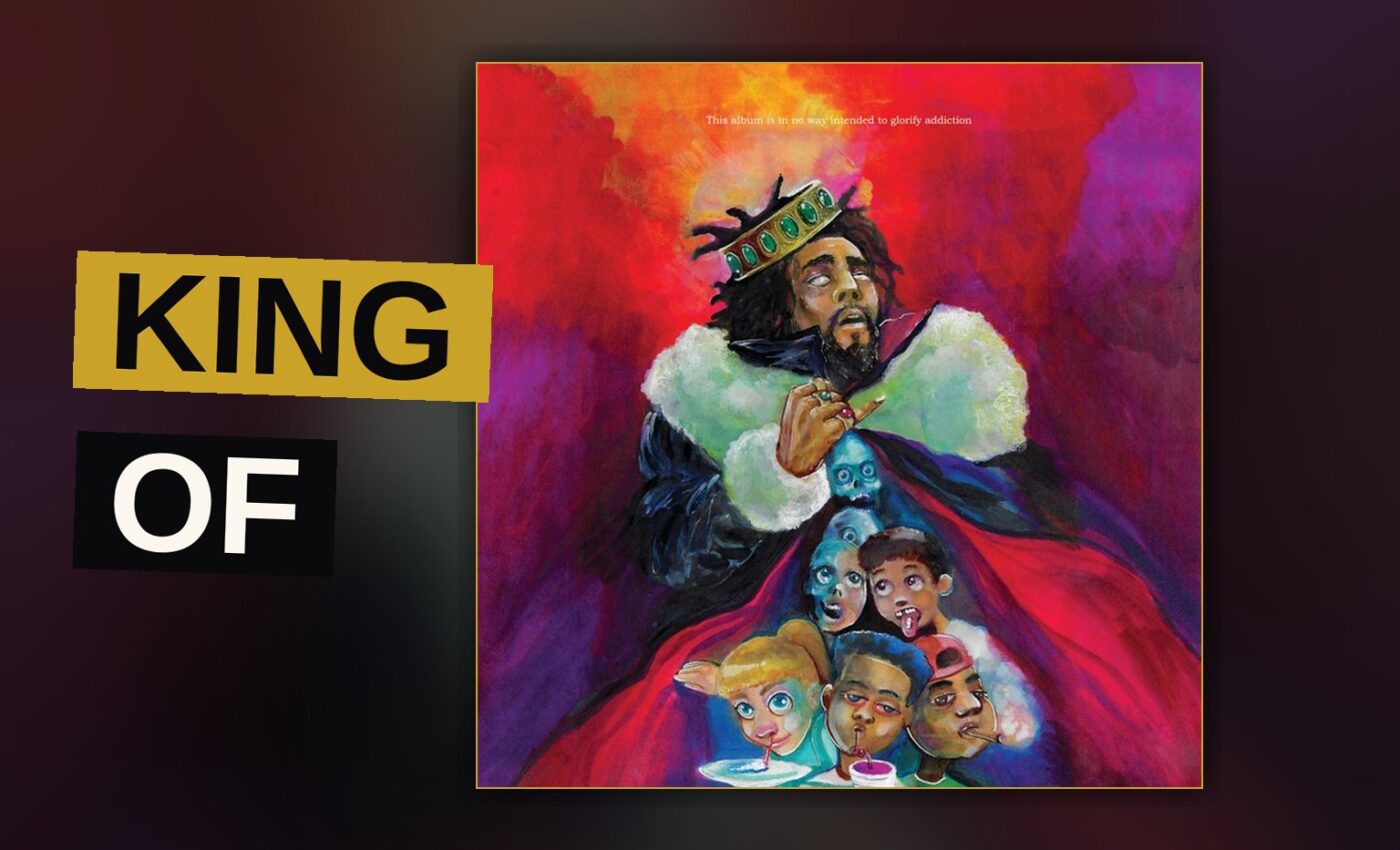
J. Cole’s KOD is a mission statement disguised as a rap album. Released in 2018, the record wants to prove that Cole can still make a hit without sacrificing the social conscience that defined his earlier work. It mostly succeeds, though not without some rough edges. This is a dense, ambitious record that asks listeners to sit with uncomfortable truths about fame, addiction, and the cost of success.
The album runs 42 minutes across 12 tracks. It opens with a spoken intro and closes with a brief outro, with most of the action packed between those two bookends. The title itself stands for King Of Drugs, and Cole spends the record wrestling with the idea of being a king while still carrying the scars of his past. It’s a record about power, guilt, and the difficulty of staying honest when the world keeps asking for more.
Opening With KOD
The album starts with “Intro,” a brief spoken-word piece that sets the tone. Then comes “KOD,” the centerpiece that gives the record its name. The song is a slow, deliberate track that builds around a simple question: what does it mean to be the king? Cole answers with a mix of self-reflection and social commentary, pulling back the curtain on the contradictions of his own position. It’s the track that best captures the album’s central tension.
“Photograph” follows, a more straightforward rap track that leans on Cole’s storytelling skills. It’s competent but forgettable, serving as a bridge rather than a destination. “The Cut Off” picks the pace back up, with Cole rapping over a tense beat about cutting ties with people who no longer serve him. It’s a solid track, though it doesn’t quite reach the heights of the songs around it.
ATM And Motiv8
“ATM” is where the record finds its footing. Cole raps about the mechanics of fame—the money, the pressure, the constant need to perform—and he does it with a sharpness that cuts through the genre’s usual bluster. It’s one of the strongest tracks on the album, and it’s easy to hear why critics singled it out.
“Motiv8” is a lighter, more upbeat track that shifts the mood after the weight of “ATM.” It’s a breath of fresh air, but it also feels slighter than the surrounding material. It’s not bad, just less essential.
Kevin’s Heart And BRACKETS
“Kevin’s Heart” is the emotional core of the record. Cole sings about a friend who died, and the grief is palpable. It’s a track that strips away the bravado and leaves only the human underneath. It’s one of the four tracks critics flagged as standout, and it earns that attention.
“BRACKETS” is the longest track on the album, and it’s a sprawling, dense rap that touches on everything from politics to personal history. It’s ambitious, but it’s also the point where the record starts to feel overstuffed. The ideas pile up faster than they can land.
Once an Addict And FRIENDS
“Once an Addict” is an interlude, a brief pause before the album’s final stretch. It’s a moment of quiet before the storm, and it works as a transition rather than a full statement.
“FRIENDS” is the other standout track critics flagged. It’s a slow, melodic rap that explores the nature of friendship and loyalty, and Cole delivers the verses with a rare level of vulnerability. It’s one of the best songs on the record, and it shows Cole at his most emotionally exposed.
Window Pain And The Fall Off
“Window Pain” serves as the album’s outro, a reflective piece that looks back on the themes of the record. It’s a fitting close, though it doesn’t offer much new ground. It’s a thoughtful ending, but it’s not a revelatory one.
The album ends with “1985,” a brief intro that leads into a track from Cole’s earlier work. It’s a strange way to close a record, but it makes sense in context. Cole is reaching back to his roots, reminding listeners of where he came from before he became a king.
What Works, What Doesn’t
The album’s strengths are its ambition and its honesty. Cole is willing to look at himself critically, to admit the costs of his success, and to ask hard questions about what it means to be a public figure. That willingness to engage with difficult topics is what makes KOD stand out from the standard rap release.
The weaknesses come from the density. Some tracks feel like they’re trying to do too much, packing in references and ideas without giving any of them room to breathe. The middle section, particularly “BRACKETS,” is where the record loses focus. It’s not bad, but it’s the part that strains the album’s 42-minute runtime.
- “KOD” — the thesis statement, strong but heavy
- “ATM” — the clearest hit, deservedly singled out
- “Kevin’s Heart” — the emotional peak, one of the four standout tracks
- “FRIENDS” — the other standout, a high point of the record
- “BRACKETS” — the longest and most ambitious, but the least focused
The Verdict
KOD is a record that aims for greatness and mostly gets there. It’s uneven, but its highs are high enough to justify the rough patches. Cole’s best work is on display throughout, even when the album’s structure occasionally gets in the way of its message.
The record’s 73/100 Metacritic score reflects that balance. It’s a solid, occasionally great album that falls short of perfection. It’s the sound of an artist pushing himself, even when the push causes some wobbles along the way.
- Intro1:47
- KOD3:11
- Photograph3:38
- The Cut Off3:57
- ATM3:37
- Motiv82:14
- Kevin’s Heart3:20
- BRACKETS5:16
- Once an Addict (interlude)3:18
- FRIENDS4:18
- Window Pain (outro)4:47
- 1985 (intro to “The Fall Off”)3:10