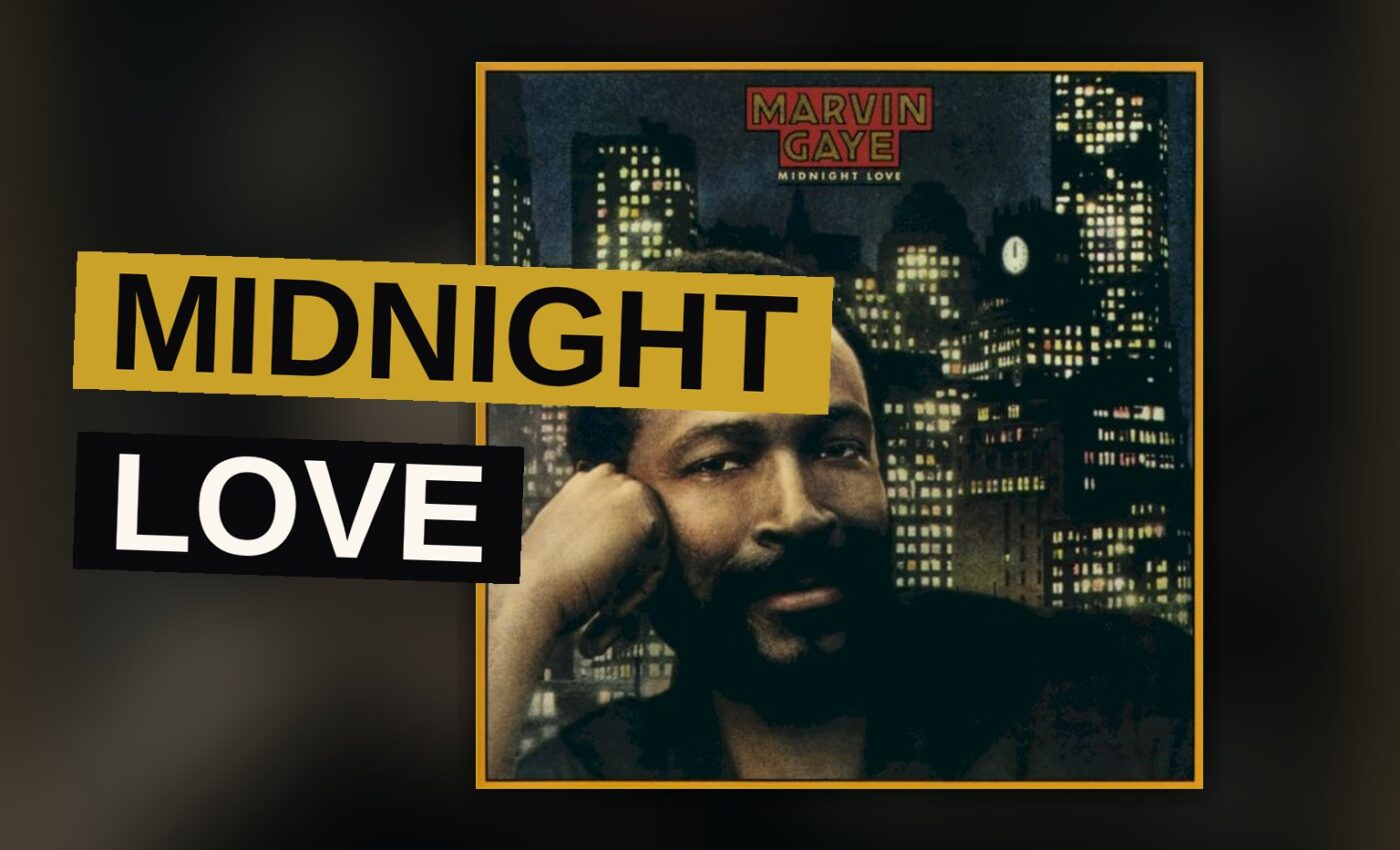
Marvin Gaye’s Midnight Love is a record that sounds like a man escaping his own legend. After the sprawling social sermon of What’s Going On and the fraught sessions of Here, My Dear, Gaye went to Europe, shed his entourage, and came back with eight tracks that trade protest for pleasure.
This is a funk album built for the bedroom and the dancefloor, not the pulpit. It is also the last studio album he completed before his death, which gives every sigh and synth stab a weight the music didn’t ask for. The record’s goal is simple: to make you move, and to make you feel something while you’re moving.
The context matters because Midnight Love was a gamble. Gaye was living in Europe, dodging his own label’s demands. He recorded in a makeshift studio, working with a young musician and a drum machine that he treated like a bandmate. The result is a hybrid: live horns and bass tangled with programmed rhythms, all coated in Gaye’s multi-tracked falsetto.
It is slick, it is warm, and it is unmistakably his. The album went double platinum and won two Grammys. But the record itself is not a victory lap. It sounds like a man rediscovering joy at close range, after years of looking at the big picture.
The Big Hit
“Sexual Healing” is the track that defines the album’s legacy, and it earns that position. The song opens with a doctor’s cadence, then settles into a groove that is part gospel, part electronics. The drum machine shuffles, the bass line is liquid, and Gaye’s voice slides between a whisper and a plea.
It is the rare hit that feels both inevitable and handmade. The song won the Grammy for Best R&B Vocal Performance, Male, and Best R&B Instrumental Performance. But the numbers undersell the craft. The track’s genius is its restraint: the arrangement leaves space, and Gaye fills that space with breath, not noise.
It is a song about desire that never sounds desperate. It sounds assured.
The rest of the album does not match that peak, but it orbits it with intelligence. “Midnight Lady” opens the record as a slow-burn invitation. The synth stabs are dated, sure, but the vocal performance is not. Gaye sings like he is leaning into a microphone in a dark room, and the track’s five-minute runtime passes without dragging.
It sets the tone: this is an album for after hours, not for the morning commute.
Rockin’ After Midnight
“Rockin’ After Midnight” shifts the energy. It is the most straightforward funk track on the record, with a driving bassline and a chant-along hook. Gaye does not have a great lyric here, but he sells it with pure physicality. The track feels like a live band warming up, even though much of it is programmed.
It is the song you play when you want the room to move, and it works.
“‘Til Tomorrow” is the ballad, and it is the album’s quiet heart. The lyrics are simple — a promise to love until the sun comes up — but Gaye’s delivery turns them into something devotional. He layers his own voice into a choir, and the effect is intimate rather than grand.
It is the kind of song that rewards headphones. The melody is not as indelible as “Sexual Healing,” but the mood is just as specific. This is the track that shows Gaye could still write a love song without a single ironic wink.
Turn On Some Music
“Turn On Some Music” is where the record gets tricky. The track is a mid-tempo groove about using music as a cure for loneliness, and it has a lovely sentiment. But the production is the most dated thing on the album — the synth horns and the chugging rhythm feel like a time capsule from early 80s radio.
Gaye’s vocal is committed, but the song does not give him much to work with. It is not a failure. It is just the track that sounds most like its era, and least like Gaye’s own voice.
“Third World Girl” is the most politically minded track on the record, and it is a welcome surprise. Gaye sings about a woman from the developing world with admiration, not pity. The groove is lighter than the rest of the album, almost reggae-tinged, and it gives the record a breath of fresh air at the right moment.
It is not a deep statement, but it is a sincere one.
Joy and the Closer
“Joy” is the most joyful track on the album, which is saying something. The song is a celebration of simple happiness, and it is the closest the record comes to pure pop. The melody is bright, the backing vocals are sunny, and Gaye sounds like he is smiling. It is slight, but it is not shallow.
The track earns its place because it shows range: after the darkness of “Sexual Healing” and the tenderness of “‘Til Tomorrow,” here is Gaye just having fun.
“My Love Is Waiting” closes the album on a note of anticipation. The track is slower, more atmospheric, and it builds to a fade rather than a resolution. The music backs up the promise with a sense of patience. It is not a grand finale. It is a door left open.
The album ends not with a statement but with a breath, which feels right for a record that is more about mood than message.
Running Order
| Track | Title | Length |
|---|---|---|
| 1 | Midnight Lady | 5:17 |
| 2 | Sexual Healing | 3:59 |
| 3 | Rockin’ After Midnight | 6:03 |
| 4 | ‘Til Tomorrow | 4:58 |
| 5 | Turn On Some Music | 5:08 |
| 6 | Third World Girl | 4:35 |
| 7 | Joy | 4:23 |
| 8 | My Love Is Waiting | 5:08 |
Total running time: 39 minutes.
Production and Voice
The production on Midnight Love is a mixed bag, and it is worth being honest about that. The drum machines sound thin by modern standards, and some of the synth patches are pure early-80s cheese. But there is a reason the album still works: Gaye’s voice is the real instrument, and it dominates every track.
He recorded his vocals in layers, creating a chorus of himself, and that technique gives even the weakest songs a human center. The horns add a live warmth that keeps the record from feeling like a demo. The bass lines are the glue that holds the grooves together.
The album’s sequencing is smart. It opens with the seductive “Midnight Lady,” peaks early with “Sexual Healing,” and then spends the rest of its runtime exploring variations on that theme. There is no filler that feels like filler — even the lesser tracks have a purpose. “Turn On Some Music” is the weakest link, but it is not a skip. It is just a song that does not reach the heights of its neighbors.
Legacy
Midnight Love was released in 1982 on Columbia Records. It was Gaye’s first album for the label after a long and bitter split from Motown, where he had spent his entire career. The move was a risk, and it paid off commercially. The album reached the top ten on the Billboard 200 and the top three on the Top R&B Albums chart.
“Sexual Healing” became his biggest hit, and the album’s success gave Gaye a new lease on life — briefly. He died in 1984, shot by his father during an argument. The tragedy is unavoidable when you listen to this record.
It is a happy album, and that is part of what makes it sad. Gaye sounds alive on every track, and he was gone within two years.
The album’s influence is real. Its use of drum machines and synthesizers helped push R&B toward the electronic sound of the mid-80s. Artists from Prince to D’Angelo have cited Gaye’s late work as a touchstone. But the record is not a museum piece. It plays like a man in his prime, even if that prime was complicated.
The Verdict
Midnight Love is not the best album Marvin Gaye ever made. That title belongs to What’s Going On, which is a masterpiece by any standard. But Midnight Love is the most personal record of his later career, and it is the one that sounds most like a man choosing happiness.
The songwriting is uneven, the production is dated, and the album leans heavily on one massive hit. But the voice carries everything.
Gaye could sing a grocery list and make it sound like a confession, and here he is singing about love, joy, and the simple act of dancing. That is enough.
The album is a document of a specific moment — a man in exile, rebuilding himself with a drum machine and a microphone. It is not perfect, but it is honest. And honesty, in Gaye’s hands, was always the most seductive quality he had. This is a record that rewards repeat listens, not for its polish but for its pulse.
8 of 10.
Get the Notebook.
The day's best stories and every fresh verdict, in plain English, in your inbox by seven. One email a day, no more.
- Midnight Lady5:17
- Sexual Healing3:59
- Rockin' After Midnight6:03
- 'Til Tomorrow4:58
- Turn On Some Music5:08
- Third World Girl4:35
- Joy4:23
- My Love Is Waiting5:08