
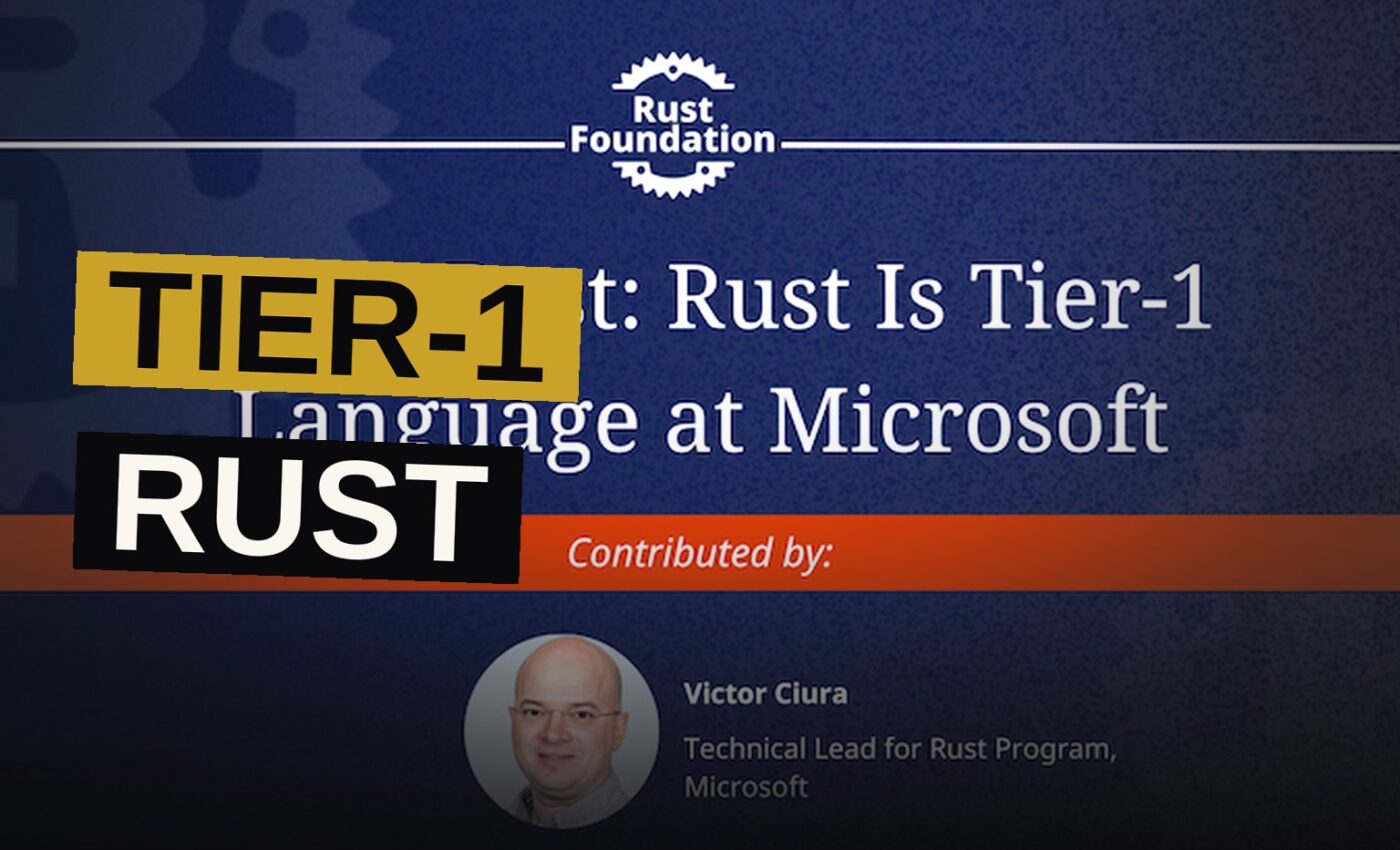
Microsoft has now placed Rust among its primary languages for internal development, alongside C++, C#, and TypeScript. The firm detailed the “Tier-1 language” designation in a blog post that outlines how it intends to maintain full compatibility between Rust and its native Windows toolchain.
Microsoft’s label signals that internal teams now have a direct route from local development all the way through to production, with secure toolchain builds, developer tooling, quality workflows, platform integration, and SDL compliance requirements built into it.
The new codegen backend
The highlight of the announcement is rustc_codegen_utc, a separate code generation backend for rustc. It occupies the same position among other backends as rustc_codegen_llvm, rustc_codegen_gcc, and rustc_codegen_cranelift do, linking rustc’s shared compiler machinery to the MSVC backend, which is also known as “UTC.”.
Windows relies on MSVC as its own compiler, and the new backend now allows Rust to take part fully in that system as its use expands across Microsoft, from firmware and drivers up through the kernel, hypervisors, microservices, and apps.
What has emerged is a single code generation platform serving both Rust and C++ development on Windows, eliminating the need to build a separate version of every Windows-specific feature.
Why a shared backend matters
Microsoft’s production software goes through thorough security and quality processes. Though Rust has climbed to Tier-1 status, C++ remains the dominant language, having developed over decades.
A shared codegen platform keeps maintenance and evolution expenses low. New code generation abilities, security features, diagnostics, and servicing technologies keep getting added to MSVC and Windows. With rustc_codegen_utc, those improvements rest on a single foundation for both languages.
The practical benefit comes from cutting down on duplicated work done by engineers. There is also a strategic reason: Rust is part of Microsoft’s own Windows-native engineering system. The backend handles binary hardening, post-link compliance and servicing, which includes Hotpatch, plus smooth Rust/C++ integration, cross-language optimization, SPGO, debugging, crash-dump analysis, profiling, diagnostics, and coverage.
Interop for hybrid projects
For quite a while now, many systems will continue to depend on both Rust and C++. A common underlying layer can give both languages an equal part to play in every stage of development.
Other platforms already let a hybrid project that builds its C++ code with Clang reach the same LLVM code generation platform across both languages. On Windows, where MSVC serves as the native compiler, rustc_codegen_utc opens up the same shared-backend possibility for C++ projects, bringing the two languages together on the same code generation foundation.
Half the battle with interop is codegen, platform quirks, ABI, and post-link tooling. The other half — high-fidelity language-level interop, FFI contracts, bindings, language semantics differences, and build systems — is where Microsoft says it is working internally and across the industry. For a look at that problem space, the company directs readers to the Rust Foundation’s Interoperability Initiative.
Rollout and production status
A dedicated team within Microsoft DevDiv has made a significant investment in rustc_codegen_utc, which became production-ready in early 2026 and was adopted for use within the compiler itself starting with Rust 1.90.
Today, more than 100 Microsoft project repositories are built with it, and the deployment keeps growing each week as additional repositories come on board.
The internal Rust platform it is a part of covers more than just its own scope. It includes secure supply-chain builds of rustc, the standard library, related tools, integration with local development, production pipelines, and common quality and compliance workflows.
Strategic context
Microsoft’s investment in Rust is not new. Azure CTO Mark Russinovich outlined the company’s future strategy for native code in bold mission statements, and Microsoft has put millions of dollars into supporting the Rust Project.
His keynote at last year’s RustConf offered a glimpse of some of the company’s core projects powered by Rust.
This is being presented as a steady investment across the entire engineering process from start to finish for Rust.
- Acquisition
- Tooling
- Quality
- Security
- Platform integration
- Production deployment
- Long-term support
Microsoft has built a native backend and platform ecosystem around Windows over decades, and rustc_codegen_utc links rustc to that infrastructure. The company argues that arrangement offers a shared basis for Rust and C++, a way for Windows platform improvements to reach both languages, and a firmer foundation for the hybrid native systems it intends to keep building.
Source: rustfoundation.org
Get the Notebook.
The day's best stories and every fresh verdict, in plain English, in your inbox by seven. One email a day, no more.