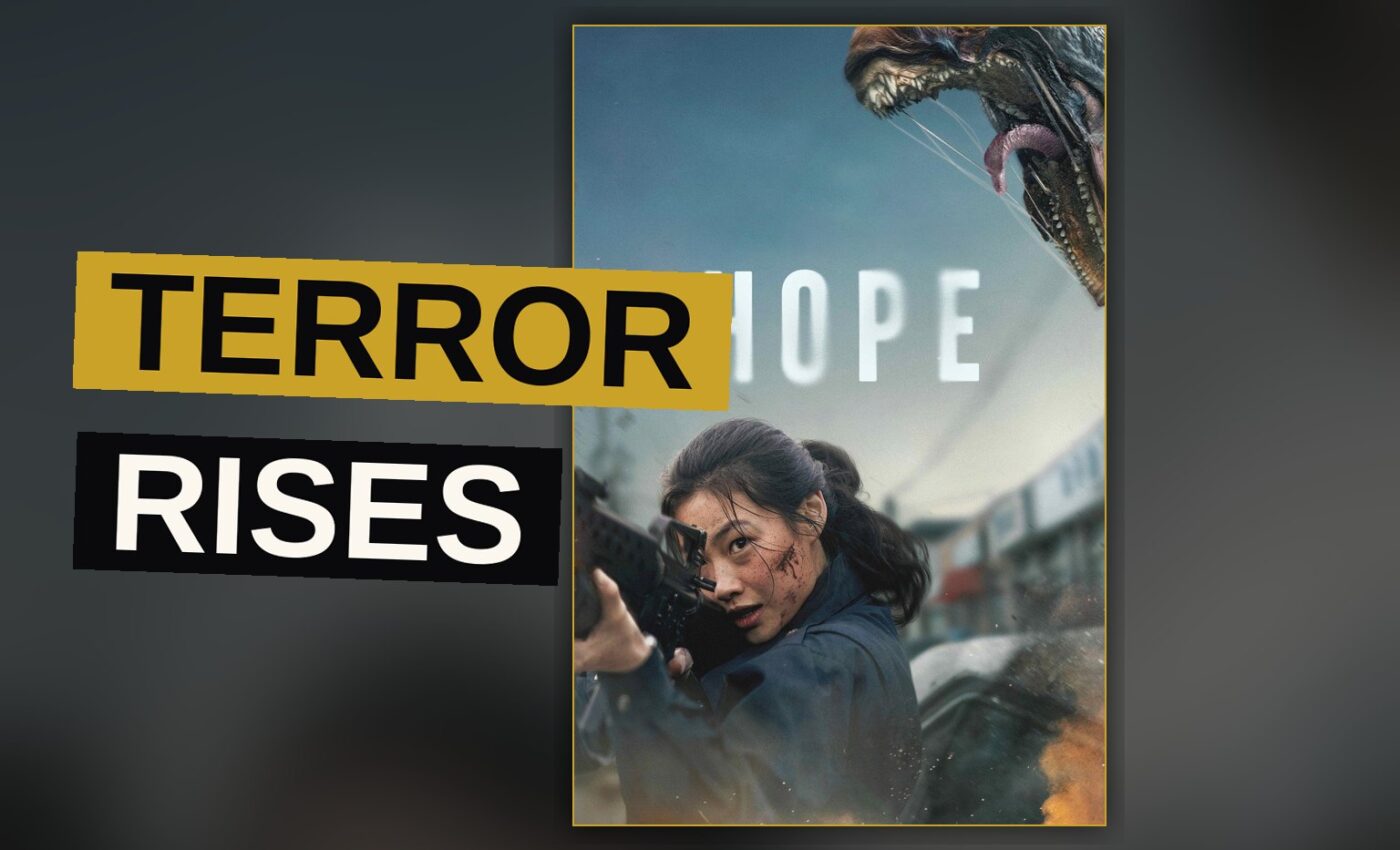
A monster is attacking a remote fishing village, and the two officers sent to investigate it are the least prepared people on screen for what they find. That’s the engine of “Hope,” the new film from Na Hong-jin, and it runs hot for nearly three hours.
Trailer, via 플러스엠 엔터테인먼트.
Go Bum-seok Takes the Call
The setup is simple enough. Police chief Go Bum-seok (Hwang Jung-min) and officer Lim Sung-ae (Hoyeon) are called into the village of Hope Harbor to look into a creature that has been tearing the place apart. Na doesn’t stay simple for long. What starts as a monster-movie premise grows fast into something stranger, pulling in Go Sung-ki (Zo In-sung) and three other figures — J’aur (Alicia Vikander), Ma’veyyo (Michael Fassbender), and Ai’dovor (Taylor Russell) — as the story moves from a local mystery into something with far more at stake than one village.
Hwang Jung-min anchors the film. He plays Bum-seok as a man whose authority means less and less the deeper he gets pulled in, and the performance carries the second half of the film almost by itself. Hoyeon matches him in the early scenes, sharp and doubtful as Sung-ae, though the script eventually asks her to react more than to investigate.
What Begins as Ignorance
Na’s pitch, built right into the film, is that what begins as ignorance plants the seed of disaster. That’s the whole shape of the movie. Bum-seok and Sung-ae read the threat in front of them wrong, act on that wrong reading, and the results grow worse through human conflict into what the film frames as a tragedy of vast proportions. It’s a bold structure — a genre setup giving way to something much bigger — and for two hours it mostly works.
Then the film keeps going.
At 157 minutes, “Hope” runs a little too long for the story it ends up telling, and there are some clearly unanswered questions by the time it’s over. Na is plainly more interested in forward motion than in a clean explanation, and that’s a fair choice for most of the running time. But the third act asks the audience to hold on to threads that never quite tie together by the end.
The Chases
None of that weakens the set-pieces, which are the reason to see this on the big screen. The car and horseback chases stay low to the ground and never let up. The production design gives every frame somewhere new to look, and even when the visual effects turn a little rough around the edges — there’s an old-fashioned quality to some of the creature work — it fits a film more interested in awe than in a perfectly clean surface.
IGN called it “It’s a nonstop blast with the kind of low-to-the-ground vehicular and horseback action that’ll have you falling off the front of your seat,” and that’s the kind of movie this wants to be.
Hope, the all-time great new action film from writer-director Na Hong-jin, is a glorious genre romp
For long stretches, it is exactly that. TheWrap’s pull quote lands on the film’s best quality: its refusal to sit still.
Where It Splits Opinion
“Hope” is going to divide viewers, and it’s not especially difficult to find faults if you go looking for them. The plot mechanics grow weaker the closer the film gets to its end, and the shift from village procedure to something much stranger will not land for every viewer. Some will find the whole thing runs on too long. Others will find the ambition worth the mess.
Both reactions are fair responses to the same film.
Screen Daily noted the film “will divide viewers, and it’s not especially difficult to find faults.” That line captures the critical split well. The nearly three-hour running time and some noticeably unanswered questions sit alongside broad praise for Na’s audacious, high-energy filmmaking and stunning action set-pieces.
The Skill on Display
What’s not in question is the skill on display. Na hasn’t lost his gift for staging chaos so it reads as chaos and not confusion, and Hwang Jung-min gives him a performance strong enough to hold the film together even when the script pulls too thin. This is a genre picture that wants to be more than a genre picture, reaching past its own premise toward something far bigger, and reaching that far means it is bound to stretch too thin somewhere.
It stretches too thin in the running time and in the answers it owes the audience by the end. It does not stretch too thin in ambition, and that is the more interesting way to fail.
The film’s production design has drawn particular note. Rotten Tomatoes’ critics consensus describes “Hope” as “an unhinged sci-fi epic that boasts awe-inspiring production design and amusingly quaint visual effects.” That mix — awe and amusement in the same frame — is exactly what Na seems to be after, and it’s why the film works as well as it does even when the story wobbles.
The Score
“Hope” earns its best moments honestly — through chases that feel real, performances that hold the center, and a director willing to let a monster story become something much stranger. It does not fully earn its ending, and nearly three hours is a long time to sit with questions the film never answers. But the ride there is one of the more purely pleasing big-genre swings around, wild and confident in ways smaller films rarely dare to be.
The film’s audience score on TMDB sits at 8.2 out of 10 from 28 votes, and its critical standing is strong — Metacritic rates it “Generally Favorable” at 69 out of 100, and Rotten Tomatoes gives it 75%. Those numbers match the experience of watching it: a picture that earns its praise through sheer force of will, even when its own story can’t quite carry the weight of its ambitions.
That’s not a small thing. Most films with this much on their plate collapse entirely. “Hope” doesn’t collapse — it keeps moving, keeps chasing, keeps throwing new images at the screen until the credits finally arrive. The questions it leaves behind are real, but so is the ride.