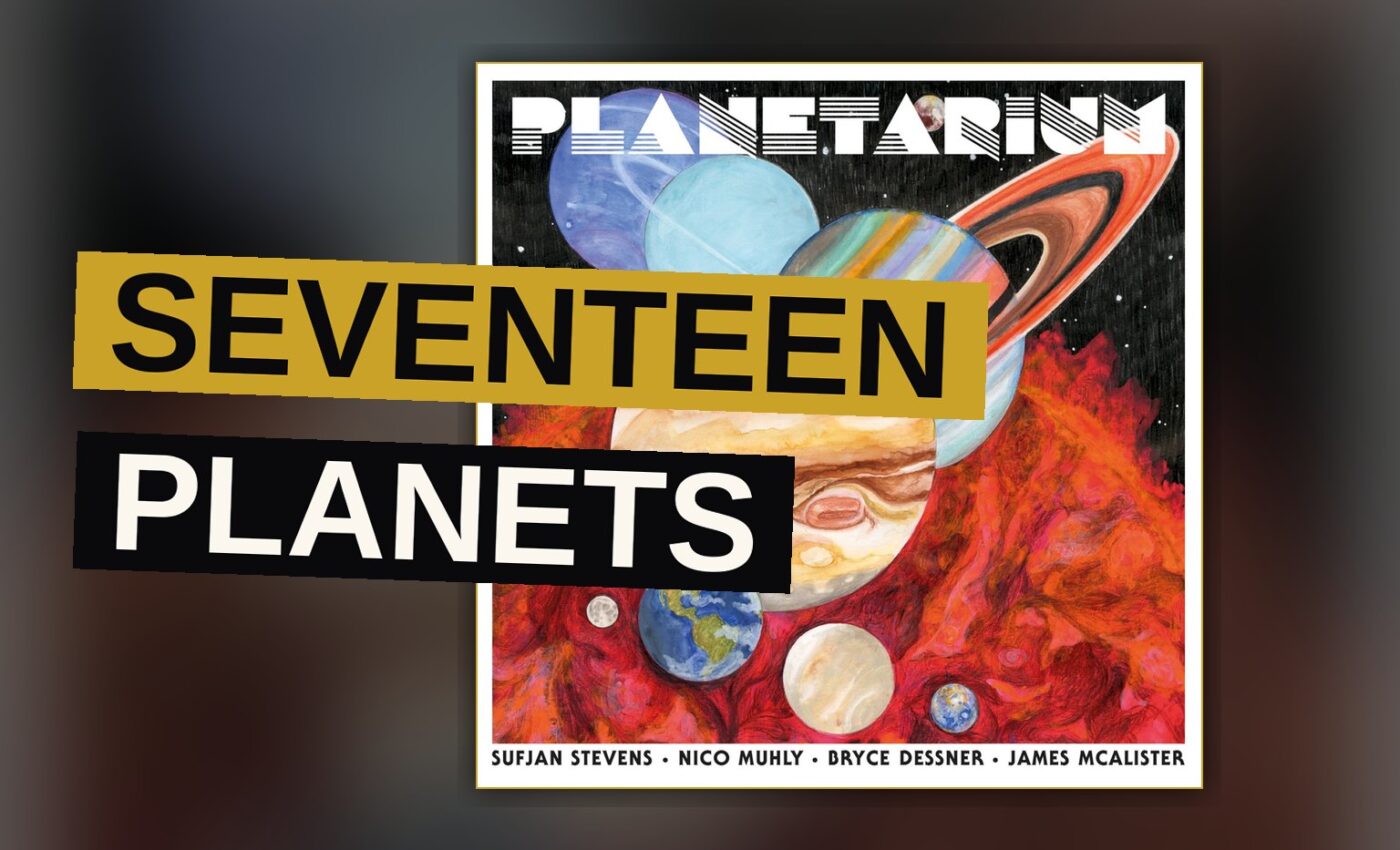
Planetarium is a strange and ambitious record. The album runs roughly 76 minutes across its seventeen tracks, and it moves from Neptune through the planets to Mercury, stopping along the way for comets, tides and black holes. It is not a pop record, and it does not pretend to be one. It is a piece of music that wants to feel like the universe itself.
Neptune Opens the Suite
Neptune starts the record at 3:05 and sets the tone immediately: strings, piano, a voice that drifts over the top. It is patient and precise, a quiet statement of intent before the album gets heavier.
Jupiter follows at 7:10 and runs longer than almost anything else on the record. It is the centerpiece, a slow, dense meditation on loneliness and power that carries real weight. The line “father of light, father of death / give us your wisdom, give us your breath / summoner says that Jupiter is the loneliest planet” sums up the whole project: a celestial object standing in for human fear and longing.
Halley’s Comet is a brief interlude at 0:30, a quick burst that functions as a pause rather than a statement.
Venus, Uranus and Mars
Venus runs 4:42 and feels lighter than the tracks around it, a gentle, warm piece that eases the tension before the record turns darker again.
Uranus stretches to 6:52 and is one of the more abstract pieces here, a long, wandering movement that does not land anywhere particular but holds the listener’s attention.
Mars, at 7:09, is the longest track after Jupiter and one of the most layered. It builds slowly, adding texture until it reaches a climax that resolves rather than crashes.
Black Energy at 5:26 is a shorter, more focused piece, a study in contrast between light and dark. Sun, at 4:00, is a bright, almost cheerful interlude that breaks the album’s heavier mood.
Tides at 0:58 is a brief instrumental that functions as a bridge rather than a destination.
Moon, at 3:42, is a gentle, reflective piece that slows things down before the album’s big finish.
Pluto, at 4:24, is a strange, angular track that stands out for its jagged shape.
Kuiper Belt at 2:04 is a short, atmospheric piece that passes quickly.
Black Hole at 0:34 is the shortest track on the record, a momentary interruption rather than a destination.
Saturn, at 3:51, is a warmer, more melodic piece that brings the record back toward the center.
In the Beginning at 1:17 is a short, hushed prelude to the album’s final stretch.
The Long Close
Earth runs 15:10 and is the longest track on the record. It is a slow, meditative piece that unfolds over its full length, building from a whisper to something close to a roar before settling back down. It is the emotional peak of the album, and it earns its length.
Mercury closes the record at 5:12, a short, sharp finale that brings the suite to a close.
What Works and What Does Not
Not everything here lands. The middle tracks, particularly the ones between Mars and Earth, can feel like filler: Tides, Black Hole, Kuiper Belt and Saturn are pleasant but easy to forget. They connect the bigger ideas without adding much themselves.
The record’s weakest moments are its weakest moments precisely because they are thin on idea. The strong tracks — Neptune, Jupiter, Mercury — are strong because they commit fully to a single image or feeling.
Track Order at a Glance
| # | Track | Length |
|---|---|---|
| 1 | Neptune | 3:05 |
| 2 | Jupiter | 7:10 |
| 3 | Halley’s Comet | 0:30 |
| 4 | Venus | 4:42 |
| 5 | Uranus | 6:52 |
| 6 | Mars | 7:09 |
| 7 | Black Energy | 5:26 |
| 8 | Sun | 4:00 |
| 9 | Tides | 0:58 |
| 10 | Moon | 3:42 |
| 11 | Pluto | 4:24 |
| 12 | Kuiper Belt | 2:04 |
| 13 | Black Hole | 0:34 |
| 14 | Saturn | 3:51 |
| 15 | In the Beginning | 1:17 |
| 16 | Earth | 15:10 |
| 17 | Mercury | 5:12 |
The Verdict
Planetarium is a sprawling, uneven record that mostly succeeds on its own terms. Its ambition is real, and its best moments — Jupiter, Earth, Mercury — are genuinely moving. Its weaker stretches, while pleasant, do not justify the length. This is a record for listeners who want to sit with big ideas and long structures, and it rewards patience even when it loses focus.
“Father of light, father of death/Give us your wisdom, give us your breath/Summoner says that Jupiter is the loneliest planet.”
The record is a worthy addition to Stevens’ catalog, even when it stumbles.
- Neptune3:05
- Jupiter7:10
- Halley’s Comet0:30
- Venus4:42
- Uranus6:52
- Mars7:09
- Black Energy5:26
- Sun4:00
- Tides0:58
- Moon3:42
- Pluto4:24
- Kuiper Belt2:04
- Black Hole0:34
- Saturn3:51
- In the Beginning1:17
- Earth15:10
- Mercury5:12