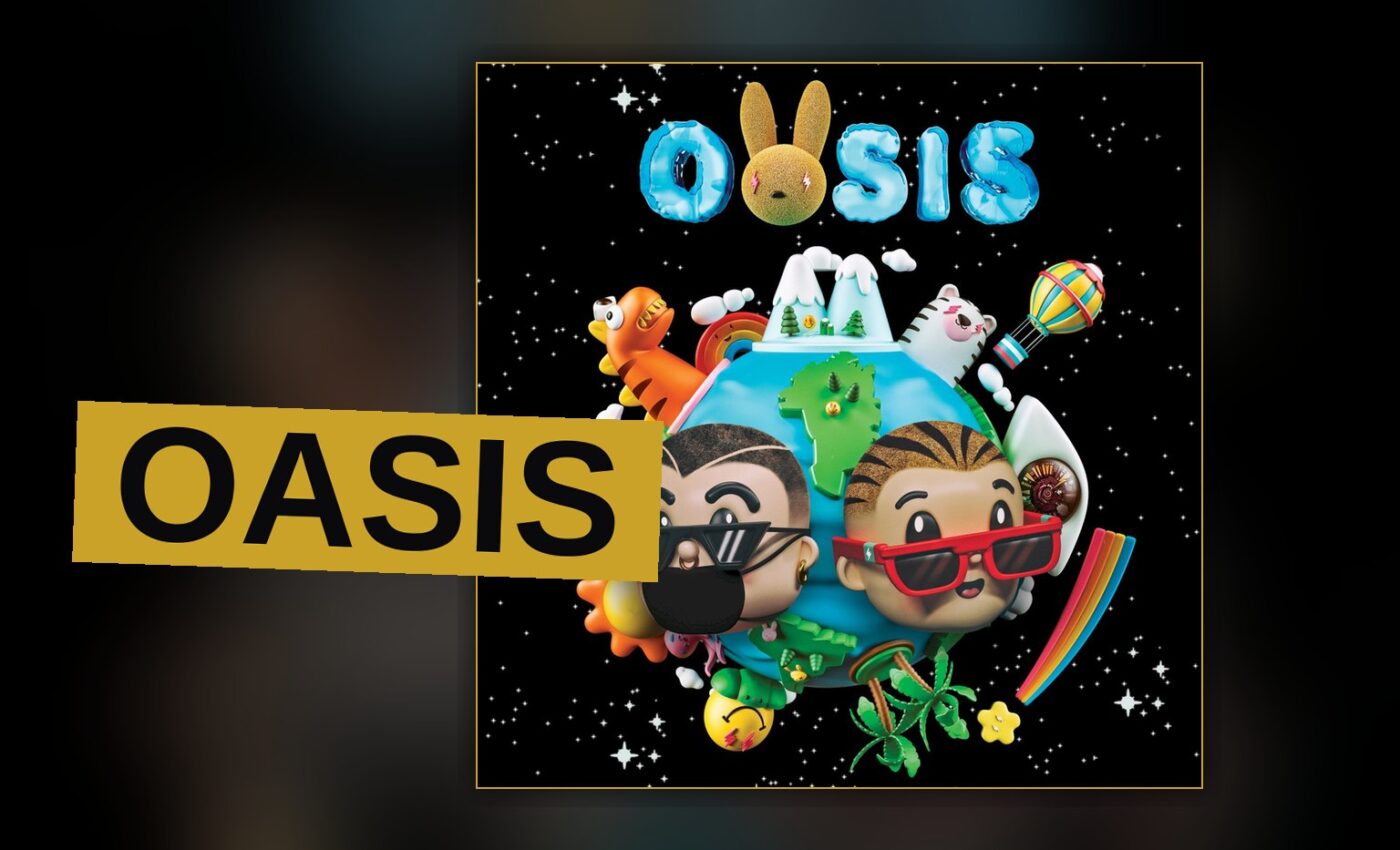
OASIS is a 31-minute summer record from two of reggaeton’s biggest stars, J Balvin and Bad Bunny. Released in 2019, it is not a full solo statement from either artist. It is a collaboration album, eight tracks long, built to capture the chemistry the pair had already shown on earlier singles. The record is trying to do one thing: feel effortless. It mostly succeeds.
The album arrived at a moment when both men were global names. Balvin had the crossover pop hits, and Bad Bunny was the restless experimentalist. OASIS sits between those identities. It is breezy, melodic, and direct, with no grand concept and no attempt at a message. The title suggests a pause, a place to rest. The music delivers exactly that.
Opening With Mojaita
The record opens with “Mojaita.” It is humid and slow-burning, with a groove that does not rush. It is not the biggest song here, but it works as an invitation.
“Yo le llego” follows. This is the track where the duo’s bounce returns. It is more energetic, more club-ready, and it shows the commercial instinct both artists bring to everything they touch. The hook is simple, the beat is sturdy, and it moves. This is the sound of two stars who know exactly what their audience wants.
“Cuidao por ahí” tightens the focus. The title is a warning, and the track carries a slightly sharper edge. It is not a ballad, but it is less celebratory than what came before. It keeps the record from becoming a single block of party music.
Qué Pretendes, La Canción, Un Peso And Odio
The first major peak arrives with “Qué pretendes.” The melody is sticky, the arrangement is clean, and the back-and-forth between Balvin and Bad Bunny feels natural. It is the most complete song on the album, the one that could stand alone on any playlist. It earns its place as a highlight.
“La canción” shifts the mood. It is slower, more romantic, and it gives both artists room to sing rather than rap. The title is a bold claim, but the track backs it up with a chorus that lands. It is the kind of cut that works at night, in a car, with the windows down. The melody is quietly memorable, and the production stays out of the way.
“Un peso” is the most intricate track on the record. The beat is more layered than the rest of the album, and the arrangement is complex. It is not the obvious single, but it shows what both artists can do when they stretch. The pacing is unhurried. This is the track that rewards repeat listens.
“Odio” keeps the quality high. The title suggests tension and frustration in a relationship. It is a duet in the truest sense, with both artists trading lines and building a conversation. It holds up well.
The Closer And The Lesser Cuts
The album closes with “Como un bebé.” It is playful, almost silly in places, and it brings the record back to the joy that opened it. It is not the deepest song here, but it is a good closer. It leaves the listener smiling, which is clearly the point.
Not every cut is a standout. “Mojaita” and “Cuidao por ahí” are pleasant but slight. They do the job of filling out the record’s mood, but they do not demand attention the way “Qué pretendes” or “Un peso” do. That is not a failure. An eight-track album needs connective tissue, and these songs provide it without dragging the whole down. “Yo le llego” is stronger than those two, but it is still a step below the top tier. The record’s weakest moments are merely good. That is a compliment.
Critical Reception
The reviews at the time were strong. Metacritic scored the album 79 out of 100. Those numbers reflect a consensus: this is a successful collaboration, even if it is not a deep one.
The album does not feel like a finale. It feels like a checkpoint, a record that captures a specific moment in both careers. The production throughout is more detailed than it first appears. The grooves are casual, but they are not lazy. There is craft in how these tracks are built.
Critics at the time praised the album’s cumulative charm. The record does not have a single obvious hit, and it does not need one. It works as a whole, and its appeal is in the total effect rather than any one track.
It is fair to say what OASIS lacks. Several critics noted that it does not have the lyrical depth or ambition of the artists’ solo work. That is true. Bad Bunny’s solo albums are more personal and more experimental. Balvin’s solo records are more focused on pop dominance. OASIS is neither of those things. It is a lighter record, and it is comfortable being that.
The lyrics are not trying to say anything profound. They are about attraction, frustration, and having a good time. That is fine. Not every album needs to be a statement. A record can be a good time, and OASIS is exactly that.
The title is honest. This is an oasis, a break from the heavier stuff. It is a record you put on when you want to feel good, not when you want to think deeply. That is a valid purpose, and the album achieves it.
Chemistry Between The Two
The real subject of OASIS is the relationship between the two artists. Balvin and Bad Bunny do not sound like they are competing. They sound like they are enjoying each other. That is rare in collaborations. Too often, a duet album feels like a negotiation. This one feels like a conversation.
The track ordering helps. By placing “Qué pretendes” early and “Un peso” in the middle, the record builds a rhythm. The slower moments come at the right times. The energetic moments do not overstay. The roughly half-hour runtime is a strength. It does not drag, and it does not feel rushed. It is a complete thought, delivered efficiently.
The album’s best moments come when the two voices are in direct dialogue. “Odio” and “Qué pretendes” both work because the back-and-forth is genuine. They are not taking turns. They are responding to each other. That is the chemistry that makes the record work.
OASIS is a successful collaboration because it knows exactly what it is. It is a summer record, a mood piece, a showcase for two artists who work well together. It is not a masterpiece, and it does not try to be. It is a well-made, enjoyable album that delivers on its promise.
The highlights are strong enough to carry the whole. “Qué pretendes,” “Un peso,” “La canción,” and “Odio” are all worth repeated listens. The lesser tracks are still listenable. The production is consistently good. The chemistry is real.
It is a strong record. It is not perfect, but it is exactly what it should be.
Key Facts
- Album: OASIS
- Artists: J Balvin & Bad Bunny
- Release year: 2019
- Total runtime: roughly half an hour
- Track count: 8
- Metacritic: 79/100
Track List
- Mojaita
- Yo le llego
- Cuidao por ahí
- Qué pretendes
- La canción
- Un peso
- Odio
- Como un bebé
Get the Notebook.
The day's best stories and every fresh verdict, in plain English, in your inbox by seven. One email a day, no more.
- Mojaita3:07
- Yo le llego4:10
- Cuidao por ahí3:18
- Qué pretendes3:42
- La canción4:03
- Un peso4:37
- Odio4:30
- Como un bebé3:39