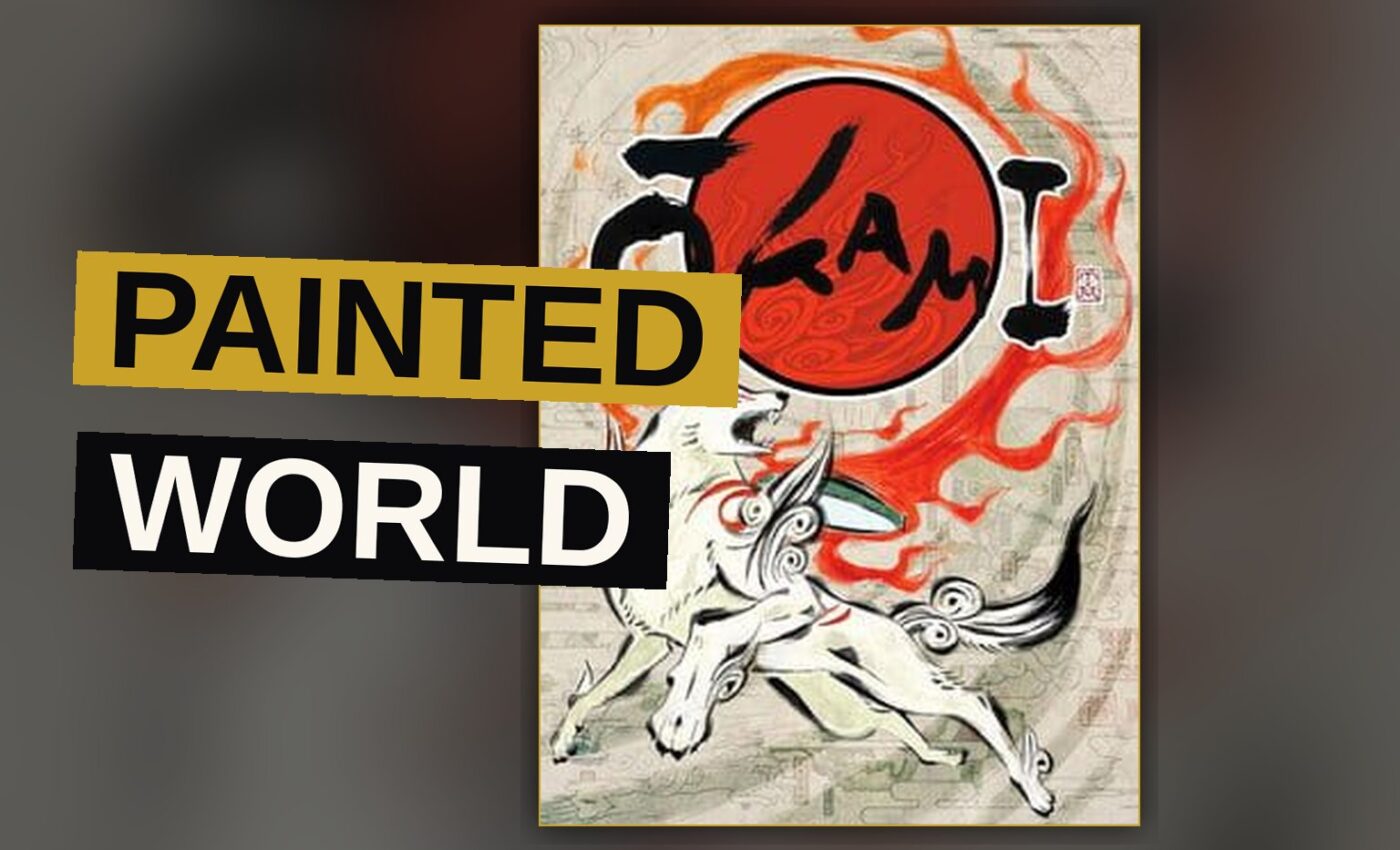
Ōkami arrives on PS3 and Wii in 2006 as a game about painting the world back into existence. That is not an empty promise. Capcom’s Sumi-e brushwork turns every screen into a living scroll, and the player’s main character, Amaterasu, wields a paintbrush as her weapon. The result is one of the most singular games ever made, a game that asks players to look at a scene as much as play through it.
The Sumi-e Brush
The Sumi-e technique gives Ōkami its identity. Every stroke of ink on screen is rendered in a way that recalls Japanese ink painting, with bold lines and soft gradations. The effect is not merely cosmetic. The brush becomes the tool used to solve puzzles, heal allies, and defeat enemies. Players can paint lightning, vines, and even water to navigate obstacles and overcome foes.
The visual style extends beyond combat into exploration. Towns, temples, and forests are rendered with a depth that invites lingering. Each area feels hand-painted, dense with small details that reward patience. The game’s presentation is not just a coat of paint over mechanics; it is the mechanics themselves, expressed through art.
Combat and Controls
Combat in Ōkami is simple and satisfying. Amaterasu can charge her attacks, unleash elemental combos, and dodge with a dash move. The controls are tight on both platforms, though the Wii version allows for motion-based sword swings, which some players find less precise than the button-driven method on PS3. The action is fluid, and battles rarely feel cheap or unfair.
Puzzles are scattered across the map, often requiring players to revisit earlier areas once new abilities are unlocked. These range from simple platforming challenges to environmental puzzles that ask players to think about the space around them. The difficulty curve is gentle, and the game rarely punishes curiosity.
Story and Setting
The plot follows Amaterasu, a sun goddess who has taken the form of a white wolf, as she fights to restore Japan from the corruption of a great evil. The story is told through dialogue with townspeople, shrines, and other gods, and it carries a weight that belies the whimsical setting. Characters are expressive, and the writing leans on folklore and mythology rather than modern storytelling conventions.
The game is structured around a series of regions, each with its own inhabitants and threats. The pacing is deliberate, and the game takes its time establishing the world before moving forward. This patience pays off, as the final act delivers a payoff that feels earned rather than rushed.
Music and Sound
The soundtrack, composed by Motoi Sakuraba, is a highlight. It mixes traditional Japanese instruments with orchestral arrangements, creating a score that feels both ancient and modern. The music swells during boss fights and hums gently during exploration, always fitting the mood of the scene. The sound design is similarly careful, with rustling leaves, distant birds, and the gentle splash of water adding texture to the environments.
The audio is consistent across both versions, though the Wii hardware limits the dynamic range compared to PS3. Neither version feels compromised in a way that detracts from the experience.
Technical Performance
On PS3, Ōkami runs smoothly, with few hitches in the frame rate or load times. The game handles large crowds and detailed backgrounds without trouble. The Wii version, running at a lower resolution, still holds up well, though the reduced graphical fidelity is noticeable in direct comparison. Both versions support the same content, including multiplayer modes and extra challenges.
The Wii version also includes a unique feature: players can save their own brush paintings and display them in a gallery within the game. This is a small touch, but it speaks to the care put into the entire package.
Comparing the Two Versions
| Feature | PS3 Version | Wii Version |
|---|---|---|
| Graphics | Full high-definition rendering | Lower resolution, softer textures |
| Controls | Button-driven sword swings | Motion-based swings |
| Gallery | Standard save gallery | Save gallery with player paintings |
| Multiplayer | Supported | Supported |
The differences are minor, but they matter to players who care about presentation. The Wii version remains a solid entry point for newcomers, while the PS3 version offers a sharper, more polished experience.
Legacy and Reception
Ōkami was released to strong reviews. Critics praised the art direction, the combat, and the world-building. The game has since become a touchstone for developers interested in narrative games that prioritize atmosphere over spectacle.
The game’s influence can be seen in later titles that experiment with art styles and storytelling techniques. Its success proved that a game could succeed by doing something different rather than chasing trends.
Ōkami is not a perfect game. Some players find the pacing slow, and the difficulty occasionally dips into repetition. The motion controls on Wii are divisive, and the game’s length means some sections feel padded. None of these flaws diminish the core experience, but they are worth noting for anyone approaching the game fresh.
Final Verdict
Ōkami succeeds because it commits fully to its vision. The Sumi-e art direction is not a gimmick; it is the foundation of every system in the game, from combat to puzzle-solving to exploration. The story, while simple, carries genuine emotional weight. The music complements the visuals without overpowering them.
Key Facts:
– Release year: 2006
– Platforms: PS3, Wii
– Developer: Capcom
– Score: 9.2/10
Ōkami is a game that demands attention, and it rewards that attention generously. It is a game about looking closely, about noticing the details that make a world feel alive. The game asks players to slow down and look at the world around them, and it delivers a payoff that justifies that investment. It remains a standout entry in the genre, a reminder that a game can be both beautiful and meaningful.
Get the Notebook.
The day's best stories and every fresh verdict, in plain English, in your inbox by seven. One email a day, no more.