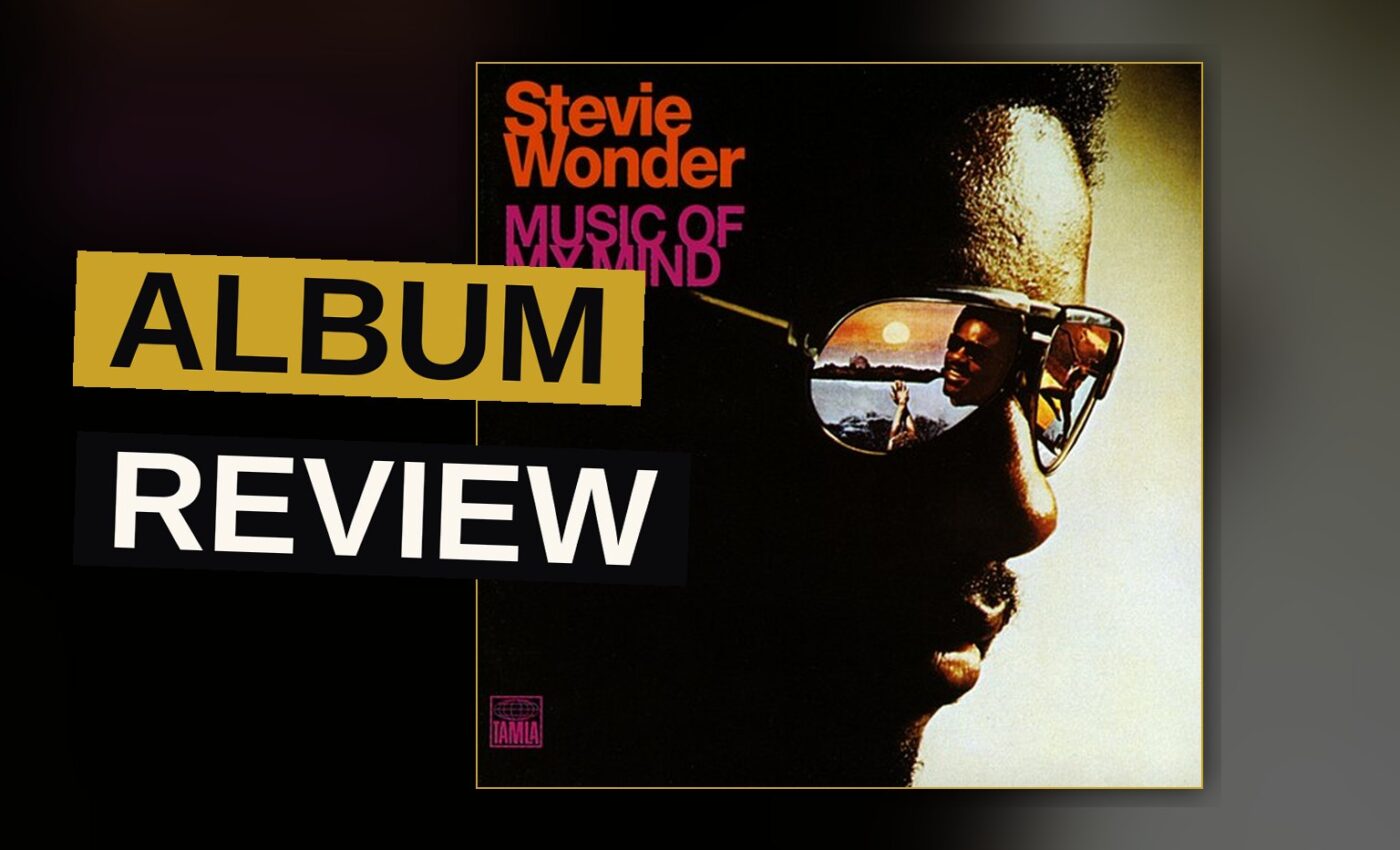
Stevie Wonder’s Music of My Mind is the sound of an artist breaking the frame. Released in 1972, it is the first album Wonder made under his new contract with Motown, a deal that gave him full creative control and his own production company. It is not a collection of singles. It is a sustained, nine-track statement of intent, built almost entirely by Wonder himself, who plays the drums, the clavinet, the bass, the synthesizers, and everything else in between. The record is trying to prove that a pop star can be a one-man band without losing the warmth of a human touch.
The album arrived at a specific moment. Motown had just been redefined by a landmark release, and Wonder, 21 years old, was answering that challenge with a record that was less overtly political but just as personal. He was not writing songs for other people to sing. He was building worlds in the studio, layering his own voice into harmonies, and treating the synthesizer not as a novelty but as a legitimate instrument. The result is a dense, warm, and occasionally messy record that still sounds like a blueprint for everything he would do next.
Opening With Love Having You Around
The opening track, “Love Having You Around,” sets the tone. It runs over seven minutes, which is an unusual length for a pop song, but Wonder earns it. The groove is loose, almost jam-like, with Wonder’s voice sliding over a bed of clavinet and bass. It is not a song that rushes. It is a song that settles in, and the length feels like a luxury rather than a flaw. The lyrics are simple — a love song, a thank-you — but the arrangement is anything but simple. Wonder is showing off, but he is showing off with taste.
“Superwoman” follows as the second track, and it is the most ambitious thing here. It runs past eight minutes, and it moves through several distinct sections, from a gentle piano intro to a funky, electric middle to a soaring, gospel-tinged finale. The song is often read as a portrait of a specific woman, but it also functions as a meditation on change and loss. Wonder’s vocal performance is the anchor. He shifts from a whisper to a full-throated cry without losing control. It is the track that most clearly signals his ambition, and it holds up as one of the great album pieces of the decade.
Middle Stretch Highlights
“I Love Every Little Thing About You” is a shorter, sweeter number. It is not a major statement, but it does not need to be. The melody is bright, the rhythm is light, and Wonder’s voice is playful. It is the kind of track that could have been a single in another context, but here it works as a palate cleanser between the two long pieces that bookend it. It is not a highlight, but it is not filler either. It is a song that knows its place.
“Sweet Little Girl” is a different matter. This is one of the tracks critics singled out, and it is easy to hear why. The groove is hypnotic, built on a bassline that does not quit, and Wonder’s vocal is full of character. There is a roughness to it, a sense that he is pushing the rhythm section harder than usual. The lyrics are a bit coy — an ode to a young woman — but the music carries the day. It is one of the most purely enjoyable moments on the record.
“Happier Than the Morning Sun” brings the mood up again. It is a bright, optimistic song, with a melody that feels like sunrise. Wonder’s vocal is clean and joyful, and the arrangement is full of small, lovely details — a flute line here, a backing vocal there. It is not a deep cut, but it is a sincere one. The song does exactly what it sets out to do, and it does not overstay its welcome.
Quiet Turn of Girl Blue
“Girl Blue” is the quietest track on the record. It is a slow, moody ballad, with Wonder’s voice floating over a sparse arrangement. The song is about a woman who is sad, and Wonder treats her with tenderness rather than judgment. It is one of the tracks critics singled out, and it is easy to see why. It shows a different side of his talent — not the virtuoso, but the empathetic observer. The melody is minor-key, the mood is contemplative, and the performance is restrained. It is a small gem.
“Seems So Long” is the weakest moment on the album. It is not bad, exactly, but it is the track where the self-indulgence that critics noted starts to creep in. The song is a love ballad, but the arrangement is busier than it needs to be, and the melody is less memorable than the ones around it. Wonder’s vocal is still strong, but the song itself does not earn its place. It feels like a track that needed one more edit.
Keep On Running Forward
“Keep On Running” is the other long track, and it is the one that most clearly shows Wonder’s command of the synthesizer. The song is built on a repeated, pulsing synth line, and Wonder’s voice rides over it with urgency. It is not a ballad. It is a driving, almost frantic piece of music, and it is one of the most exciting things on the record. Critics singled it out, and rightly so. It sounds like nothing else from 1972, and it points directly toward the electronic textures Wonder would explore for the rest of the decade.
The closing track, “Evil,” is a strange, fascinating end to the record. It is a dark, minor-key song, with a vocal that is almost theatrical. Wonder is not playing the sweetheart here. He is playing someone who has been wronged, and there is a bitterness in his voice that is rare for him. The arrangement is sparse, built on a low, rumbling bass and a simple drum pattern. It is not an easy listen, but it is a compelling one. It ends the album on a note of tension rather than resolution, which is a bold choice.
What Critics Said
The record was praised at the time, and the praise has held up. Rolling Stone called it “the best thing to come out of Motown since Marvin Gaye’s What’s Goin’ On,” which is high company. The same review noted “a tendency toward gimmickry that often eludes his fine sense of control,” which is a fair critique.
There are moments where Wonder’s enthusiasm outruns his judgment, and “Seems So Long” is the clearest example. But the same review also praised the record for “one of the very few down-to-earth uses of the synthesizer,” which is exactly right. The synthesizer is not a gimmick here. It is a tool, used to create textures that would have been impossible otherwise.
The critical consensus was that this was a significant artistic leap, and that is accurate. Wonder had made good records before, but he had never made a record that felt this personal. The fact that he played nearly everything himself is not just a trivia point. It is the reason the record sounds the way it does. There is a unity to it, a sense that every sound is coming from one mind. That is rare, and it is valuable.
Where the Album Sits
Music of My Mind is not Wonder’s best album. That title belongs to later records that came after it. But this record is the gateway. It is the album where he figured out what he wanted to do, and it is the album that made everything after it possible. The leap from his earlier work to this one is enormous, and the leap from this one to his mid-70s masterpieces is much smaller.
The track list is uneven, but the highs are very high. “Superwoman” is a masterpiece. “Keep On Running” is a revelation. “Girl Blue” is a quiet triumph. The lesser tracks do not sink the record, because the overall vision is so clear. This is an album that knows what it is, and it does not apologize for its ambitions.
Final Score
The record is a 9 out of 10.
It is not perfect. “Seems So Long” drags, and there are moments where Wonder’s one-man-band approach feels like a flex rather than a necessity. But the ambition is real, the execution is mostly brilliant, and the influence is undeniable. This is a record that changed the conversation about what a pop album could be. It is a landmark, and it deserves its place in the canon. If you want to understand Stevie Wonder, start here.
| Track | Length |
|---|---|
| Love Having You Around | 7:21 |
| Superwoman | 8:04 |
| I Love Every Little Thing About You | 3:46 |
| Sweet Little Girl | 4:54 |
| Happier Than the Morning Sun | 5:18 |
| Girl Blue | 3:35 |
| Seems So Long | 4:27 |
| Keep On Running | 6:35 |
| Evil | 3:35 |
Get the Notebook.
The day's best stories and every fresh verdict, in plain English, in your inbox by seven. One email a day, no more.
- Love Having You Around7:21
- Superwoman8:04
- I Love Every Little Thing About You3:46
- Sweet Little Girl4:54
- Happier Than the Morning Sun5:18
- Girl Blue3:35
- Seems So Long4:27
- Keep On Running6:35
- Evil3:35