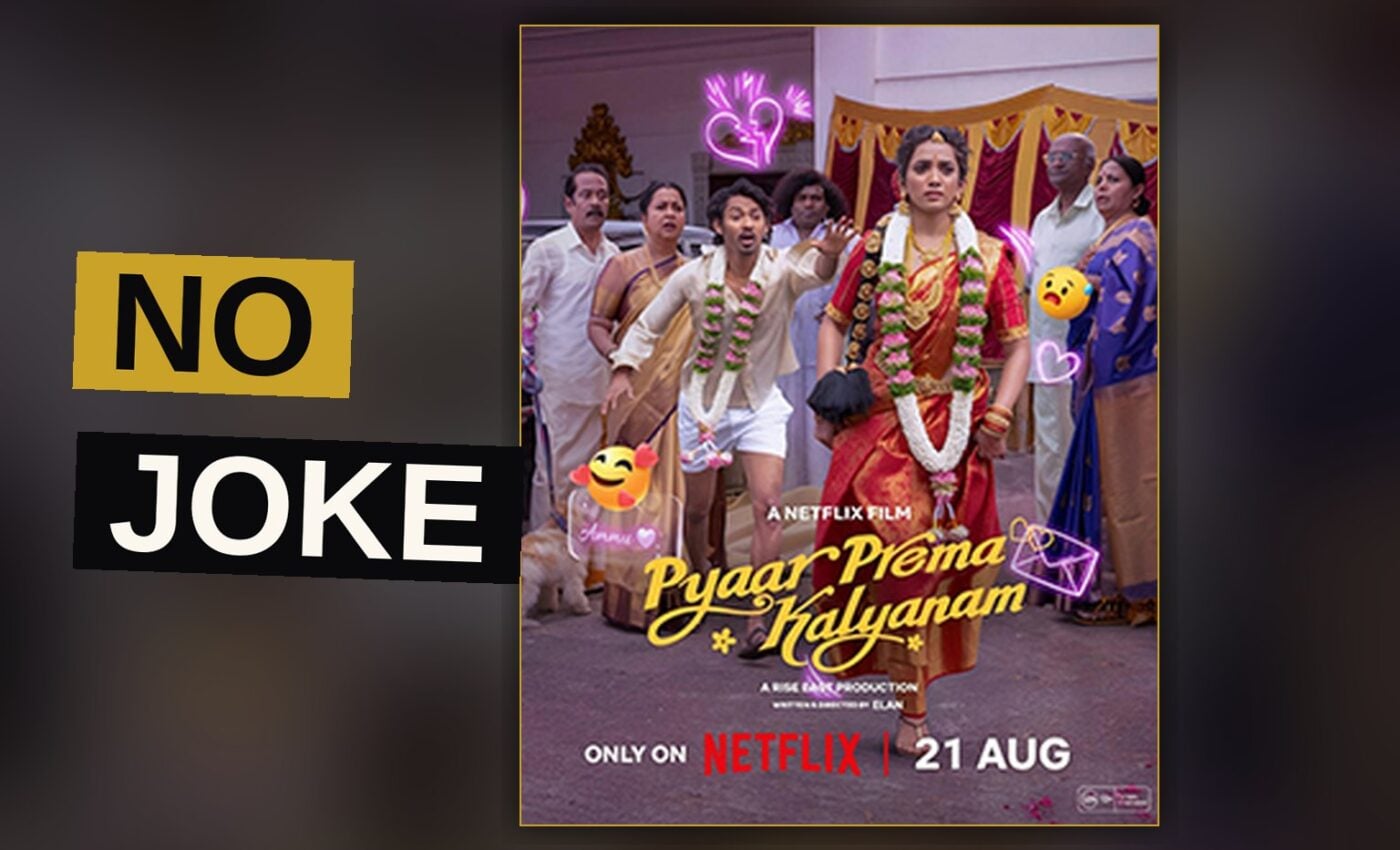
Pyaar Prema Kalyanam wants to be a comedy about love, caste, and family pressure. It mostly fails. The film follows a young man who falls for a girl from a different caste, and the resulting chaos comes from his family’s refusal to accept the match. That setup could support a sharp, satirical story. Instead, director Gopi Sunder gets stuck in broad, unfunny set pieces and a script that treats the characters less as people and more as vehicles for jokes.
The result is a movie that announces its intentions early and then spends the next two hours proving it has nothing to say. This is a film that thinks being loud and chaotic is the same thing as being funny. It is not. Pyaar Prema Kalyanam is a mess, and not in the way a good comedy earns its chaos. It is a mess because it does not know what it wants to be.
The Setup
The plot is simple. A young man meets a girl from a different caste and falls for her. His family disapproves. There is a wedding arranged for him. He resists. The conflict is classic romantic comedy territory, and the film spends the first half hour establishing it without ever finding a fresh angle. The problem is not the idea. The problem is the execution.
Every character exists to deliver a punchline. The father is a caricature of traditional values. The mother is a caricature of gentle pleading. The girl is a caricature of quiet resistance. None of them feel like actual people. They feel like roles in a play about Indian families. That distance is the film’s biggest flaw, and it never closes.
Comedy Without Purpose
The humor in Pyaar Prema Kalyanam is loud, repetitive, and often just plain wrong. Jokes about caste are repeated multiple times across the runtime. The film seems to think that saying something twice makes it funnier. It does not. It makes the film feel cheap and lazy. Broad physical comedy is used to cover for moments where the writing has failed. It works sometimes. Mostly, it does not.
There is a scene involving a wedding procession that drags on for far too long. The film keeps adding new characters and new gags, but none of it lands. The audience is left waiting for the joke that never arrives. The pacing is broken from the start. Scenes that should be quick and sharp are stretched out until they collapse under their own weight.
The Cast
The performances are solid in places, weak in others. The lead actor plays the young man with a mix of charm and desperation, but he is given little room to breathe. The supporting cast is competent, but they are all playing types rather than individuals. The uncle who opposes the romance is meant to be menacing, but the film never quite commits to making him feel dangerous.
The chemistry between the young couple is thin. Their scenes together feel like a series of forced interactions rather than a relationship. The film tries to build tension through their secret meetings, but the writing keeps undercutting the stakes. Every secret rendezvous ends with a comic mishap, and the emotional weight of the story gets lost in the shuffle.
Technical Craft
The direction is competent without being memorable. The cinematography is bright and colorful, which works in wide shots but struggles in tighter close-ups. The editing is choppy in places, with scenes that jump from one location to another without warning. The sound design is loud, often drowning out dialogue during key moments. These are not fatal flaws, but they add up to a production that feels rushed and unfinished.
The music score is functional, though it occasionally overpowers the scenes around it. The songs are placed at predictable points, doing the expected job of pausing the action and giving the audience a breather. They are pleasant, but they do not elevate the material. The costume design is careful, with each character dressed in a way that signals their social status. It is a small victory in a film full of missed opportunities.
Structure and Pace
The film’s structure is loose, and it moves through its sections without a clear shape. The opening sets up the conflict, the middle stretches drag through the wedding procession and the family conflict, and the climax rushes toward a conclusion that feels tacked on rather than earned. The closing scenes tie things up quickly, but they do not feel like a natural end to the story.
The pacing is a disaster. The film opens strong, but it loses momentum halfway through. By the final stretch, the jokes are tired, the audience is exhausted, and the film has nothing left to offer. The ending resolves the conflict too neatly, ignoring the questions the film raised earlier.
What Works
There are moments where Pyaar Prema Kalyanam finds its footing. A brief scene between the young man and his sister, played with genuine warmth, stands out as one of the few genuinely human interactions in the film. The film’s best work comes in its quieter stretches, when it stops leaning on jokes and lets the characters breathe. Those moments are rare, but they are there.
The film also benefits from a sense of place. The settings are specific, and the film captures the texture of daily life in a way that many comedies do not attempt. That attention to detail is a credit to the filmmakers, even if the rest of the package does not live up to it.
What Does Not Work
The problems are systemic. The film’s central conflict is about caste and family honor, and it never once engages with those issues on a meaningful level. The characters talk about tradition, but they never explain why they believe what they do. The film is content to set up a conflict and let the jokes do the rest.
The pacing is a disaster. The film opens strong, but it loses momentum halfway through. By the final stretch, the jokes are tired, the audience is exhausted, and the film has nothing left to offer. The ending resolves the conflict too neatly, ignoring the questions the film raised earlier.
The Verdict
Pyaar Prema Kalyanam is a film with a good idea and a bad execution. It is a comedy that never commits to being either clever or wild. It settles for being loud, and that is not enough. The performances are adequate, the production is polished, but the script is the fatal flaw. It is a film that knows what it is about but does not care enough to make it matter.
The film’s failure is not a failure of ambition. It is a failure of follow-through. The ideas are there, but the writing never rises to meet them. The result is a film that feels hollow, a collection of jokes strung together without a center. It is a film that will be forgotten quickly.
| Section | Focus |
|---|---|
| The Setup | Conflict between young man, girl from different caste, and family’s refusal to accept the match |
| Comedy Without Purpose | Loud, repetitive jokes; wedding procession scene |
| The Cast | Lead actor, supporting cast, uncle’s menace |
| Technical Craft | Cinematography, editing, sound design, music, costume design |
| Structure and Pace | Loose structure, pacing disaster, rushed ending |
| What Works | Warmth between young man and sister, sense of place |
| What Does Not Work | Failure to engage with caste and family honor, repetitive jokes, rushed conclusion |
Pyaar Prema Kalyanam scores 3.5 of 10.