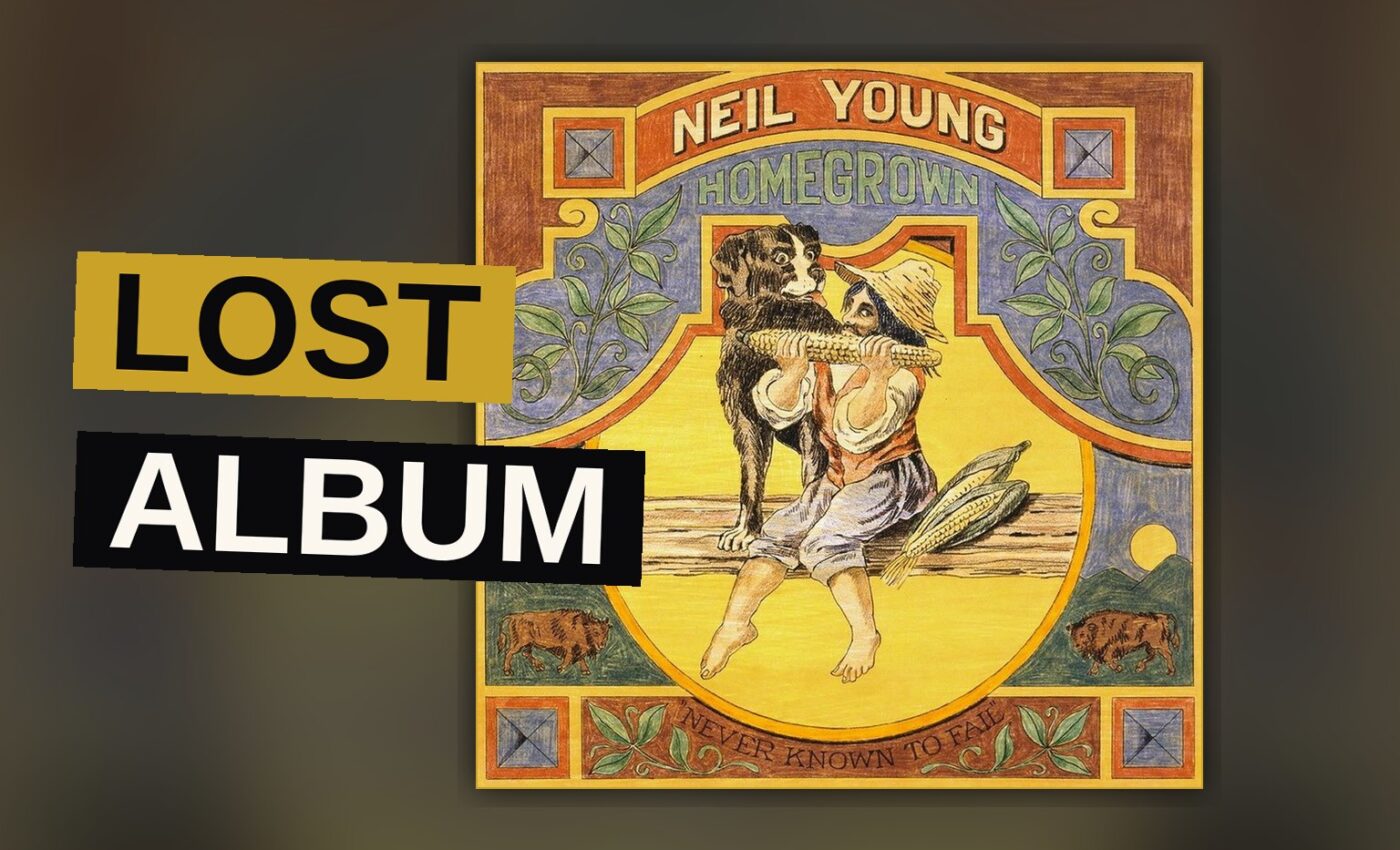
Neil Young’s Homegrown is a ghost that finally got a body. Recorded in 1975 and shelved for 45 years, the album arrives as the raw, bruised center of Young’s mid-1970s work. It is not a polished artifact. It is a private tape that got loose, full of heartbreak, weed jokes, and the sound of a man trying to laugh through a broken marriage.
The record does not try to be tidy. It opens with “Separate Ways,” a song that cuts straight to the wound, and it never really lets up. Young knew he was making something true, then hid it for decades. Now it is out, and it carries the weight of that wait.
Critics have rallied behind it. The album holds a Metacritic score of 88/100, a strong consensus that this lost record was worth digging up.
Separate Ways Sets the Wound
“Separate Ways” (3:33) is the thesis statement. It is a slow, acoustic burn about a relationship splitting at the seams, and Young’s vocal cracks with the effort of it. The song earns its place as the first thing you hear because it tells you exactly what this album is: not a comeback, not a reinvention, but a confession.
“Try” (2:49) follows with a lighter touch, a country-rock shrug that almost smiles. Then “Mexico” (1:41) is barely a sketch — a minute and a half of travelogue that feels like a postcard sent from a cheap hotel. It is slight, but it works as a palate cleanser before the title track.
Love Is a Rose and the Title Track
“Love Is a Rose” (2:17) is pure country polish, a song that would have fit on any of Young’s 70s records without fuss. “Homegrown” (2:48) itself is the hinge — a warm, acoustic meditation on what it means to grow something in your own life, even when the soil is bad. It is the most reflective moment on the record, and it lands.
“Florida” (2:58) is a strange, slippery travelogue that never quite settles, and “Kansas” (2:12) does the same trick in a different key. Both are minor but not filler; they give the album a sense of wandering, of a man moving through states and moods without a map.
We Don’t Smoke It No More Turns Heavy
“We Don’t Smoke It No More” (4:51) is the joke that turns serious. It starts as a weed anthem, a grin at the counterculture, but the band stretches it out and the laughter fades into something more rueful. It is the longest track here and it earns every second.
“White Line” (3:14) is a band locked in a groove, its rhythm steady and insistent. “Vacancy” (3:59) is the darkest thing on the record — a piano-led confession about an empty house and an emptier heart. The two sit side by side like the two sides of Young’s personality: the road dog and the lonely man.
Little Wing and Star of Bethlehem Close It
“Little Wing” (2:12) is a quiet, acoustic piece — a small, tender thing that floats. Then “Star of Bethlehem” (2:48) closes the album with a hymn-like calm, a sense of resignation that feels earned after everything before it.
Seven Never-Released Songs
Of the 12 songs, seven have never been released anywhere. That makes Homegrown the most revelatory entry in Young’s recent run of Archives releases, a trove of material that fans have only heard as bootlegs or rumors. It is not a greatest-hits record. It is a time capsule, and the time it captures was not a happy one.
Critics Called It Revelatory
Rolling Stone’s coverage framed the album as “Neil Young’s Great, Lost 1975 Album” and said it was worth the wait. The review also noted that the seven unreleased tracks make this “the most revelatory of Young’s recent run of Archives releases.”
The album’s rough edges are the point. Young recorded these songs in the wake of a breakup, and the tape hiss, the dropped notes, the vocals that strain past their range — all of it reads as honesty. Pitchfork’s review had not posted a score at the time of writing.
Homegrown is not Young’s best album. It is not even his most consistent. But it is his most personal, and that counts for something in a catalog this deep.
The songs are uneven — “Mexico” and “Florida” are sketches, not statements — but the whole is greater than the parts. It is a document of a man at a low point, and it does not flinch.
The record does what the best lost albums do: it makes you wonder what else is sitting in the vault. It makes you grateful this one got out.
| Song | Length | Role on the Album |
|---|---|---|
| “Separate Ways” | 3:33 | Opening thesis — the breakup in focus |
| “Mexico” | 1:41 | Brief travelogue, a palate cleanser |
| “We Don’t Smoke It No More” | 4:51 | The joke that turns heavy |
| “Vacancy” | 3:59 | Darkest track — an empty house and heart |
| “Star of Bethlehem” | 2:48 | Closing hymn, earned calm |
Get the Notebook.
The day's best stories and every fresh verdict, in plain English, in your inbox by seven. One email a day, no more.
- Separate Ways3:33
- Try2:49
- Mexico1:41
- Love Is a Rose2:17
- Homegrown2:48
- Florida2:58
- Kansas2:12
- We Don’t Smoke It No More4:51
- White Line3:14
- Vacancy3:59
- Little Wing2:12
- Star of Bethlehem2:48