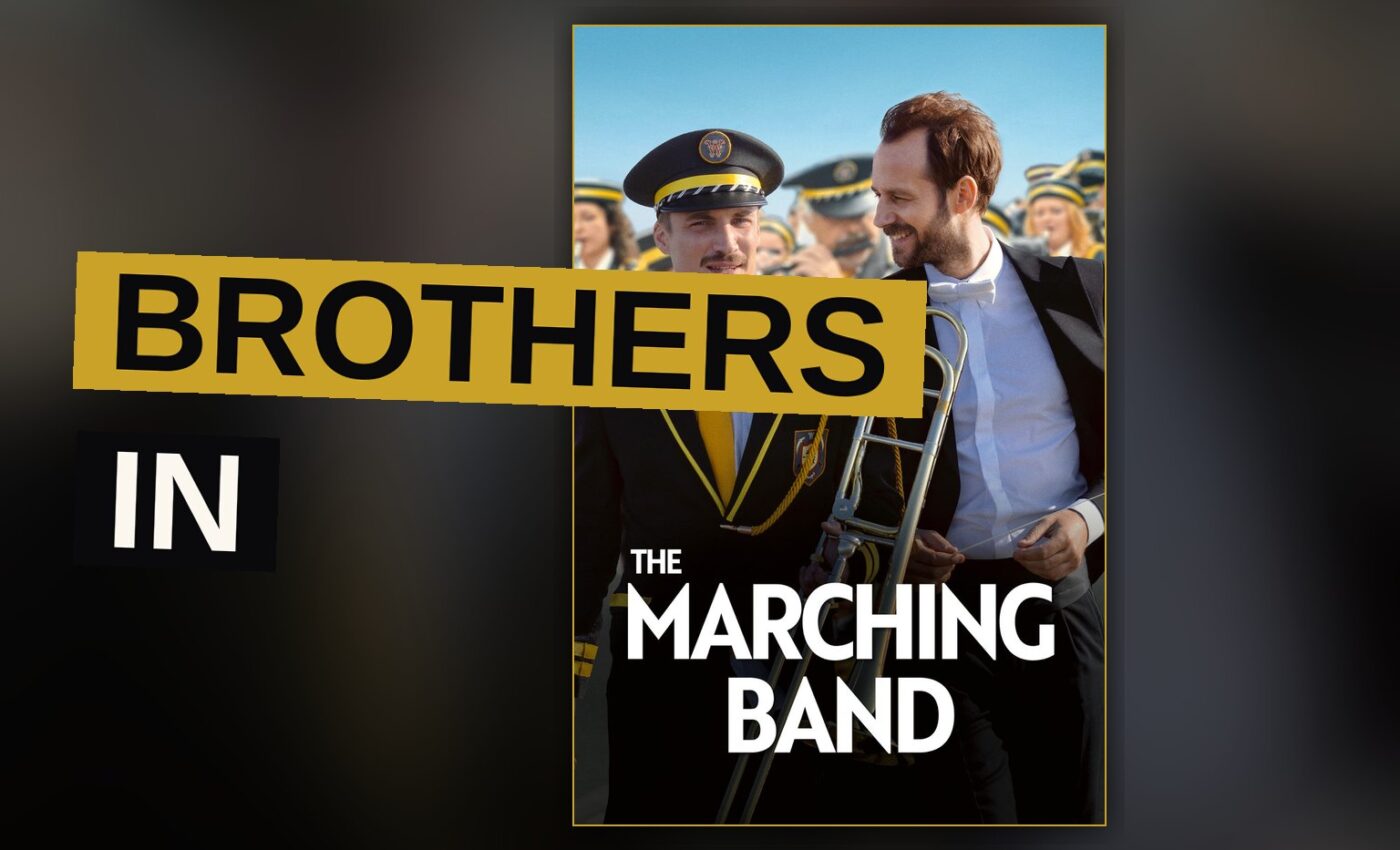
A trombone player in a cafeteria uniform turns out to share blood with a world-famous conductor. That is the setup for “The Marching Band,” and it works because the film never treats it as a gimmick.
Emmanuel Courcol directs from a script he wrote with Irène Muscari and Oriane Bonduel, and the three of them understand exactly what kind of story they have. Thibaut Desormeaux, played by Benjamin Lavernhe, is the conductor. Jimmy Lecocq, played by Pierre Lottin, is the brother he never knew existed, a man who works in a school kitchen and blows trombone in a local marching band on the side. Thibaut hears something in Jimmy’s playing that nobody else bothered to look for. The rest of the film is him trying to rectify what the story calls the injustice of fate.
Trailer, via Vertigo Releasing.
Two Brothers, One Instrument
Lavernhe and Lottin carry this picture. Lavernhe plays Thibaut with the coiled precision you’d expect from a man who conducts orchestras for a living, but he lets warmth leak through the control whenever Jimmy is on screen. Lottin has the harder job — Jimmy’s talent went undetected for years, and Lottin plays that reality without turning him into a sad sack. Their scenes together are the film’s engine, and Courcol knows it. He keeps the focus on the two of them and the bond forming between them, letting their performances drive the story rather than leaning on plot machinery.
The supporting cast fills in the world around them without ever stealing focus:
- Sarah Suco as Sabrina
- Clémence Massart-Weit as Claudine
- Ludmila Mikaël as Mme Desormeaux
- Anne Loiret as Claire
None of them get much room to breathe, but that’s fine. This isn’t an ensemble piece. It’s a two-hander wearing an ensemble’s clothes.
The Music Does the Talking
The best stretches of “The Marching Band” are the ones where Courcol lets the music carry the emotion instead of the dialogue. A brass instrument in the hands of someone nobody expected much from is a good image, and the film returns to it again and again without wearing it out. The marching band itself, unglamorous and a little ragged, becomes a stand-in for everything Jimmy has been denied — recognition, a stage, a brother who noticed him sooner.
The final act is where the film loosens its grip. The story finds the beats you’d expect from a tale about buried talent and family reconciliation, and it hits them roughly where you’d guess. That’s the one real knock against it.
But even in that stretch, the picture never loses its footing, because Lavernhe and Lottin keep the emotional stakes grounded in two specific people rather than a formula.
“finds its resonance in the dynamic of its leads & the focus on its music”
That line gets at what makes this film work. It isn’t reinventing the underdog-musician story. It’s trusting two actors and a horn section to make an old shape feel lived-in again.
Where It Lands
Runtime is 102 minutes, and Courcol doesn’t waste a scene of it. The film moves fast, in the way of stories that know exactly when to stop explaining themselves and let a scene do the work.
It’s a crowd-pleaser, unapologetically so.
That’s not an insult. “The Marching Band” wears its heart on its sleeve and never pretends otherwise, and there’s something disarming about a film this confident in its own sentiment. It doesn’t need irony or distance to earn its emotion — it just needs Lavernhe’s control and Lottin’s warmth, pointed at each other for 102 minutes.
The predictable stretch late in the film keeps this from being a great picture. But the central relationship, the specificity of the two lead performances, and the way the music is used to say what the characters can’t — those elements are strong enough to carry the whole thing across the finish line.