
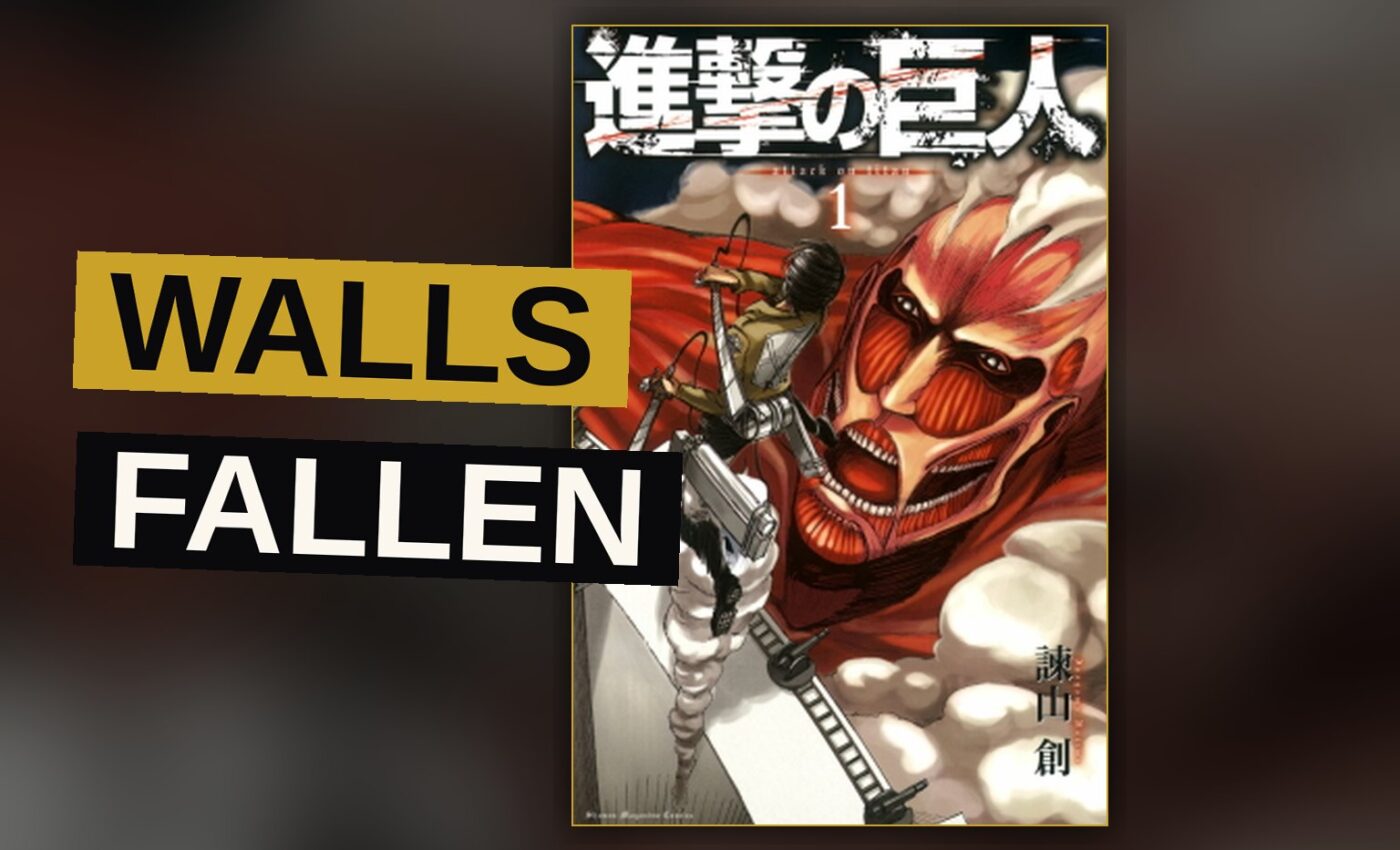
Attack on Titan is a show about walls, monsters, and the people who live in between them. The 2013 anime adaptation of Hajime Isayama’s manga takes a simple premise — humanity hides behind three enormous stone barriers to keep out the Titans — and turns it into a machine of dread, betrayal, and slow revelation. It runs for 25 episodes across two seasons, and it never lets you rest.
The story follows Eren Yeager, Mikasa Ackerman, and Armin Arlert, three friends in a small town near Wall Maria. They witness the fall of their wall, and the arrival of a Titan that kills their mother. That moment sets everything in motion. The show is built on questions: What are the Titans? Why do they exist? Who are the Eldians? And what does Eren want?
Trailer, via Crunchyroll Dubs.
The Titans
The Titans are the horror engine. They are humanoid giants, mindless, almost animal, that devour anything in their path. The show draws on classic monster tropes — the lumbering threat, the sudden attack, the sense that the world has turned against you — but it also gives them a mystery. Some Titans can speak. Some are controlled by humans. The reveal that the main character is a Titan himself changes the game entirely.
The animation holds up. The Titans are rendered with thick, rubbery movement, and their attacks are brutal. A Titan’s bite is not a quick snap; it is a slow, crushing collision. The show earns its reputation for violence early on, and it never backs down. It is a show about eating people, and it does not look away.
The Cast
Eren is the driving force. He is angry, desperate, and often wrong. Mikasa is his anchor, loyal without ever being a prop. Armin is the strategist, the thinker, the one who notices things others miss. The supporting cast is deep: Levi, the elite soldier with a sharp temper; Erwin Smith, the commander with a plan for everything; Historia, the quiet girl carrying a terrible secret. Each gets a moment to breathe, and each feels real.
The dialogue is sharp. Characters talk fast, interrupt each other, and say things that sting. The show does not soften its edges for comfort. When a character dies, it hurts. When a plan fails, the cost is shown. That honesty is what makes the drama land.
The Walls
The setting matters. Walls Maria, Rose, and Sina are more than scenery. They are political borders, social divisions, and psychological traps. The show spends time in these spaces, showing how people live, what they eat, and how they die. A scene in a hospital, a conversation in a barracks, a fight in a tower — each carries weight because the world is built with care.
The music matches the tone. The opening theme, “Guren no Yumiya,” is a soaring anthem that sets the stage. The battle scores are tense, the quiet moments are melancholic, and the finale is a slow, heavy build. The sound design is excellent too, with footsteps echoing in corridors and the distant roar of a Titan always present.
The Betrayals
The plot moves fast. The first season introduces the Scouts, the group that fights outside the walls, and the second season opens with a massive shake-up. A character you trusted turns out to be a traitor. A plan that seemed noble reveals its dark side. The show is not afraid to make you hate a hero and love a villain.
The pacing is deliberate. It does not rush to the big moments. It lets the small ones land. A conversation between two soldiers waiting for a mission can carry as much tension as a full-scale assault. That patience pays off in the final stretch, where the pieces finally click together.
The Reveal
The central twist — that Eren is a Titan — is the show’s greatest achievement. It reframes everything you thought you knew. The characters who seemed fixed become fluid. The enemy becomes the protagonist. The show asks you to sit with discomfort, and it rewards you for staying.
“The Titans are us.”
That line captures the heart of the series. The monsters are not just threats; they are symbols of human nature. Greed, fear, ambition, cruelty — all are on display. The show does not offer easy answers, but it offers clarity about what drives people.
The Final Season
The third season, released later, picks up where this 2013 adaptation leaves off. It continues the story, though critics have been less kind to it. For now, the 2013 version stands alone as a complete, self-contained arc. It ends on a cliffhanger, a move that felt bold at the time.
| Season | Episodes | Year |
|---|---|---|
| Season 1 | 12 | 2013 |
| Season 2 | 13 | 2013 |
The show is not perfect. Some filler episodes stretch the middle of the second season. A few scenes feel rushed. The political intrigue can get tangled. But none of that diminishes the core experience. This is a show that understands tension, escalation, and release.
Attack on Titan is a masterclass in storytelling. It is a show about power, about legacy, about the weight of history. It is also a show about friendship, loss, and the courage to keep fighting even when the world is falling apart. It is loud, messy, and often beautiful.


