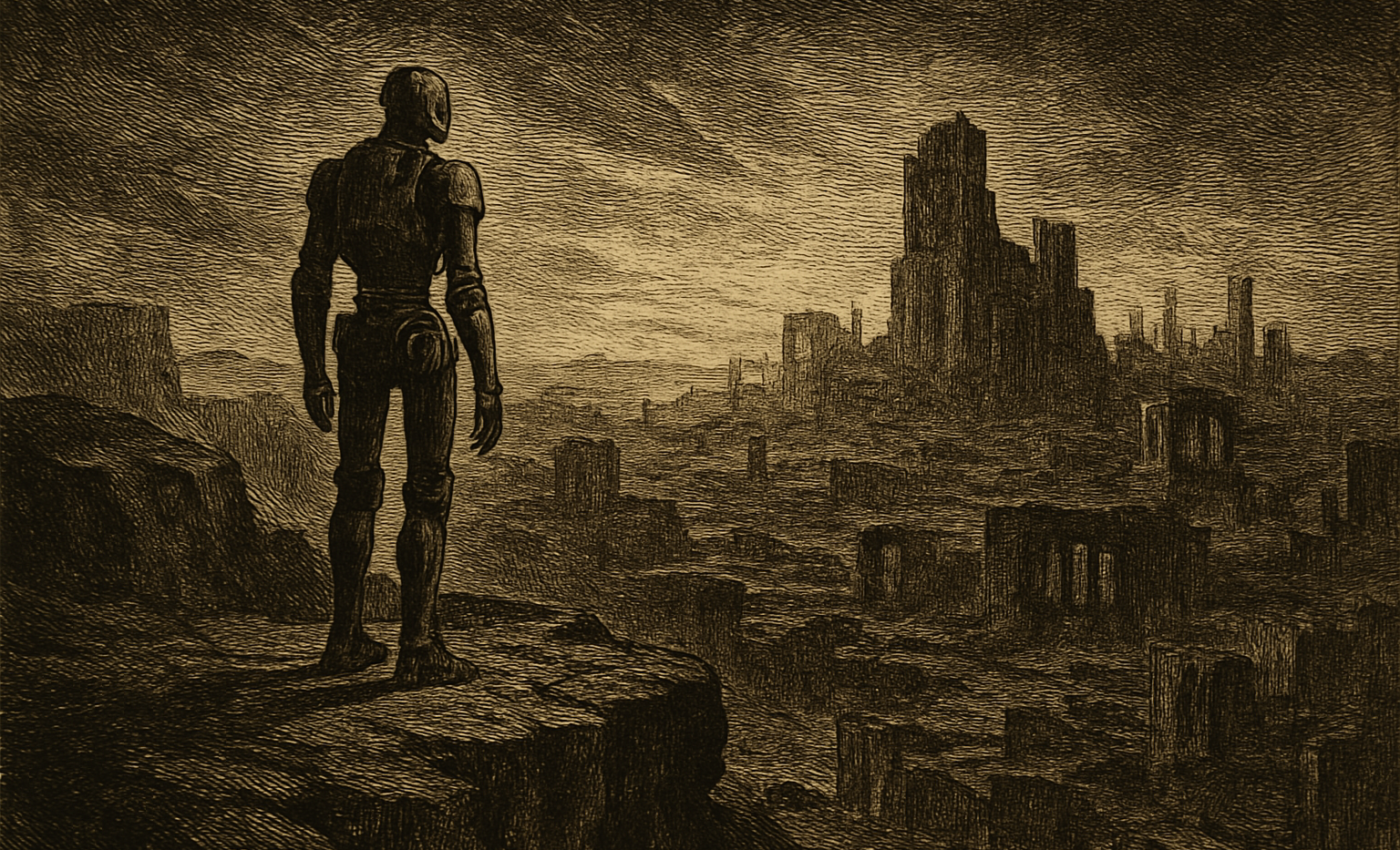
The Talos Principle II is a puzzle game about big questions. It asks what consciousness means, whether a machine can have a soul, and what a civilization owes to its own past. It is also, quite simply, one of the best puzzle games ever made.
The sequel to the 2014 original drops you into a vast, ruined city called New Jerusalem. You play as a robot named 1K, one of a thousand new beings created in the wake of the first game’s events. A strange, massive structure has appeared on the horizon, and your people must decide whether to investigate it. The journey takes you across a dozen sprawling environments, from sun-baked deserts to frozen coastlines, each packed with puzzles.
Trailer, via DevolverDigital.
The Puzzle Tools
The core loop is familiar. You enter a closed arena, find the tools available, and solve a series of logic problems to reach a terminal. The tools are the real innovation. You get a device that can copy objects, a gadget that creates gravity-defying platforms, and a drill that can be placed and then activated from a distance. Each tool is introduced gently, then combined in ways that feel genuinely clever.
The difficulty curve is near-perfect. Early puzzles teach you a mechanic in isolation. Later ones force you to chain three or four ideas together across a large space. The game rarely tells you what to do, but it never feels unfair. When you solve a hard one, the satisfaction is real. The Talos Principle II respects your intelligence, and that respect is the whole point.
New Jerusalem’s Politics
The narrative is a major step up from the first game. New Jerusalem is a city of 1,000 robots, and they have politics. There are factions, disagreements, and personal grudges. You talk to dozens of characters, each with a distinct voice. The writing is sharp, and the voice acting is excellent.
The central conflict is about the future of your species. Should you open the mysterious structure, risking the unknown? Or should you stay safe inside your walls? The game does not give you an easy answer. It lets you argue with characters, change their minds, or fail to change them. Your choices matter in small ways, and the ending reflects them. It is a story about community, memory, and the fear of making the wrong choice.
A World That Looks Great
The Talos Principle II is a beautiful game. The environments are enormous and detailed, with a painterly quality that makes every screenshot worth taking. The lighting is superb, and the sense of scale is constant. You are a small robot in a huge world, and the game never lets you forget it.
The sound design is just as strong. The ambient music is subtle, but it swells at the right moments. The sound of your own footsteps echoes in empty halls. The voice acting carries the emotional weight without ever feeling overwrought. The whole package is polished to a high sheen.
Small Faults, Big Payoff
The game is long, and not every section is equal. Some puzzles near the end feel like variations on earlier ideas. A few of the side quests are fetch quests in disguise, and they can drag. The story also leans on philosophical texts that you can read, and some of them are dense to the point of being a chore.
The Talos Principle II is not a game for everyone. It demands patience, attention, and a willingness to think. But for those who meet it on its own terms, it is a triumph. It is smart, sincere, and deeply humane. It is a game about what it means to be alive, and it earns every moment of its run time.
The Talos Principle II is a masterpiece.
The Numbers
- Game: The Talos Principle II
- Platforms: PC, PS5, Xbox Series X/S
- Release year: 2023
- Score: 9.0/10
What You Get
- A dozen major environments, each with dozens of puzzles
- Three core puzzle tools, combined in creative ways
- A branching story with multiple endings
- A full voice cast and a detailed world to explore
Get the Notebook.
The day's best stories and every fresh verdict, in plain English, in your inbox by seven. One email a day, no more.