
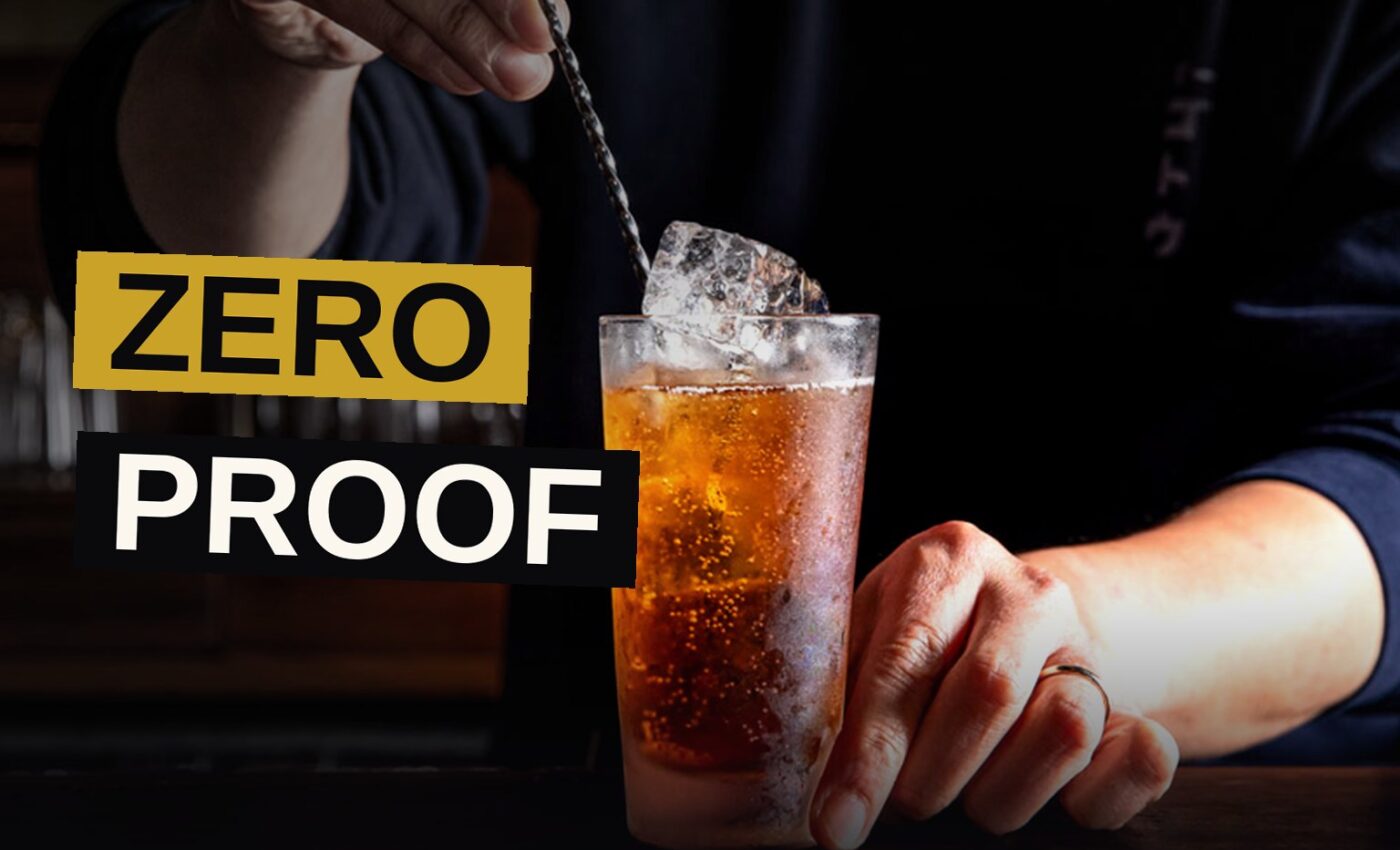
Bartenders say nonalcoholic amaro has real promise, even though the category hasn’t yet cracked the code. The style is currently enjoying a moment.
While many alcohol-free spirits still struggle to capture the flavor and feel of the real thing, amaro has a built-in advantage. Without alcohol, it’s hard to replicate texture, mouthfeel, brightness, or that familiar warmth. But amaro’s herbal foundation carries over naturally.
“You are still able to achieve the familiar flavors coming from macerating traditional amaro ingredients like herbs, botanicals and citrus,” says Robby Dow, owner of Bespoke, an Italian-inspired café and cocktail bar in Wilmington, North Carolina. For those who don’t drink, Dow says these spirits present “a very special opportunity for inclusion while still providing a quality product that tastes great.”
The Pathfinder Leads the Pack
Since its launch in Seattle in 2021, the Pathfinder Hemp & Root Non-Alcoholic Spirit has earned a following. It’s made from fermented hempseed mixed with wormwood, angelica root, Douglas fir, ginger, orange peel, and saffron. The spirit doesn’t label itself an amaro, yet its list of ingredients places it squarely in that category.
Across a wide range of drinks, bartenders reach for the bottle, whether shaking it into a Daiquiri, adding it to a highball, or pairing it with a zero-proof boilermaker. Ben Hopkins-Prager, a bartender at Milly’s in Brooklyn, praises its “tannic profile and solid structure.” He notes it’, has been a favorite among service industry workers.
“My dad has been a chef for 40 years, and his gift to himself in his sobriety was buying a dinghy, which he christened The Pathfinder.”
Lucano and the Italian Standard
Amaro Lucano Non-Alcoholic comes from Pisticci, Italy, made with the same batch of 30 herbs and botanicals as the original. Dow calls it the current “best in show” among nonalcoholic amari. The nonalcoholic version channels the same balanced, fragrant, bittersweet Mediterranean spirit of the full-proof original.
Damiano Coren, Director of Cocktail Programming for New York’s Sant Ambroeus and Casa Lever, uses it for its “complexity and distinctive balance of baking spice and citrus notes.” He developed the Until Sunset, a layered, sour-style shaken drink for the fall menu, rounded out with Fluère non-alcoholic aperitivo, fresh citrus, pomegranate juice, and mint.
Amaro Falso Keeps the Legacy Alive
Brooklyn’s first modern amaro was introduced by St. Agrestis in 2014. This past spring, The Wine Group, which is based in California, took over the brand and discontinued the flagship amaro so it could concentrate on building out its lineup of nonalcoholic products instead.
Amaro Falso carries forward the character of the original St. Agrestis Amaro, drawn from the same 20 botanicals. The familiar soda-fountain mix of spearmint and sarsaparilla remains at its center. Each bottle holds 200 milliliters of a blend of carbon dioxide and nitrogen, which gives it a smooth texture and silky mouthfeel, imitating the distinctive bite of alcohol.
Amaro Falso’s serves-two bottle format streamlines pouring, while its concentrated character suits mixing into highballs, spritzes, and spirit-forward nonalcoholic alternatives. Hopkins-Prager compares it to a full-strength amaro paired with soda.
From Review Blog to Retailer
The origin of Lapo’s Non-Alcoholic Amaro is rooted in a partnership. Sean Goldsmith and Trevor Wolfe built Zero Proof, a review blog, in 2019, which eventually became the largest online retailer for the adult nonalcoholic category. From there, they went on to create their own brands, among them Lapo’s, named after Lapo Fantoni, a barman Goldsmith befriended over Negronis at Harry’s Bar in Florence.
Goldsmith is the speaker here, and he is quoted directly, with his words set apart as “When I stopped drinking, I wanted that same experience—sipping Negronis with my friend Lapo in a classic, Italian setting—just without the booze,”.
Who’s Buying These Bottles
The audience for nonalcoholic amari is broader than you might think. “Most people drinking nonalcoholic drinks aren’t necessarily sober; they’re simply looking for alternatives to integrate into their drinking habits,” says Michael Toscano, East Coast Regional Director for The Pathfinder.
It also means that nonalcoholic amari appear in mixed drinks containing alcohol, not only in those without any liquor at all. They take the place of a digestif in many cocktails.
Amaro’s momentum is building fast despite its category being new, and the reason has to do with what goes into it: herbs, botanicals, and citrus. Those ingredients are so expressive that they don’t require alcohol to carry their character across.
Anyone who longs for the sharpness of a genuine digestif will find these bottles worth learning about.
“Most people drinking nonalcoholic drinks aren’t necessarily sober; they’re simply looking for alternatives to integrate into their drinking habits.”
The Bottles at a Glance
- The Pathfinder: $40 (700 milliliters), less than 0.5% ABV, from Seattle
- Amaro Lucano Non-Alcoholic: $37 (750 milliliters), less than 0.5% ABV, from Pisticci, Italy
- St. Agrestis Amaro Falso: $40 (six 200 milliliter bottles), less than 0.5% ABV, from Brooklyn
- Zero Proof founded as a review blog in 2019
- St. Agrestis original amaro launched in 2014
Source: punchdrink.com
Get the Notebook.
The day's best stories and every fresh verdict, in plain English, in your inbox by seven. One email a day, no more.