
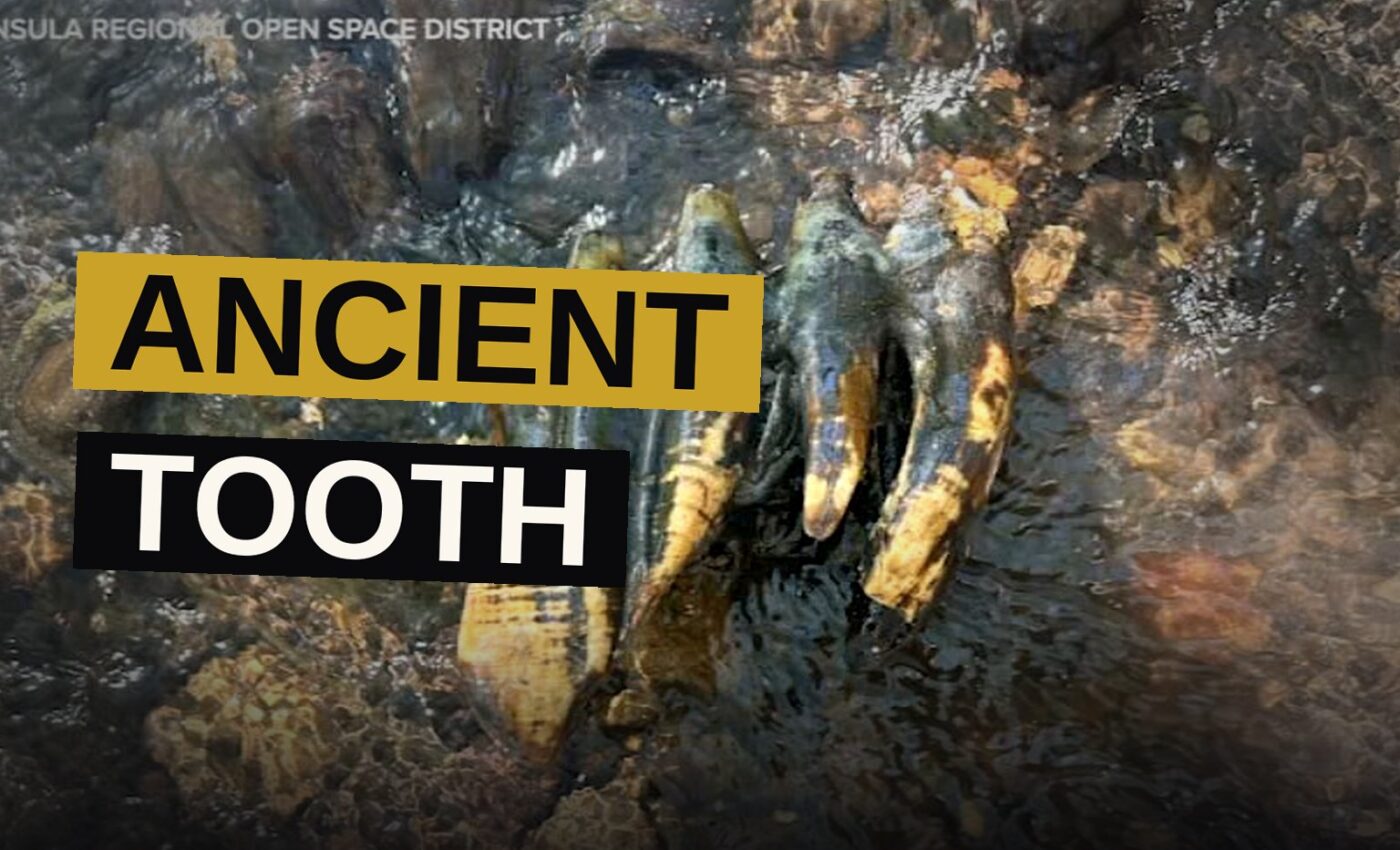
A fossilized tooth belonging to a Pacific mastodon, estimated to be at least 10,000 years old, has been found in a creek bed in San Mateo County, California. The discovery was made during field surveys for a habitat enhancement project in a Midpeninsula (Midpen) Regional Open Space District preserve.
The tooth is described as being in “immaculate condition.” Scientists say it is the most complete molar of its kind from the region, and it is also the most spectacular molar they have ever seen.
The Tooth That Looked Like a Rock
The fossil was initially mistaken for an oddly shaped rock. It was only after paleontologists examined it that they confirmed it was an intact molar from an adult Pacific mastodon.
Wayne Thompson, a paleontologist and owner of the environmental planning and management firm Pacific Paleontology, said he felt a physical reaction upon seeing it.
“It’s the most complete mastodon molar from our area, and the most spectacular mastodon molar that I’ve ever seen,” Thompson stated in the press release. “I had chills and shivers up and down my spine.”
Dimensions of the Molar
The tooth measures about 8.5 inches long, 7 inches deep and 3 inches wide, according to Midpen. Those dimensions give a sense of scale: this is a substantial piece of ancient bone.
The tooth was discovered by Brigid Lynch, who said she had never seen anything quite like it in her fieldwork.
“As a geologist, I’ve gone out and seen stuff in the field, but definitely nothing as exciting as this,” Lynch said.
A Massive Herbivore of the Past
The Pacific mastodon was a massive herbivore that roamed California, Oregon, the northern Rocky Mountains and parts of Mexico during the Pleistocene epoch. That epoch spanned from about 2.5 million years ago until 11,700 years ago, when the animals went extinct.
The species differs from the more well-known American mastodon in several ways. It had narrower teeth, thicker leg bones and different tusks.
The mastodon resembled the woolly mammoth but was distinct in key features. Its molars were suited for crushing twigs and other vegetation.
Both of the large mammals were distant relatives of the elephant and existed in similar regions and time periods.
What the Tooth Tells Us
The tooth has been donated to the Doerr School of Sustainability at Stanford University. Researchers there plan to determine its exact age through carbon dating and will create a 3D scan of it.
Christine Garcia, curator and manager of the Geoscience Specimen Collection at Stanford University, explained why the tooth matters.
“We can study fossils to better understand Earth’s past, past wildlife and the ecosystem they were a part of, and to help us make better predictions and better decisions about how to help our ecosystems and biodiversity thrive into the future,” Garcia stated in the Midpen press release.
The Habitat Survey Context
The tooth was found during surveys conducted as part of a habitat enhancement project. The surveys were carried out in a Midpen preserve, and the tooth emerged as something far rarer than anyone expected.
The fact that it was mistaken for a rock at first speaks to how easily these things can be overlooked.
The DNA Story Behind the Tooth
Researchers have used DNA from mastodon fossils to discover that the mammal was far more genetically diverse than previously known. They also found that it had migrated long distances in response to a shifting climate, according to a 2025 study published in the journal Science Advances.
That genetic research helps explain how the species moved across its range over millennia.
Why This Discovery Matters
The tooth is not just a curiosity. It is a physical link to a creature that lived in North America tens of thousands of years ago.
It also carries scientific weight. The carbon dating will establish its precise age, and the 3D scan will preserve its form for future study.
The fact that it is so well preserved means it holds more information than a worn or broken specimen would.
A Small Delight
This is a small story with a big payoff. A tooth found in a creek turned out to be the finest example of its kind ever seen.
The chills and shivers Thompson felt were genuine. The excitement Lynch expressed was real. These are people whose job is to find such things, and they still reacted like the rest of us would.
That reaction is the story’s best feature. It reminds us that even those who study these things every day can still be surprised.
Key Facts Box
- Age: At least 10,000 years old
- Species: Pacific mastodon
- Location: Creek bed, Midpeninsula Regional Open Space District preserve, San Mateo County, California
- Dimensions: About 8.5 inches long, 7 inches deep, 3 inches wide
- Study: Carbon dating and 3D scan planned
- Related research: 2025 study in Science Advances on mastodon genetics
The tooth will now join the collection at Stanford, where it will be studied and scanned.
For now, the tooth belongs to a creek in San Mateo County, and it has been found. That is enough for one day.