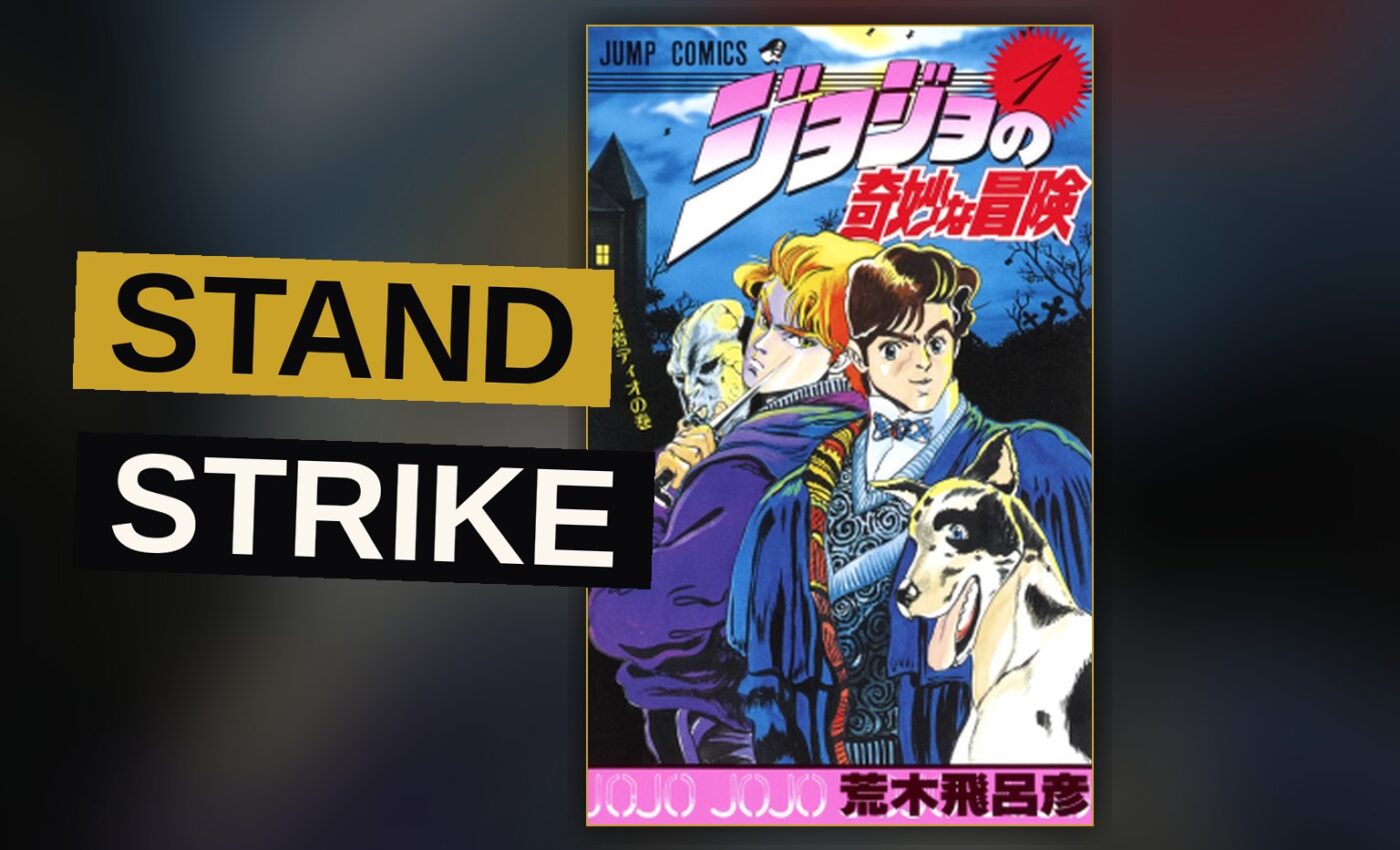
JoJo’s Bizarre Adventure: Eyes of Heaven launched in Japan on December 17, 2015, for the PlayStation 3 and PlayStation 4. Western territories got it on June 28, 2016, on the PlayStation 4 only. CyberConnect2 developed it. Bandai Namco Entertainment published it. It is the second JoJo game from CyberConnect2, after 2013’s JoJo’s Bizarre Adventure: All Star Battle, with which it shares the same engine. It scored 6.3 out of 10 across 10 outlets. That number is fair, and the reasons show up in the first match.
Trailer, via Bandai Namco Entertainment.
A 2v2 Brawler in Manga Arenas
Eyes of Heaven is a 3D action brawler with tag-team elements. Matches play out in large arenas modeled on locations from the manga. Each side fields two fighters, so every battle is a 2v2. A player picks one character to control directly, then a second character handled by either a CPU or a second human player.
The structure is straightforward, and CyberConnect2 does not hide its lineage. The combo system and the air-to-air combos follow the studio’s Naruto: Ultimate Ninja games. Anyone who has played those will recognize the rhythm inside a minute. The game supports online play through the PlayStation Network system. Single player and multiplayer modes are both present.
What separates Eyes of Heaven from a straight reskin is the pairing. Certain match-ups trigger special animations and dialogue between two characters, mostly between allies. These arrive as unique combination attacks: Dual Combos and Dual Heat Attacks. They are the game’s signature flourish, and they are also its biggest problem.
Dual Combos That Do Nothing
The Dual Combos and Dual Heat Attacks exist purely as presentation. The game provides no discernible bonuses or advantages in battle for triggering them.
A tag-team fighter lives or dies on what the tag actually does. Here, in this paper’s reading, the second character is a body on the field, not a system. There is no resource to manage, no meter to spend, no reason to time a switch beyond the animation it unlocks. The combo mechanisms inherited from the Ultimate Ninja series carry the fighting. The team element sits on top of them like a coat of paint.
This is where Eyes of Heaven loses its claim to the genre it advertises. A 2v2 brawler that gives no mechanical weight to the 2 is a 1v1 brawler with extra bodies. The Dual Heat Attacks are worth seeing once. They are not worth building a match around, because the game does not let you build anything around them.
The Saint’s Corpse and the Alternate Dio
The story picks up immediately after Stardust Crusaders. Jotaro Kujo and his allies have just defeated the vampire Dio Brando when they are attacked by friends and enemies who had disappeared or died along the way. A young Robert E. O. Speedwagon arrives with a piece of the Saint’s Corpse. The relic lets him travel through time and space and dispel the evil influence possessing the mysterious attackers.
Speedwagon leads Jotaro and his allies across space, time and alternate universes to stop another Dio and his disciple Enrico Pucci from collecting the Saint’s Corpse and wiping out the Joestar family. The roster joins them part by part: Jonathan Joestar, a younger Joseph Joestar, Josuke Higashikata, Giorno Giovanna, Jolyne Cujoh, the paraplegic jockey Johnny Joestar, and an amnesiac given the temporary name of Josuke Higashikata.
The heroes gather every piece of the Corpse but one. Then an alternate Dio Brando appears, wielding an upgraded Stand he calls The World Over Heaven, which can rewrite reality itself. He takes most of the collected pieces. The group escapes with Jotaro holding one. Funny Valentine then reveals that this Dio, now called DIO, Gone to Heaven, comes from a world where he beat Jotaro and became a god.
The game’s main storyline takes place immediately following the events of Stardust Crusaders.
That premise is the best thing Eyes of Heaven has. It is a crossover with a reason to exist, not a roster thrown at a wall. The problem, in this paper’s view, is that the game’s structure cannot carry it.
53 Fighters and One Missing Guest
Eyes of Heaven brings back every playable character from All Star Battle except the guest character Ikuro Hashizawa. It adds 13 new playable characters, for a total of 53. Characters are sorted by fighting style, a system carried over from All Star Battle. The styles are Hamon, Ogre Street Techniques, Vampiric, German Science, Mode, Stand and Mounted.
The roster is deep, and the style categories are a real attempt to organize a franchise that spans generations of power creep. Hamon and Stand users do not fight the same way, and the game knows it. Fifty-three fighters is a serious number for any licensed brawler, and the returning cast means All Star Battle players keep their muscle memory.
The one non-playable figure who matters is DIO, Gone to Heaven, voiced by Takehito Koyasu. His Stand is The World Over Heaven. He is the final threat and the plot’s engine, and he is not selectable. For a game that sells itself on its roster, locking the central antagonist out of the character select screen is a strange call.
How Eyes of Heaven Compares
| Feature | Eyes of Heaven (2015) | All Star Battle (2013) |
|---|---|---|
| Developer | CyberConnect2 | CyberConnect2 |
| Engine | Shared with All Star Battle | Shared with Eyes of Heaven |
| Platforms | PlayStation 3, PlayStation 4 | Not stated in source |
| Battle format | 2v2 tag-team | Not stated in source |
| Playable roster | 53, all All Star Battle fighters except Ikuro Hashizawa, plus 13 new | All playable characters return in Eyes of Heaven except Ikuro Hashizawa |
| Fighting styles | Hamon, Ogre Street Techniques, Vampiric, German Science, Mode, Stand, Mounted | Same style categories carried over |
| Western release | PlayStation 4 only, June 28, 2016 | Not stated in source |
The comparison is not flattering. Eyes of Heaven is a sequel that shares an engine with its predecessor, carries over its fighting-style categories, and brings back its cast. What it adds is the tag system, and in this paper’s view the tag system is the part that does not work.
What the 6.3 Gets Right
A 6.3 out of 10 is not a bad game. It is a game with one good idea and no follow-through. Eyes of Heaven has the roster, the arenas, the online play, and a story that justifies its own existence. It does not have a reason for the second fighter to be on the field.
The Dual Combos are the whole pitch, and they are cosmetic. Strip them out and you have an All Star Battle follow-up with better arenas and a time-travel plot. Keep them in and you have the same thing, plus animations you will watch twice. Neither version is a tag-team fighter, because in this paper’s reading the game never asks you to think about your partner.
The 53-character roster is real value, and the style categories give it shape. But a fighting game is judged on its fights, and Eyes of Heaven’s fights are 1v1 affairs wearing a 2v2 costume. The Saint’s Corpse story is the strongest asset here, and it is told through a structure that cannot support the weight of its own premise.
The PlayStation 4 exclusivity in the West is worth noting too. Japanese players got the game on the PlayStation 3 and PlayStation 4 on December 17, 2015. Everyone else waited until June 28, 2016, and got one platform — a gap of a little over six months. That is not a dealbreaker, but it narrows who can play.
Verdict
Eyes of Heaven is a fan-service crossover with a genuine hook and a hollow center. The story earns its crossover status. The roster earns its 53 slots. The tag-team combat does not earn its second character, because in this paper’s view the game gives that character nothing to do.
CyberConnect2 knows how to build a combo system, and the Naruto lineage shows in every exchange. What the studio did not solve is the reason to pair fighters up. Dual Combos and Dual Heat Attacks are spectacle without stakes, and a brawler built on spectacle alone runs out of reasons to keep playing.
Buy it for the roster and the Saint’s Corpse arc. Do not buy it expecting a tag-team fighter. In this paper’s view it plays like a 2013 game with a 2015 coat of paint and a better story, and the 6.3 out of 10 is a fair summary of that.
Get the Notebook.
The day's best stories and every fresh verdict, in plain English, in your inbox by seven. One email a day, no more.