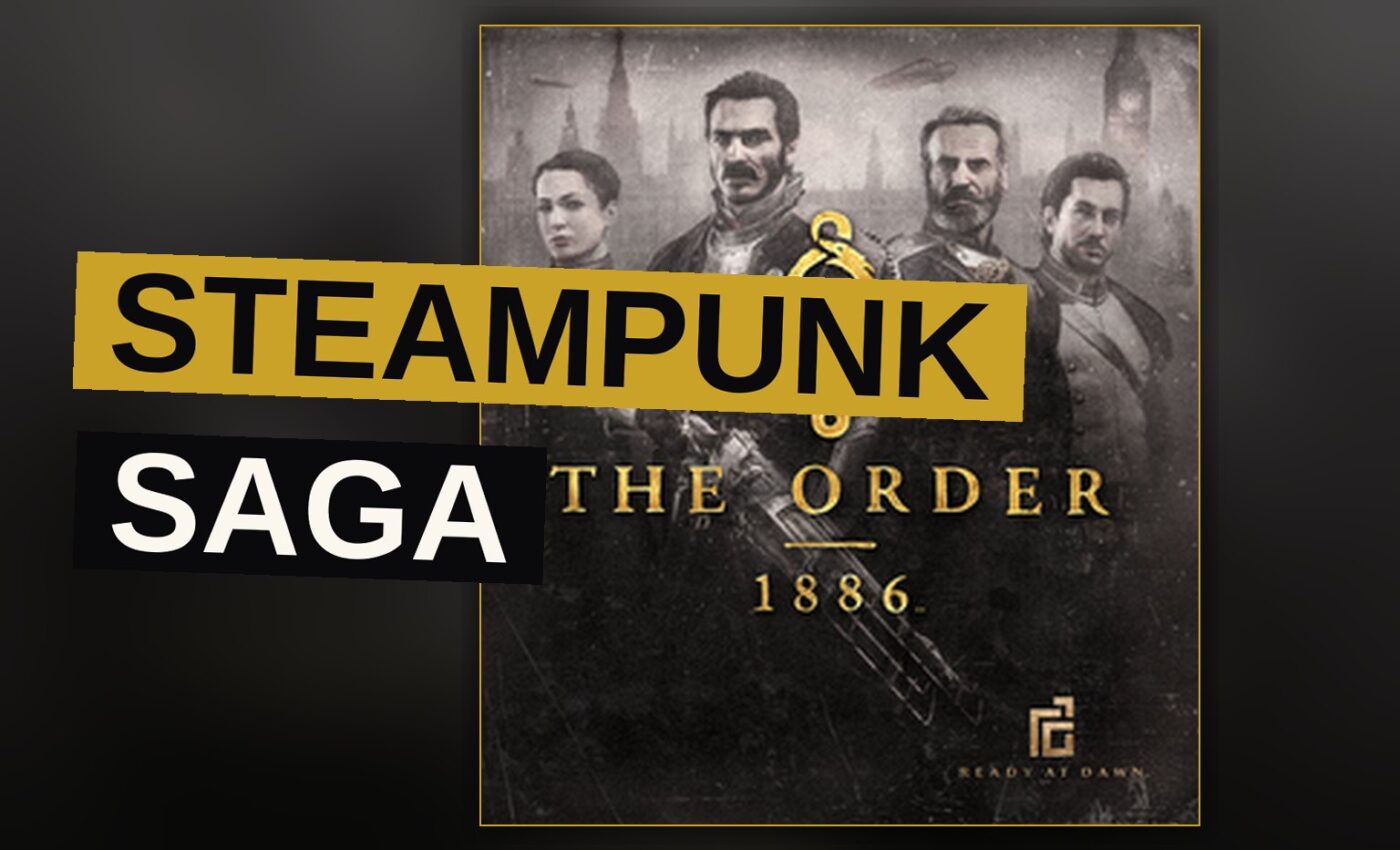
The Order: 1886 is a beautiful, brief argument against itself. Ready at Dawn’s PlayStation 4 exclusive builds an alternate 1886 London of zeppelins, thermal imaging and wireless communications, then hands the player a rifle and a corridor and asks for patience. It lasts a handful of hours. It looks like nothing else on the console. Those two facts sit at the center of everything that follows.
Trailer, via IGDBcom.
A War That Started in the Seventh Century
The setting is the game’s best idea, and it arrives fully formed. Around the seventh or eighth century, a small number of humans took on bestial traits. The majority feared these half-breeds, and war broke out. Humans outnumbered them, but animal strength gave the half-breeds the upper hand across centuries of conflict.
King Arthur and the Knights of the Round Table take the fight to them. Arthur soon realizes it is a losing battle. Then the Knights discover Blackwater, a mystical liquid that significantly extends their lifetimes and grants remarkable healing abilities. The half-breeds keep winning anyway, until the Industrial Revolution turns the tide.
By 1886 the war grinds on and martial law is nearly in place. A new threat emerges: the lower classes rebelling against the rich and the social order. The Knights side with the well-to-do upper classes and nobles. That is a sharp, ugly premise for a shooter, and The Order: 1886 mostly declines to use it.
Sir Galahad and the Other Three Knights
The player controls Sir Galahad, third to bear that title, who has battled the order’s enemies for centuries. Grayson, as the game also calls him, views Sebastian Mallory as a mentor, Lafayette as a friend, and Isabeau as a potential love interest. Little else about him is known.
Mallory is the oldest of the four, the second to bear the name Sir Percival, and a descendant of Thomas Mallory, who wrote Le Morte d’Arthur in the 1400s. A close friend of Grayson, he is one of the best Knights in the order’s history.
Isabeau D’Argyll is one of the younger Knights, though far older than her late-twenties appearance. The latest Lady Igraine, she was Grayson’s apprentice and, if not for her commitment to the order, his lover. Marquis de Lafayette fought in the French and American Revolutions; his tactical expertise brought him to the order’s attention, and Mallory convinced him to join. He is the group’s youngest and does not yet bear a Knight’s name.
That is a strong ensemble on paper. The Order: 1886 gives it a squad’s worth of banter and almost no room to breathe.
Cover, Button Prompts, Scattered Lore
The gameplay revolves around cover-based shooting. The player guides Galahad through linear environments, following the story, battling humans and werewolf-like half-breeds. Galahad carries variations of rifles, grenades, crossbows and pistols. He also uses melee attacks and silent kills.
Quick time events are a major aspect. The player completes button prompts to progress. Collectibles providing lore are scattered around the environment for the player to find.
The weapons are the most inventive part of the kit. New weapons belch electricity, ignite clouds of thermite on top of enemies, and serve dual functions as fragmentation grenades and proximity mines. Engineers in this timeline are far ahead of their time, inventing thermal imaging, railguns, zeppelins and wireless communications.
None of it changes the shape of an encounter. You take cover, you fire, you move forward. The thermite is a spectacle, not a tactic.
A Story Told Down a Straight Line
The Order: 1886 is a story-focused action-adventure game played in third-person perspective. The structure is linear by design. The player follows Galahad through the environments rather than choosing a route through them.
That choice costs the game its replay value. There is little to return to once the campaign ends, and the collectibles are lore, not play. The Order: 1886 wants to be watched as much as played, and it succeeds at the first half of that ambition.
The production value is the reason to be here. Faces, cloth, rain-slick streets and the interior of an airship all hold up. The Order: 1886 received mixed reviews from critics, with praise directed at production value, graphics and technical achievements, and criticism aimed at short length, story, gameplay, replay value and the limited involvement given to the player. That split is the correct read.
Jack the Ripper Happened Two Years Earlier
One detail deserves more than the game gives it. The events involving Jack the Ripper have taken place two years before the campaign. The Order: 1886 mentions this and moves on.
In autumn 1886, London is plagued by half-breed attacks and an anti-government insurgency. After fighting off rebels in Mayfair, Sir Galahad pursues the survivors. Steve West plays Galahad, and the performance carries the material further than the script does.
The insurgency is the thread the game pulls hardest, and it is also the thread that exposes the premise’s weakness. The Knights protect the wealthy against the poor, and The Order: 1886 treats that as texture rather than argument. A game this handsome should have something to say about the order it asks you to serve.
What the Production Value Buys
Here is the part worth weighing. The Order: 1886 is not a failure of craft. It is a failure of proportion. Every system in it works: the shooting is competent, the quick time events are legible, the collectibles are written with care, and the art direction is the best argument the PlayStation 4 had in 2015 for its own existence.
What it lacks is room. The campaign is short, and the linear structure means the player never gets to test the tools against a problem they chose. The half-breeds are a striking enemy. The Blackwater is a striking idea. The Knights are a striking cast. None of them are given a level that lets them be more than a backdrop.
The Order: 1886 is worth playing for the hour or two where it is genuinely astonishing. It is not worth defending as a whole. A sequel that kept this London and doubled the campaign, kept the squad and gave it a real argument, kept the thermite and built encounters around it, would be a major game. This is a demo for that game, sold at full price.
The Order: 1886 is a 2015 action-adventure game developed by Ready at Dawn and published by Sony Computer Entertainment for the PlayStation 4. It is set in an 1886 alternate history steampunk London and follows the Knights of the Round Table as they battle half-breeds such as werewolves and vampires, plus fringe organizations rebelling against the government.
It is a gorgeous, disciplined, thin piece of work. The production value is real. So is the shortness, the thin story, the limited involvement, and the replay value that isn’t there. The Order: 1886 earns its mixed reception honestly.
6.2 of 10.
The Hard Numbers
- Title: The Order: 1886
- Release year: 2015
- Developer: Ready at Dawn
- Publisher: Sony Computer Entertainment
- Platform: PlayStation 4
- Genre: Action-adventure, shooter
- Perspective: Third person
- Modes: Single player, multiplayer
- Setting: Alternate history 1886 London
- Protagonist: Sir Galahad, played by Steve West
- Score: 6.2 of 10
Get the Notebook.
The day's best stories and every fresh verdict, in plain English, in your inbox by seven. One email a day, no more.