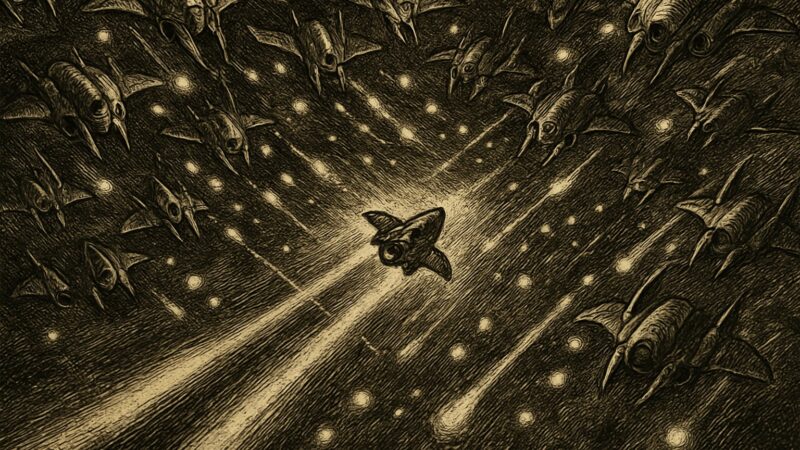
Hohokum asks you to be a kite. You are a multicolored serpent, gliding through 17 worlds with no score, no timer, and no tutorial. It came out on August 12, 2014, for PlayStation 3, PlayStation 4, and PlayStation Vita, with a later PC release from Annapurna Interactive. Sony Computer Entertainment published the console versions. Honeyslug built it with artist Richard Hogg, and SCE Santa Monica Studio helped finish it. The result is one of the strangest, most beautiful things Sony put its name on that year. It is also, by the end, a little tired.
Trailer, via IGN.
The Long Mover Glides Through 17 Worlds
You control the Long Mover, a multicolored serpent creature. It glides through whimsical game worlds with loose objectives. There is no correct way to play. The developers began work in 2008 and compared the concept to flying a kite. They drew inspiration from free London museums, Portmeirion, and indigenous cultures.
That pitch survives contact with the game. Hohokum is non-linear. It has no score, no time limit, no tutorial. The developer described the game as about “relaxing in a space and just enjoying the experience and the music, instead of trying to complete it to make progress.”
An IGN preview called it “simply about the beauty of exploring.” That is the whole promise, and Hohokum mostly keeps it.
What Lamp Lighting and Sponge Land Ask of You
There are 17 worlds. Each has unique characters, a single primary goal, and secondary activities. The game does not explicitly have a story, but a narrative line connects the disparate worlds.
- In “Lamp Lighting,” you activate lights while flying past silhouettes, and each light adds a new layer of music.
- In Sponge Land, an underwater world, you gather fish to swim alongside the Long Mover.
- In Kite Village, you collect seeds.
The player flies through a series of color-changing circles to access the next world. That is the connective tissue between them.
USgamer’s Jeremy Parish wrote that the game’s challenges were in distinguishing the interactive objects from the environment and then figuring out the function of those interactive objects. His example is the clearest one in the game. A ball resembling a dandelion releases its spores when circled. The player has to follow the floating spores to realize that other villagers use the spores as a vehicle.
That is Hohokum at its best. It teaches you a rule without telling you the rule.
Two Buttons, One Wiggle, and a Light Bar
The game communicates with visual and audial cues. It uses few of the standard controller buttons. Two buttons slow or accelerate the Long Mover. The triggers make it wiggle for a boost. The Long Mover changes color based on the direction it faces, and the DualShock 4’s light bar matches that color.
That is the entire control scheme. Compare it to what the average 2014 adventure game asked you to memorize:
| Input | Hohokum | Standard 2014 adventure |
|---|---|---|
| Movement | Glide, no fail state | Walk, jump, climb |
| Progress | Color-changing circles between worlds | Objective markers, quest log |
| Failure | None | Death, retry, checkpoint |
| Feedback | Visual and audial cues | Tutorials, pop-ups, on-screen text |
| Time pressure | None | Timers, chase sequences |
The table is not a knock on other games. It is a description of how far Hohokum strips things back. Two buttons, a wiggle, and a light bar. No on-screen text. No tutorial. No death.
Where the Drift Sets In
The soundtrack comes from Ghostly International artists, and it is the load-bearing wall of the whole thing. In “Lamp Lighting,” each light you touch adds a new layer of music. That is the best idea in Hohokum: the world does not reward you with a number, it rewards you with a sound. The art and music earned the praise they got. Metacritic logged “generally favorable reviews.”
The complaints were consistent, and they are correct. Critics felt the gameplay turned to drudgery towards its end. They also felt the objectives were too vague.
Both are true at once. The vagueness that makes the first few worlds feel like discovery makes the last few feel like guesswork. Once you have learned how Hohokum teaches, the teaching stops. What is left is a long glide toward a goal you cannot name, in a world that will not say whether you are close.
The game’s defenders will call that the point. It is not quite the point. Flying a kite is pleasant because the kite responds. Hohokum’s last worlds ask you to keep flying a kite that has stopped responding and hope the string is still attached.
What Hohokum Gets Right and Where It Runs Out
Hohokum is worth playing for its first half alone. Richard Hogg’s art, the Ghostly International soundtrack, and the “Lamp Lighting” idea are enough to justify the trip. The Long Mover is a genuine creation, and the 17 worlds are genuinely distinct.
The problem is that Hohokum has no way to end. A game designed to be enjoyed without pursuing objectives still has to stop, and Hohokum stops by running out of momentum rather than arriving somewhere. The dandelion spores are a small miracle. The fifth world that asks you to find another set of spores is not.
Play it for the music. Play it for the light bar. Play it for the hour where you understand what the game is doing and it understands you. Then put it down when the drift starts, because Hohokum will not tell you when.
Get the Notebook.
The day's best stories and every fresh verdict, in plain English, in your inbox by seven. One email a day, no more.