
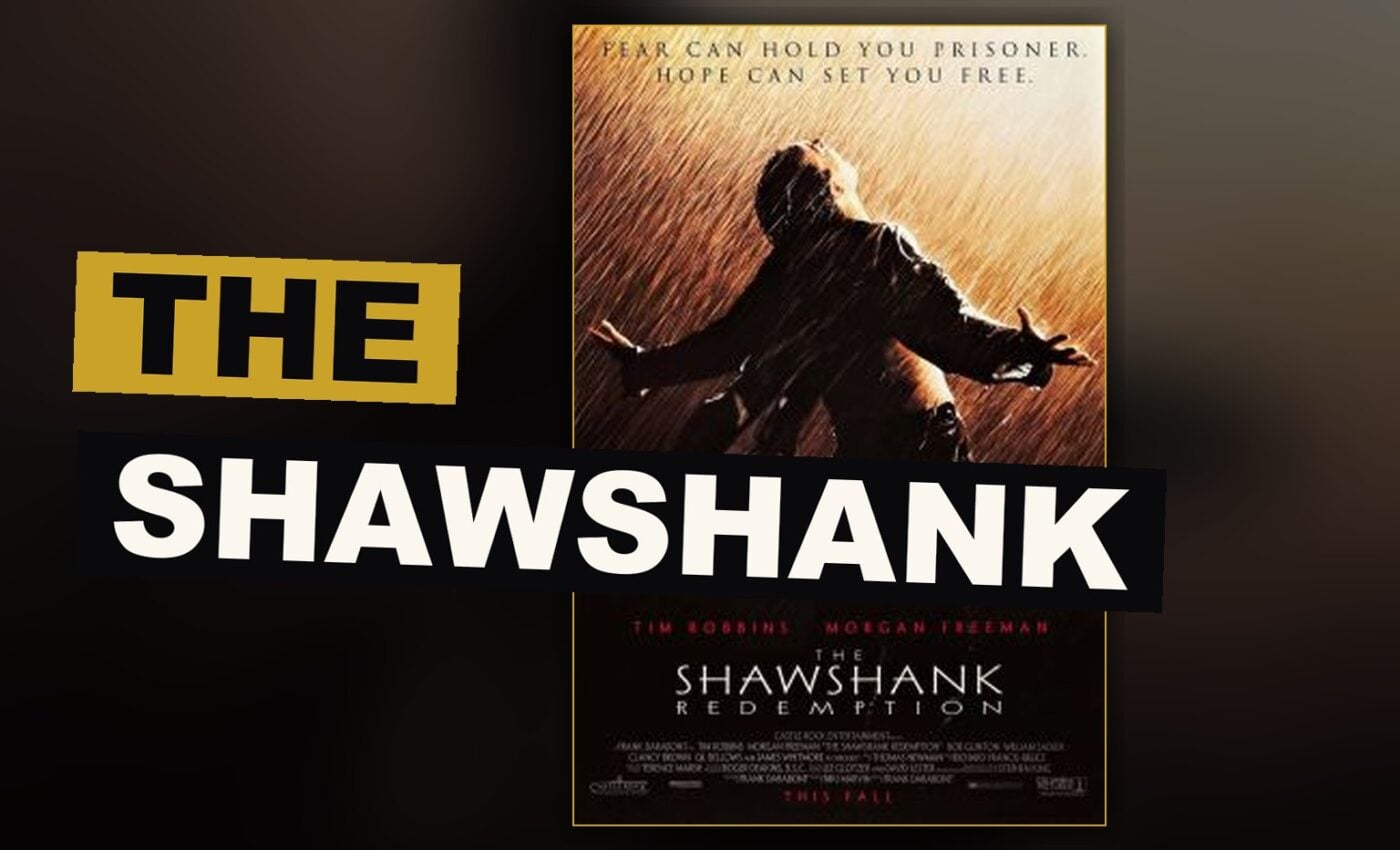
Frank Darabont spent eight weeks writing the script for The Shawshank Redemption. He bought the rights to Stephen King’s 1982 novella Rita Hayworth and Shawshank Redemption in 1987. Development did not begin until five years later. Two weeks after he handed the script to Castle Rock Entertainment, he had a $25 million budget. Pre-production began in January 1993.
A Banker Arrives in Portland, Maine
The Shawshank Redemption premiered at the Toronto International Film Festival on September 10, 1994. It runs 142 minutes. It is a drama and a crime story, and the poster tagline was “Fear can hold you prisoner. Hope can set you free.”
The plot starts in 1947. Andy Dufresne, a Portland, Maine banker played by Tim Robbins, arrives at Shawshank State Prison to serve two consecutive life sentences for murdering his wife and her lover. He claims he is innocent. The sentence stands.
Inside, he meets Ellis Boyd “Red” Redding, played by Morgan Freeman, a contraband smuggler serving a life sentence of his own. Red procures a rock hammer and a large poster of Rita Hayworth for Andy. Andy is assigned to the prison laundry, where he is frequently raped by a gang called the Sisters, led by Bogs Diamond.
Byron Hadley and the Inheritance
The turn comes in 1949. Andy overhears Byron Hadley, the captain of the guards, complaining about being taxed on an inheritance. Andy offers to help him shelter the money legally. Clancy Brown plays Hadley as a man whose violence is administrative rather than personal, which is what makes him frightening.
After the Sisters beat Andy nearly to death, Hadley cripples Bogs. Bogs is transferred to a minimum-security hospital. Andy is not attacked again. The arrangement is ugly and it works, and the movie does not pretend otherwise.
Warden Samuel Norton, played by Bob Gunton, then assigns Andy to the prison’s decrepit library. The stated reason is to assist Brooks Hatlen, the elderly inmate librarian played by James Whitmore. The real reason is to use Andy’s financial expertise in managing the warden’s and other prison staff’s finances.
Andy also starts writing weekly letters to the state legislature asking for library funding. After years of those letters, the legislature sends a donation that includes a recording of The Marriage of Figaro. Andy plays an excerpt over the public address system. It is a moment of personal freedom, and he is punished for it with solitary confinement.
Brooks Hatlen, Paroled in 1954
Brooks is paroled in 1954 after 50 years inside. He cannot adjust to the outside world. He hangs himself. Whitmore has maybe ten minutes of screen time and the sequence lands harder than most entire films.
After his release, Andy tells a dismissive Red that hope is what gets him through his sentence. Red does not want to hear it. That argument is the spine of the movie.
In 1963, Norton begins exploiting prison labor for public works, profiting by undercutting skilled labor costs and receiving bribes. Andy launders the money under the alias “Randall Stephens.” In 1965, a young convict named Tommy Williams arrives, played by Gil Bellows, imprisoned for burglary.
The Cast Darabont Almost Didn’t Get
The casting history is a list of near-misses. Darabont looked initially at some of his favorite actors, such as Gene Hackman and Robert Duvall, for Andy; both were unavailable. Clint Eastwood and Paul Newman were considered. Tom Cruise attended table readings but declined to work for the inexperienced Darabont. Tom Hanks passed because he was starring in Forrest Gump. Kevin Costner passed because he had the lead in Waterworld.
Freeman was cast at the suggestion of producer Liz Glotzer, who ignored the novella’s description of Red as a white Irishman. The film acknowledges the change. When Andy asks Red why he is called that, Red replies, “Maybe it’s because I’m Irish.”
Freeman said he did not research the role: “acting the part of someone who’s incarcerated doesn’t require any specific knowledge of incarceration … because men don’t change. Once you’re in that situation, you just toe whatever line you have to toe.”
Darabont knew Freeman from his minor role in Brubaker, the 1980 prison drama. Robbins had grown up watching Freeman on The Electric Company.
Where the Film Was Actually Shot
The story is set in Maine. The shooting was not. Principal photography ran from June to August 1993 almost entirely in Mansfield, Ohio, with the Ohio State Reformatory standing in for Shawshank. Thomas Newman wrote the score.
| Production stage | Date |
|---|---|
| Darabont buys the rights | 1987 |
| Development begins | 1992 |
| Script completed | 1992 |
| Budget secured | 1992 |
| Pre-production starts | January 1993 |
| Principal photography | June–August 1993 |
| Toronto premiere | September 10, 1994 |
Here is how the two leads sit against each other, and why the pairing is the whole engine.
| Andy Dufresne | Red Redding | |
|---|---|---|
| Actor | Tim Robbins | Morgan Freeman |
| Crime | Double murder | Unspecified, life sentence |
| Role inside | Financial work for Norton | Contraband smuggler |
| Arc | Plans, endures | Narrates, waits |
| Position on hope | Insists on it | Resists it, then converts |
The comparison is not decorative. Andy is a man who acts; Red is a man who watches and reports. The film needs both, because Andy alone would be a procedural and Red alone would be a monologue.
What Holds Up and What Doesn’t
The Shawshank Redemption is not a subtle movie. Norton is an amoral warden who presents himself as pious, and the film makes sure you see the gap every time. The Sisters are monsters with no interior life. The institutional cruelty is stated rather than implied. If you want ambiguity, this is the wrong film.
But the craft is nearly faultless. Darabont’s script moves through two decades without a wasted scene, and the structure is a machine: the rock hammer, the poster, the library letters, the alias. Every object introduced early pays off late. Newman’s score never begs.
The performances are the reason it survives rewatches. Robbins plays Andy as a man who has decided that despair is a choice he will not make, and he never tips it into sainthood. Freeman’s narration is the film’s real architecture; he makes exposition sound like memory. Gunton’s Norton is a small man with a large office, and Brown’s Hadley is worse because he is obedient.
The 142 minutes are long. The middle stretch, with the library and the tax work and the money laundering, is where attention can drift. It earns the length, but it does not always justify it.
What matters most is that the film takes a position and holds it. Hope here is not a feeling. It is labor — the letters written for years, the request made to a friend who has stopped believing. That is why the tagline is not a slogan but a thesis, and why the movie has outlasted almost everything released alongside it.
The Shawshank Redemption is not the best film ever made. It is something rarer: a film with no irony in it that still works on adults. It earns the ending, and the ending is why people keep handing it to someone else.
9.3/10 on IMDb.
Get the Notebook.
The day's best stories and every fresh verdict, in plain English, in your inbox by seven. One email a day, no more.