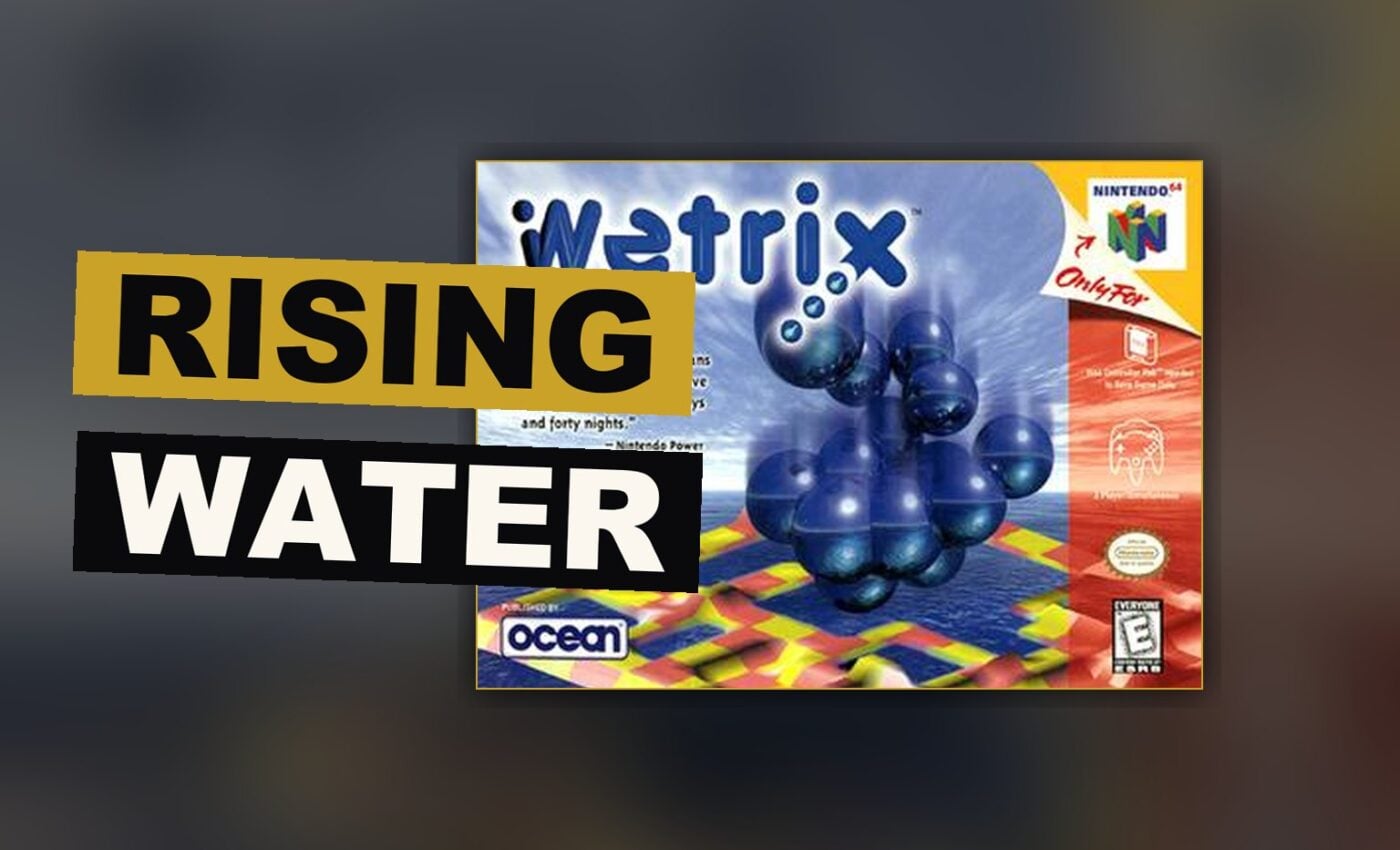
Wetrix asks a simple question and then spends hours making sure you never answer it easily. The puzzle game, developed by Zed Two and published by Ocean Software, arrived in 1998 for the Nintendo 64 and for personal computers. It drops you onto a square isometric landscape and hands you the job of catching water. Not fighting monsters, not racing cars. Catching rain.
The rain is the problem. A storm so fierce it keeps you indoors for six months, and if the water drains away, you lose. The premise is blunt. The execution is anything but.
Uppers, Downers, and a Water Meter
Wetrix works like this. Water bubbles fall from the sky. You build mounds to hold them. Uppers are the pieces that raise the ground, arriving as rectangles, squares, and T-shapes. They fall in a manner similar to Tetris blocks, which the source notes is the only real similarity between the two games. Downers do the opposite, lowering the landscape.
If a wall is missing, water seeps off the edge and into a drain. That drain is shown as a water meter. Fill it and the game ends.
Fireballs appear and can evaporate water. Vaporizing a lake earns points based on how much water you destroyed, and it also lowers the drain level so you can keep playing. That loop — build, catch, panic, evaporate, survive — is the whole engine of Wetrix.
Mines, Ice Cubes, and Earthquakes
Hazards fall alongside the water and wreck what you have built. Mines blast holes into the ground. Ice Cubes freeze the water. Earthquakes flatten the landscape once it gets too high.
Each one attacks a different part of your plan. A mine punches a hole where your wall used to be. An ice cube locks water in place so you cannot evaporate it. An earthquake erases the height you spent minutes building.
The result is a game that keeps interrupting your own good work. You are never finished. You are always repairing.
Classic, Pro, Practice, and the Challenge Modes
Wetrix ships with a real spread of modes.
- Classic, the standard game
- Pro, which speeds everything up
- Practice, which teaches the basic rules
- Challenge modes that end after a set time, including one minute and five minutes
- Challenge modes that must be survived within a number of pieces, including 100 and 500
- Handicap modes that start with a half-full water drain, an ice layer, Raised Land, Random Land, and Random Holes
That list matters more than it looks. A puzzle game lives or dies on whether it gives you a reason to come back after the first hour. Wetrix does.
The Two-Player Split Screen
The only multiplayer feature is a two-player split screen battle mode. The goal is the same as Classic, but the water meter is different. It has four colored spaces.
Where your water level sits determines which color space is active, and that decides what attack you can launch at the other player. The meter cannot be lowered by evaporating a lake with a fireball. That single rule changes the entire match. In single player, evaporation is your escape hatch. In the battle mode, it is gone, and you have to live with whatever you have built.
It is a small design decision with a large consequence, and it is the sharpest thing in the package.
Where Wetrix Came From
The Pickford brothers, Ste and John, built Wetrix out of a water demo they had worked on for another Zed Two game, the hack and slash Vampire Circus. The design focus was on how the basic elements interacted with each other, and on originality within the puzzle genre.
Zed Two signed a two-game deal with Ocean Software a week before Ocean merged with Infogrames. The deal required the brothers to turn Vampire Circus into Taz Express in 2000, while giving them free rein on Wetrix.
The PC version was made from January to October 1997 by the brothers themselves. The Nintendo 64 port was developed with three additional programmers from around June to Christmas 1997.
The Numbers Behind It
The Nintendo 64 version sold over 105,000 units in the West and just above 12,000 in Japan. The PC version sold 30,000 copies.
Those are modest figures. Wetrix was never a blockbuster. It asked players to think about drainage instead of spectacle, and the sales reflect a game that found an audience rather than a mass one.
The 1999 follow-ups went to the Dreamcast and Game Boy Color as Wetrix+ and Wetrix GB respectively. The idea had legs.
What Wetrix Gets Right
The core interaction is the whole game, and it holds up. Uppers and Downers are not just blocks. They are terrain, and terrain has consequences. Raise the ground in the wrong place and you have created a slope that sends water straight to the drain.
Fireballs are the smartest piece of the design. They are a resource, a scoring tool, and a safety valve at the same time. Spending one to save yourself costs you points. Spending one to score costs you safety. That tension never resolves, and it should not.
The hazards each break a different assumption. A mine removes ground. An ice cube removes your ability to evaporate. An earthquake removes height. The game keeps taking your work apart, and that is the point.
And the isometric bird’s-eye view is the right camera for it. You need to see the whole board, read the water’s path, and plan three moves ahead. Anything closer would have ruined it.
What Wetrix Gets Wrong
The learning curve is steep and the Practice mode does not fully solve it. Understanding that a Downer can be as useful as an Upper takes time.
The two-player mode is thin. One battle mode, split screen only, no more. That is the entire multiplayer offering, and for a game this good at spatial thinking, it is a small one.
The package is lean around a deep core. That is the trade.
The Case for Wetrix
In this paper’s view, Wetrix earns its 8.5/10 by doing one thing exceptionally well and refusing to dilute it. The water, the terrain, the fireballs, and the hazards form a closed system where every action has a cost. That is rare in puzzle games, which often pile on mechanics without asking what they take away.
The Tetris comparison gets made constantly, and it is a lazy one. Tetris is about clearing lines and managing speed. Wetrix is about managing space and managing risk. The falling blocks are the only shared idea, and Zed Two knew it.
Here is how the pieces rank, from the part that carries the game to the part that lets it down:
- The water-and-terrain system, which is the entire reason to play
- The fireball economy, which turns every rescue into a sacrifice
- The hazard set, which stops any single strategy from working
- The mode selection, which gives the solo game real length
- The split screen battle mode, which is good but far too small
What keeps Wetrix from a higher score is the thin multiplayer and the uneven onboarding. The single-player game is deep.
The best argument for Wetrix is that nothing else plays like it. The Pickfords built a puzzle game about hydrology and made it tense. The 1998 release is the one to play, on either platform it shipped on.
Get the Notebook.
The day's best stories and every fresh verdict, in plain English, in your inbox by seven. One email a day, no more.