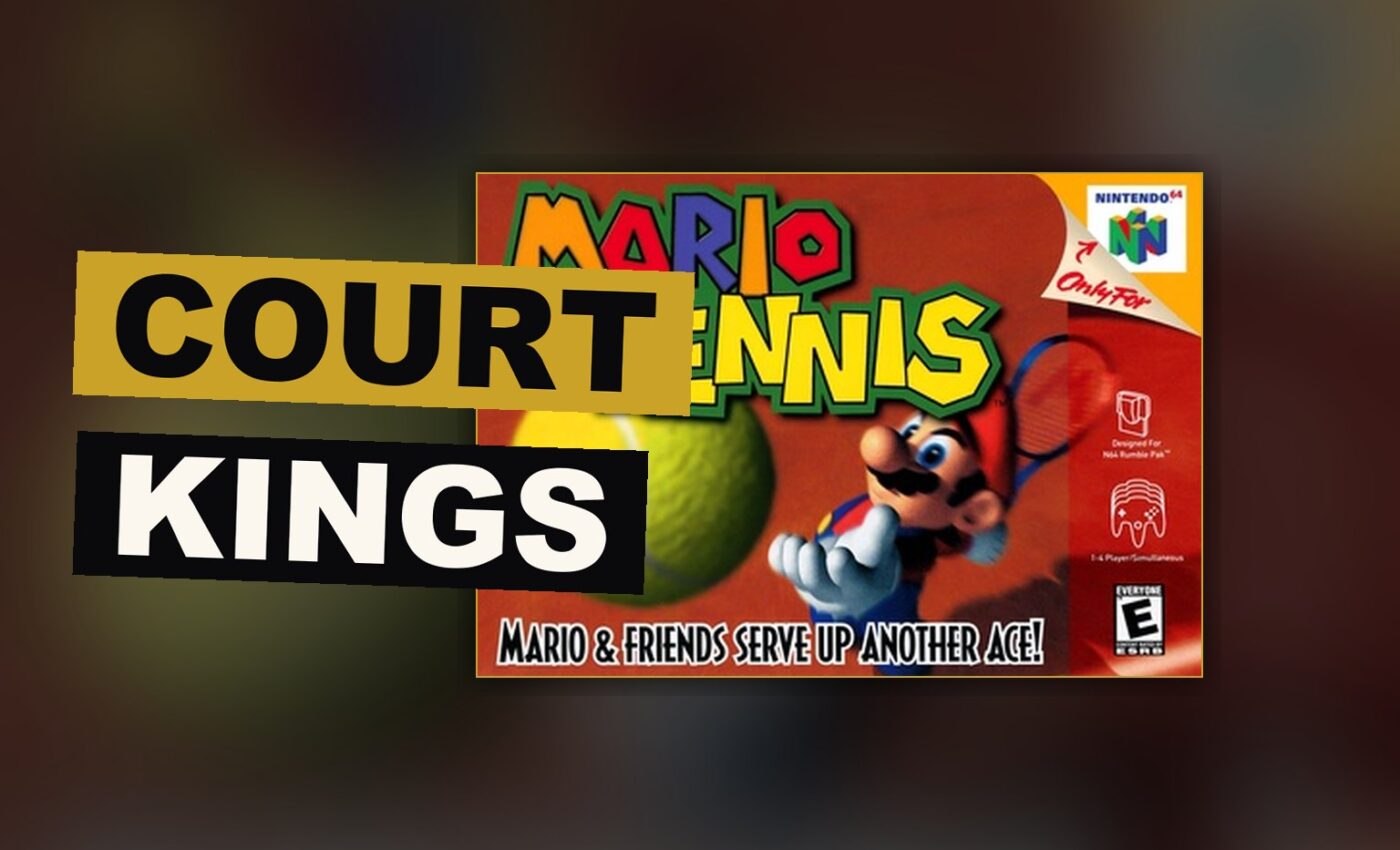
Mario Tennis landed on the Nintendo 64 in 2000, and it is still the cleanest argument for why a sports game does not need a season mode, a broadcast package or a licensed roster to work. Camelot Software Planning built it, Nintendo published it, and it is the second entry in the Mario Tennis series after Mario’s Tennis. It is also the game that introduced Waluigi and brought Princess Daisy and Birdo back into the fold.
A and B Do All the Work
The whole game rests on a control scheme that looks too simple to carry a full release. Shots come from one or both of the two main buttons, A and B, which apply different spin. Press a button twice and the shot gains power and spin. Press the two in a different order and you get a different shot entirely — a lob or a drop shot. Press both at once and you hit a smash.
Hold the button longer before contact and the shot lands harder. That is the entire vocabulary, and it produces seven distinct shot types.
The design does two things at once. New players learn the mechanics in minutes. Experienced players get a full spread of shots to build points around, which is why the system carried forward into later Mario Tennis games. Matches run as singles or doubles.
Ring Shot, Piranha Challenge and Bowser Stage
The Nintendo 64 version packs in more than a tennis game needs. Exhibition gives you a single basic match. Tournament mode runs singles or doubles elimination brackets against computer opponents, with higher difficulties unlocked each time you finish one. Certain tournaments, played with specific characters, unlock new characters and courts.
The side modes are where the game shows its range:
- Ring Shot, built around hitting the ball through rings scattered across the court
- Piranha Challenge, a single-player mode where three Piranha Plants spit out balls you have to return
- Bowser Stage, a bonus mode
The roster runs 14 players deep. Mario, Luigi, Bowser, Peach, Toad and Donkey Kong lead it off. The action moves fast, and the shots have names to match — vicious volleys, lobs, backhands and super-charged smashes.
A companion Game Boy Color version shipped under the same title worldwide, and as Mario Tennis GB in Japan. Camelot developed that one too, and it carries a story mode with role-playing elements the N64 release does not have.
Virtual Console and Nintendo Classics
Nintendo has kept Mario Tennis in circulation. The Nintendo 64 version came to the Wii Virtual Console in 2010, the Wii U Virtual Console in 2015, and the Nintendo Classics service in 2021. The Game Boy Color version hit the Nintendo 3DS Virtual Console in 2014 and Nintendo Classics in 2024.
Both branches got sequels. The N64 game was succeeded by Mario Power Tennis on the GameCube. The Game Boy Color game was succeeded by Mario Tennis: Power Tour on the Game Boy Advance.
Why the Two-Button System Still Holds Up
The reception at the time was critical acclaim, with praise for the gameplay, the depth and the amount of content. That holds up. Mario Tennis is not a game that hides a thin core behind a pile of modes — the core is the modes. Seven shots from two buttons is a real design achievement, and it is the reason the series still plays this way decades later.
The Game Boy Color version is the more interesting artifact for anyone who has already played the N64 game, because the story mode and role-playing elements make it a different thing wearing the same name. The N64 version is the one that matters, though. It is the one that introduced Waluigi and reset Daisy and Birdo, and it is the one whose control scheme every later entry inherited.
What makes Mario Tennis worth returning to is that nothing in it is filler. Ring Shot and Piranha Challenge are not padding bolted onto a tournament mode; they are ways to practice the shot system under pressure. Tournament mode gives the unlocks a reason to exist. The 14-player roster gives you a reason to keep playing tournaments with characters you would not otherwise pick.
The one thing to note is that the Game Boy Color companion is not a port. It is its own game with its own structure, and treating the two as interchangeable will leave you confused about which one has the story mode. They are separate releases with separate sequels.
Mario Tennis earns its place as the second game in the series and the template for everything after it. It is fast, it is deep where it counts, and it respects the player enough to teach them everything with two buttons.
Get the Notebook.
The day's best stories and every fresh verdict, in plain English, in your inbox by seven. One email a day, no more.