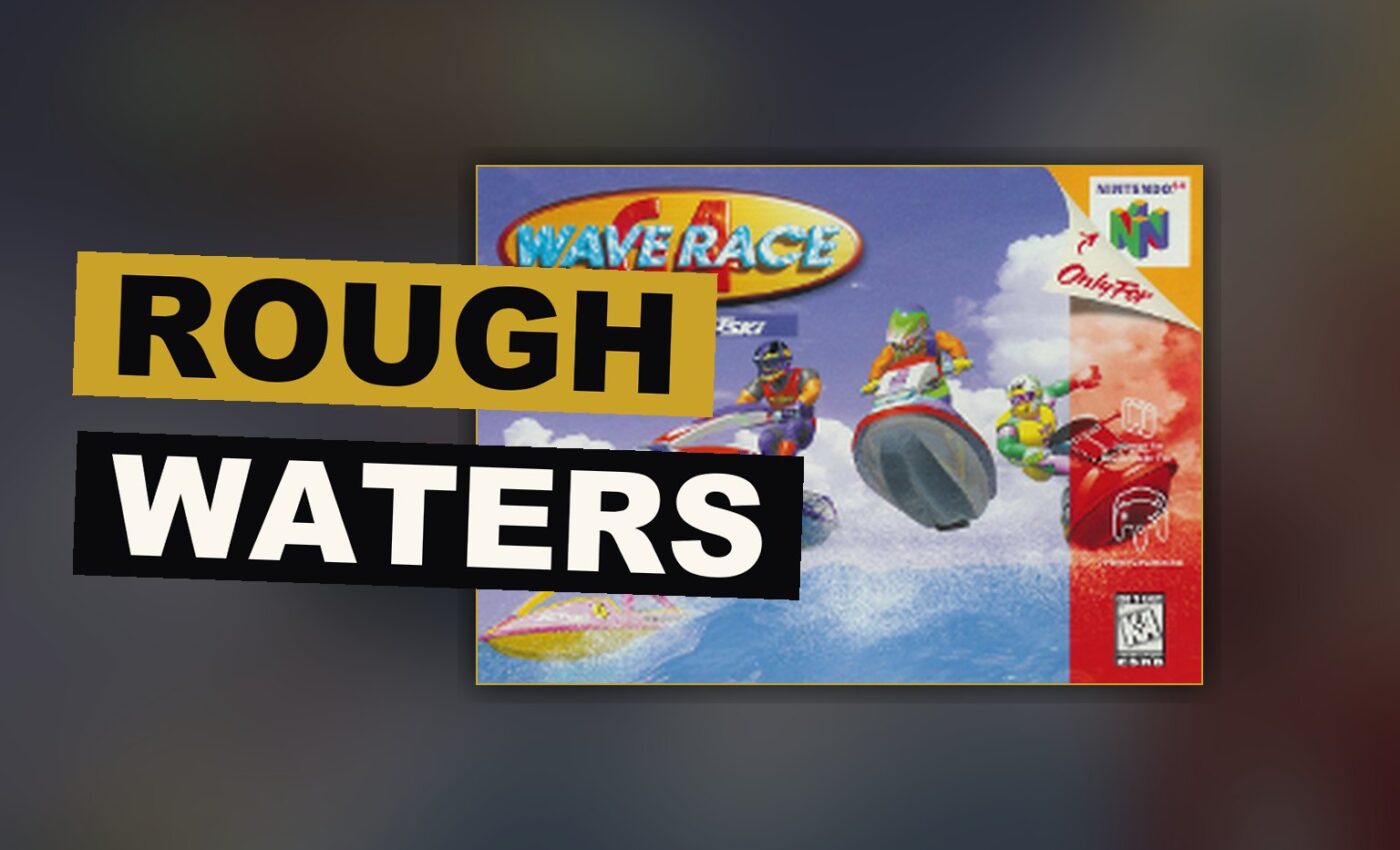
Wave Race 64 puts you on a Jet Ski, and the water does most of the talking. Nintendo’s 1996 racer for the Nintendo 64 turns open water into a moving track, where the surface under you shifts with every wave and every rival. It is the second entry in the Wave Race series, following the 1992 Game Boy game Wave Race, and it remains the one that set the terms for everything after it.
Buoys, Power Arrows, and the Rules of the Water
The core mechanic is simple to state and hard to master. Players race personal watercraft around courses marked by buoys, and the buoys are not decoration. Red buoys must be passed on the right side. Yellow buoys must be passed on the left. Get one right and a power arrow in the HUD lights up, giving your craft more speed. Light all five and you have maximum power.
Miss a single buoy and you lose every arrow you have earned. You can light them again one by one, but the race does not wait. Miss five buoys across a race and you are disqualified. Drift outside the course area marked by pink buoys for more than five seconds and you are disqualified too. The punishment is harsh, and that is the point.
Championship, Time Trials, and Stunt Mode
Wave Race 64 offers three single-player modes: Championship, Time Trials, and Stunt Mode. Championship is the main event. You race opponents through a series of courses and need first place. Four difficulty levels exist — Normal, Hard, Expert, and Reverse. Reverse is Expert with the tracks run backwards, and Hard, Expert, and Reverse must be unlocked by finishing an earlier difficulty.
Difficulty also sets the length of the season. Normal runs six courses, Hard runs seven, and Expert and Reverse run eight. Points come from your finishing rank, and if you do not meet the required total, you are disqualified and the game is over. A multiplayer mode lets two players compete on a chosen course, and the game supports the Controller Pak for moving saved data between cartridges.
Where the Water Fights Back
The courses are set in exotic locales, and the race conditions change as you go. The wave action responds to how you and your opponents race. That single design choice is what separates Wave Race 64 from a standard racer. The track is not a fixed ribbon of asphalt. It is a surface that reacts, and reading it becomes as important as steering.
The game is presented in a letterboxed 14:9 aspect ratio, a small detail that gives the action a wider frame than the standard television image of its era. Wave Race 64 was originally referred to as “F-Zero on water,” and the plan called for high-speed boats with transforming capabilities. Those boats were replaced with Jet Skis. Producer Shigeru Miyamoto felt the game would not be differentiated enough from other titles on other systems.
Originally referred to as “F-Zero on water”
That call looks correct in hindsight. The Jet Ski is low to the water, and the camera sits close enough that every swell reads as a physical obstacle. A transforming boat would have put a machine between the player and the sea. The Jet Ski puts the player in it.
Why the Water Still Matters
Wave Race 64 received acclaim from critics, who praised the game’s satisfying controls and dynamic watery environments and considered it one of the best games ever made. It holds a 9.2/10 on Metacritic. That score is not nostalgia talking. The controls are the reason the game holds up: they are responsive enough that a missed buoy feels like your error, not the game’s.
The game is credited with helping Nintendo make its paradigmatic leap from the 16-bit 2D graphics of the Super Nintendo Entertainment System to the Nintendo 64’s 3D capabilities. That is a large claim for a racing game, but the water is the evidence. Rendering a surface that moves, reflects, and shoves your craft around was not a given in 1996. Wave Race 64 made it look easy.
Nintendo has kept the game available. It was re-released for the Wii and Wii U’s Virtual Console in 2007 and 2016, respectively, and on the Nintendo Classics service in 2022. A sequel, Wave Race: Blue Storm, came to the GameCube in 2001. The series has been quiet since, which is a shame given how well the original’s ideas have aged.
The buoy system deserves the credit it rarely gets. It converts a race into a test of line and discipline. Speed is a reward for precision, not a thing you simply hold down. Lose your arrows and you feel it immediately, because the craft that was flying a moment ago is suddenly heavy. Few racers of the era tied their speed so directly to their handling.
The difficulty curve is honest about what it wants. Unlocking Hard, Expert, and Reverse means the game expects you to finish what you started. Disqualification for missing five buoys sounds brutal until you realize the rule is what makes clean racing worth anything. A forgiving version of this game would be a worse one.
Wave Race 64 is not a perfect game. Its content is thin by modern standards, and the single-player structure is a ladder rather than a world. But the thing it does — making water a live opponent — it does better than almost anything since. The wave action still responds to how you race. That is the whole idea, and it still works.
Get the Notebook.
The day's best stories and every fresh verdict, in plain English, in your inbox by seven. One email a day, no more.