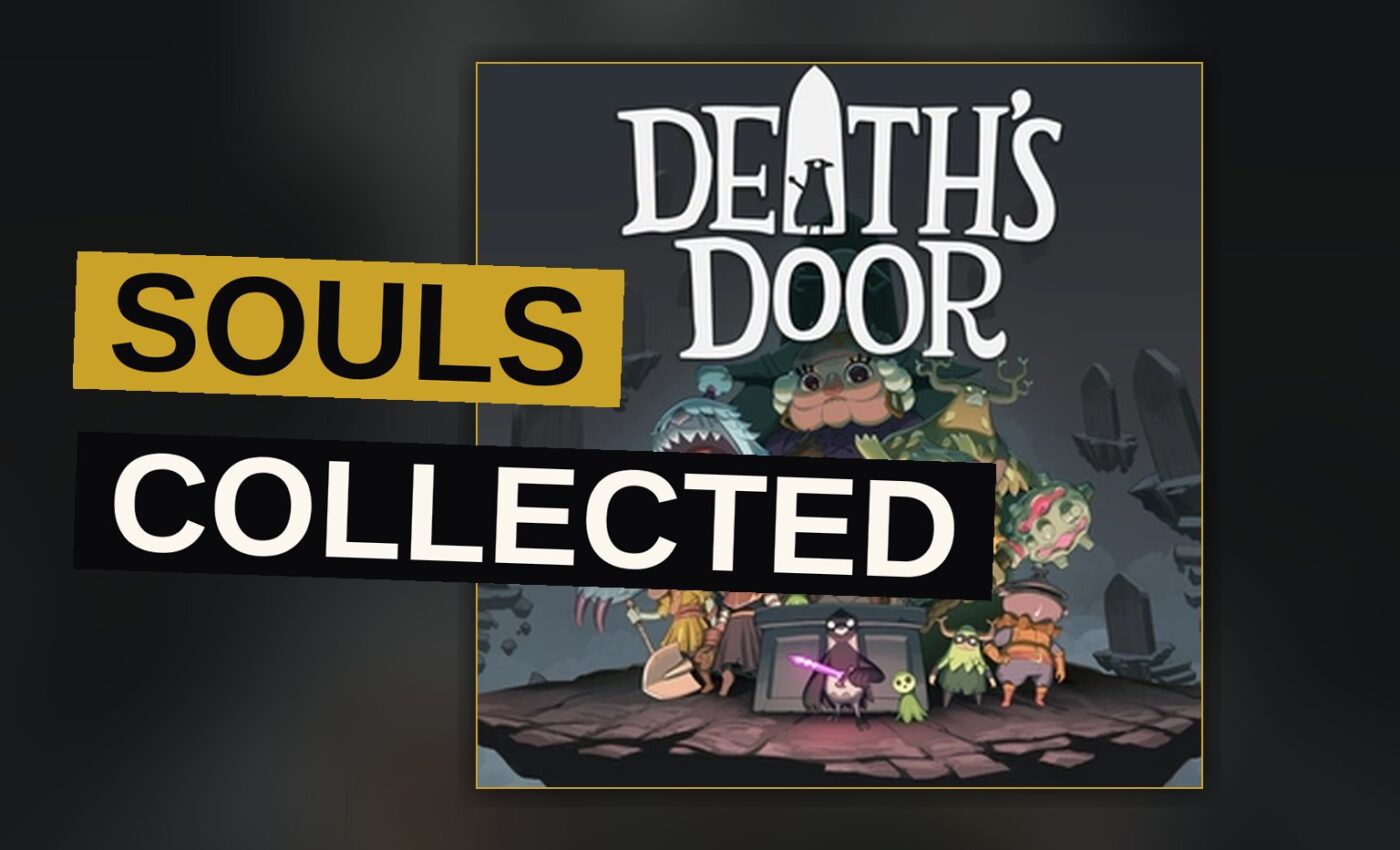
Death’s Door opens with a small crow doing paperwork. That is the joke Acid Nerve builds its whole game on, and it is a good one. The crow works as a reaper for the Reaping Commission Headquarters, an office-like bureaucratic afterlife, and his first assignment is to collect the soul of a monster who does not want to go quietly. He kills it. A large, old crow swoops in, steals the soul, and warns him that other crows have been disappearing. From there, Death’s Door sends you through three dungeons to collect three Giant Souls, the keys you need to open the door of the title.
Trailer, via DevolverDigital.
A crow, a sword, and three dungeons
The pitch is Zelda with a sharper edge and a shorter temper. Death’s Door is a 3D isometric action-adventure game. You start with a sword and a bow and arrow. Sword strikes chain into combos, and every swing of the blade refills your ammo, so the loop never lets you stand still and plink from a distance. Four other weapons and three magic projectiles unlock as you go, but the basic attack mechanics do not change. That restraint is the point.
You begin with four health points, six in the mobile version. Every hit costs one. Health comes back by collecting and planting seeds in pots scattered across the world; the seeds grow into plants that restore full health and eventually regrow. Doors to and from the afterlife act as checkpoints. When you die, you respawn at the nearest door and lose nothing else. Souls are the currency, earned by killing enemies and finding secret pick-ups, and you spend them on upgrading your basic abilities.
The Reaping Commission’s real business
The story is where Death’s Door earns its keep. The old crow tells the player to work through three dungeons and collect three Giant Souls to open Death’s Door. Each area links back to Headquarters through a door, so the game keeps folding you back into the office between excursions. You beat three bosses, take their Giant Souls, and open the door.
What waits behind it is the best idea in the game. The bureaucracy was created when Death made an arrangement with the first Lord of Doors: the Commission would process souls on Death’s behalf, and in exchange the Lord of Doors would live until they appointed a successor. The current Lord did not appoint one. Instead, they imprisoned Death behind the door to keep their own immortality. The final boss is the Lord of Doors. Beat them and the bureaucracy comes apart.
Souls as currency, doors as save points
Death’s Door understands that a checkpoint is a promise. Every door you pass through is a place the game will return you to, and the game never punishes you beyond the walk back. No lost souls, no dropped currency, no corpse run. For a game that borrows so openly from Dark Souls, that is a deliberate softening, and it is the right call. The difficulty lives in the fights, not in the bookkeeping.
The combat asks you to keep moving. Your bow is only as good as your last sword swing, so retreating to range means earning the arrows first. Dodging matters. New items and abilities open routes in levels you have already cleared, and dungeons require you to solve puzzles with whatever tools you are carrying. That structure will be familiar to anyone who has played a Zelda game, and Death’s Door does not pretend otherwise. It just executes the pattern with fewer wasted steps.
What the reviewers got right
Death’s Door drew positive reviews on release. Several publications praised its mechanics, its simplicity, and its difficulty level, comparing it to The Legend of Zelda and Dark Souls. That comparison is accurate, and it undersells the tone. The game is funny about death in a way neither of its reference points is. A crow filing soul paperwork is a better joke than either franchise has managed.
It is also a sequel to Titan Souls, Acid Nerve’s earlier game. That history shows. Death’s Door is a studio taking a sharp idea and giving it room to breathe, and the result is tighter than most games twice its length.
Release schedule and platforms
| Date | Platform |
|---|---|
| July 20, 2021 | Microsoft Windows, Xbox One, Xbox Series X/S |
| November 23, 2021 | Nintendo Switch, PlayStation 4, PlayStation 5 |
| December 4, 2023 | Android, iOS (Netflix subscribers) |
Devolver Digital published the game. Netflix published the mobile ports, which arrived on Android and iOS on December 4, 2023, for Netflix subscribers. The mobile version hands you six health points instead of four, a quiet acknowledgement that touch controls are not a gamepad.
The numbers behind Death’s Door
- Developer: Acid Nerve
- Publishers: Devolver Digital, Netflix
- Released: July 20, 2021 (Microsoft Windows, Xbox One, Xbox Series X/S); November 23, 2021 (Nintendo Switch, PlayStation 4, PlayStation 5); December 4, 2023 (Android, iOS)
- Genres: Action-adventure, RPG, hack and slash, indie
- Modes: Single player
- Perspective: Third person, isometric
- Starting health: 4 points (6 on mobile)
- Critic aggregate: 8.7/10 from 11 outlets
Night mode and the Tablets of Knowledge
After the credits, Death’s Door is not finished with you. The player can switch to night mode and solve puzzles in each of the levels to collect Tablets of Knowledge. Collect them and you unlock the true ending, which reveals that the crows were acting on the will of an entity called Truth. It is a strange, ambitious swing for a game that already told a complete story about a bureaucracy that refused to die.
The true ending reframes the whole campaign. The Reaping Commission is not just a joke about office work. It is a machine with an owner, and the owner has an owner too. Death’s Door does not spell that out, and it does not need to. The Tablets are optional. The game trusts you to go looking.
Our verdict
Death’s Door is the rare game that knows exactly how long it should be. Three dungeons, three Giant Souls, one door. The combat never bloats into a skill tree, the world never opens into an empty map, and the checkpoint system never turns death into a chore. Acid Nerve built a small, sharp thing and refused to pad it.
The comparisons to Zelda and Dark Souls are fair but incomplete. Death’s Door takes Zelda’s structure and Dark Souls’ difficulty and then does something neither does: it makes death administrative. The Lord of Doors is not a demon or a god. They are a bureaucrat who found a loophole and kept their job forever. That is a sharper villain than most games manage, and the final fight lands because the idea behind it lands first.
Where Death’s Door falls short is in the middle. The three dungeons are strong, but the game’s best ideas are saved for the ending and the optional night mode content. The four-weapon, three-projectile upgrade path adds options without changing how you play, and the basic attack mechanics stay fixed from the first hour to the last. That is a design choice, and a defensible one, but it means the game’s ceiling is set early.
None of that changes the verdict. Death’s Door is a confident, funny, well-built action-adventure game from a studio that knows its own strengths. The mobile version’s extra health is a small mercy for a version that needs it. The true ending is worth the extra work. And the crow with the paperwork is worth the price of entry on its own.
Get the Notebook.
The day's best stories and every fresh verdict, in plain English, in your inbox by seven. One email a day, no more.