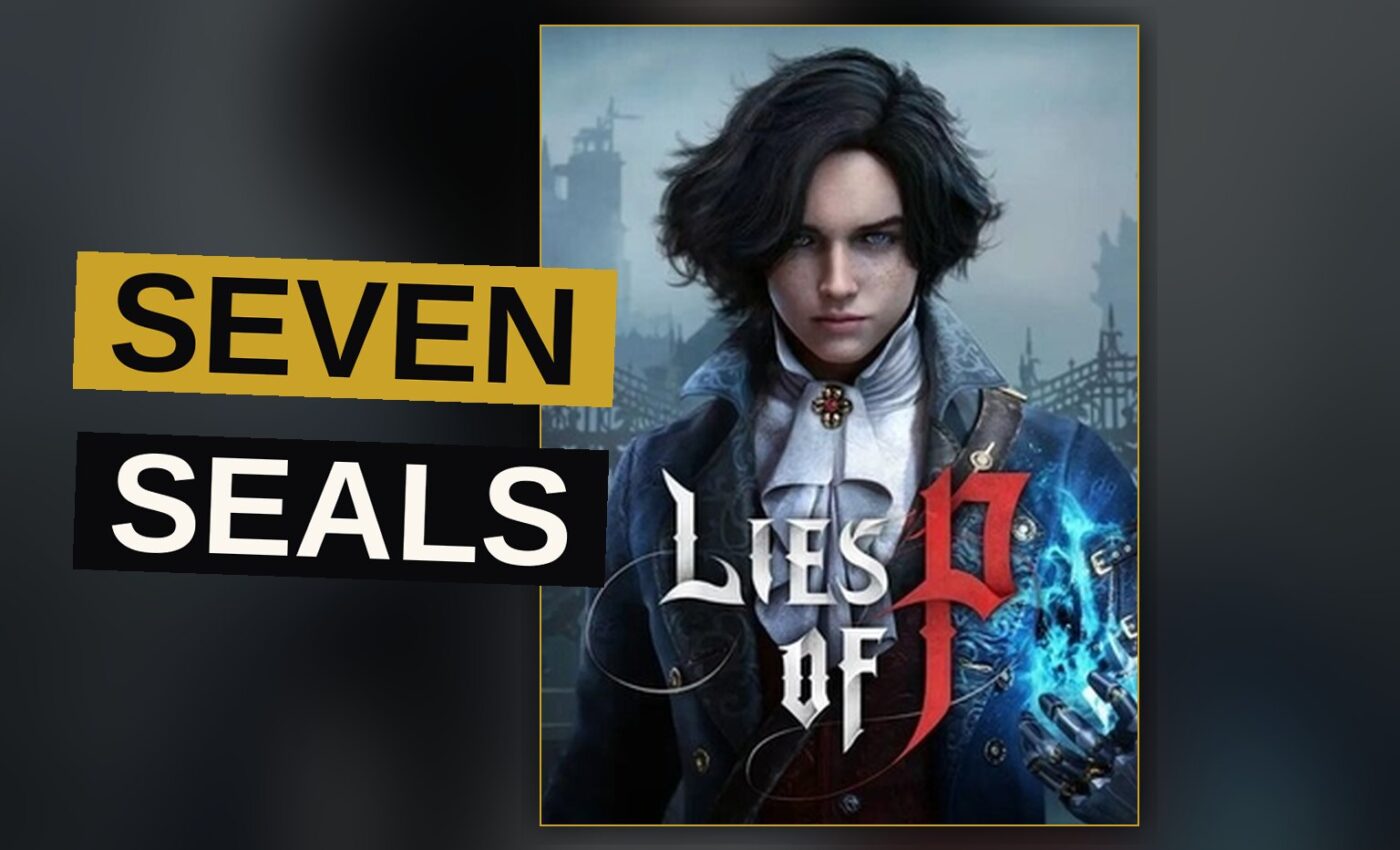
Lies of P asks a simple question: what if the Book of Revelation were a fighting game? That sounds like a joke, but the game actually builds a whole world around it, and it mostly works. Developed by Neople, published by Krafton, and released for Series X|S, PS4, PC, and PS5, Lies of P drops players into a city built from the seven seals of the apocalypse, each district ruled by a faction of angels and demons. The result is a strange, beautiful mess that rewards curiosity and punishes hesitation.
Trailer, via Gematsu.
The Seven Seals
The city is the star. Each seal represents a district, and each district has its own look, its own factions, and its own lore. Players wander through a cathedral district, a marketplace, and a ruined palace, all rendered in a painterly style that blends fantasy and horror. The lighting is spectacular, and the scale is huge. Characters stand tall against towering buildings, and the world feels lived-in even when it is empty.
Movement is fast. Players dash, jump, and glide between platforms, and the city is designed to encourage exploration. Side quests and hidden collectibles fill every corner, and the map is dense enough to justify wandering for hours. The main story follows a young man who wakes up with no memory, pursued by angels and demons who want to use him as a pawn in their war. It is a thin setup, but it gives the player room to explore without feeling railroaded.
Combat and Choices
Combat is the heart of Lies of P, and it is where the game shines brightest. Players build a team of three characters, each with their own skill tree, and switch between them in real-time. Attacks chain together, combos break enemies apart, and the screen fills with light and blood. The action is fluid, and the controls respond well, even on the PS4 version, which runs at a lower resolution than the other platforms.
The combat system rewards aggression. Enemies telegraph their attacks clearly, and players who wait to act get punished. This can feel harsh at first, but it teaches players to read the battlefield quickly. Boss fights are memorable, especially the angelic bosses that summon waves of lesser foes while hitting hard themselves. These fights test everything the player has learned about positioning and timing.
Choices matter, but not in the way some games promise. Players can side with angels or demons, and their decisions affect dialogue and some story beats. However, the branching paths are limited, and the final outcome is more about style than substance. A player who picks one side rarely sees a dramatically different ending. The game is more interested in letting players express themselves through their teams and their playstyle than in crafting a deep moral tale.
The Skill Trees
Skill trees are where the depth hides. Each character has a unique set of abilities, and players spend experience points to upgrade them. Some upgrades increase damage, some reduce cooldown, and some open up new moves. The system is complex enough to reward study, but it never feels overwhelming. Players can specialize a character for a particular role or keep them balanced, depending on how they want to fight.
The game also includes a parry system. Enemies attack with glowing tells, and players can block or dodge to avoid damage. This adds a layer of risk-reward to every encounter. Blocking costs stamina, and dodging leaves players open for follow-up attacks. It is a small mechanic, but it changes how fights play out. Players who master it can walk through hordes unscathed, while those who ignore it get punished.
The City’s Factions
The factions add texture to the world. Angels represent order, demons represent chaos, and humans represent neutrality. Players can join either side, and their allies will fight for them in battles. These factions also control the districts, and players must navigate their politics to complete missions. A demon ally might help a player sneak past an angel guard, while an angel ally might offer a secret passage through a walled area.
The relationships are simple, but they give the city a sense of life. NPCs react to the player’s reputation, and their dialogue changes based on past actions. A player who has sided with demons might hear snide remarks from angel guards, while a player who has sided with angels might be treated with suspicion by demon merchants. It is a small touch, but it makes the world feel less static.
Performance Across Platforms
Performance varies across platforms. The Series X|S and PC versions run at a higher resolution and frame rate than the PS4 version, which shows its age. The PS5 version sits somewhere in between, offering a smooth experience but with slightly reduced visual fidelity. Load times are short on all versions, and the game rarely stutters during combat.
The game is demanding on older hardware, though. Long waits between areas can frustrate players who are used to faster transitions. On the Series X|S and PC, the visuals are stunning, with detailed environments and character models that hold up in close inspection. The game looks best on these platforms, but it is playable on all of them.
The Sound Design
The music is a highlight. The score mixes orchestral pieces with electronic beats, creating a tense atmosphere that fits the apocalyptic setting. The sound design is just as strong, with enemy roars, weapon clangs, and ambient noises that make the city feel alive. The voice acting is solid, though some lines are delivered with a flat cadence that can feel rehearsed.
The game’s presentation is consistent across its systems. The audio and video work together to create a cohesive experience, even when the hardware underneath is different. The sound design carries the weight of the world-building, giving players a sense of dread even when the screen is quiet.
The Final Word
Lies of P is not a perfect game, but it is a confident one. It trusts players to explore, to experiment with its systems, and to find their own path through its many districts. The combat is thrilling, the world is gorgeous, and the story, while thin, never drags. It is a game that rewards curiosity and punishes hesitation, and that balance is rare.
Some players will find the difficulty curve too steep, and others will feel the story lacks depth. Those criticisms are fair, but they do not undercut the core experience. Lies of P is a game about spectacle, and it delivers on that promise.
Key Facts Box
– Developer: Neople
– Publisher: Krafton
– Platforms: Series X|S, PS4, PC, PS5
– Release Date: 2023
– Critical Score: 8.5/10
Lies of P earns an 8.5 of 10.
Get the Notebook.
The day's best stories and every fresh verdict, in plain English, in your inbox by seven. One email a day, no more.