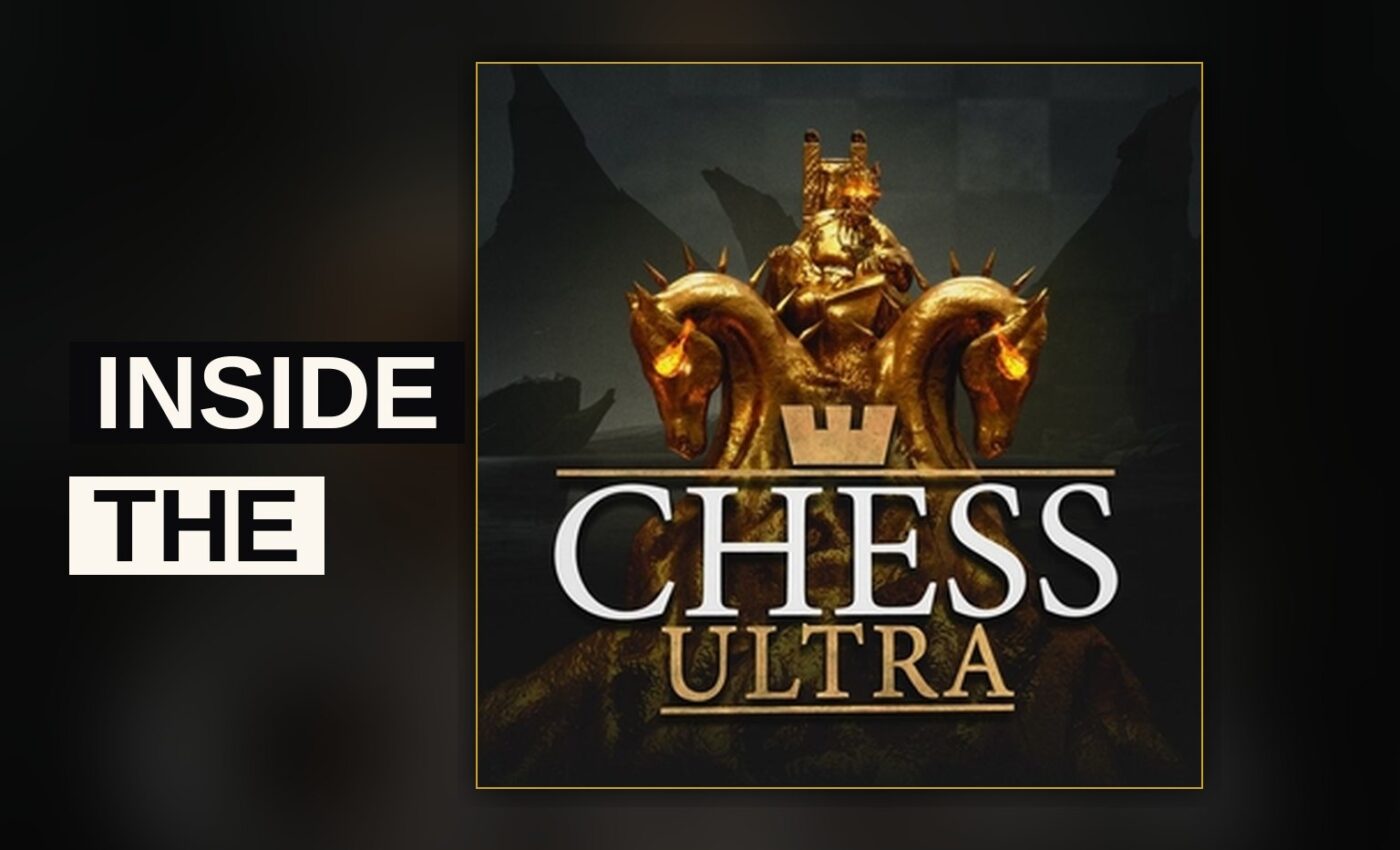
Chess Ultra is not a standard chess game. It is a full virtual reality experience built around a chessboard, one that can be played solo or online, with a board that moves and changes shape as you play. The game launched in 2017 for PS4, PSVR, PC, and Steam VR, and it asks players to step inside a chessboard and move pieces through a series of puzzles, battles, and strategic contests.
The premise is simple: you enter a chessboard, pick up a piece, and move it. But the execution adds layers that make it stand apart from a regular chess app. The board itself is the star, shifting and folding into new shapes as you progress. It is a clever idea, and it works far better than it has any right to.
Inside the Board
The core of Chess Ultra is its setting. The chessboard is not flat. It bends, folds, and twists into a series of connected rooms and chambers, each shaped like a different chess piece. The white squares become walls, the black squares become floors, and the whole thing feels less like a game and more like a puzzle box you have to walk through.
Each stage is a new arrangement of the board. The visual style is clean and geometric, with a bright color palette that makes it easy to follow where you are in the maze.
The puzzles are simple at first but grow harder quickly. They ask you to move pieces across gaps, solve timing challenges, and navigate narrow paths while avoiding obstacles. The difficulty curve is gentle at the start and steepens sharply once you reach the later stages.
Pieces as Tools
Every piece in Chess Ultra has a distinct ability. Knights can jump over obstacles. Rooks slide along straight lines. Bishops move diagonally. Pawns push forward in a straight line. Each one behaves like its real-world counterpart, but the VR setting means you are actually moving your hands through the space to make those moves happen.
That physical interaction is where the game earns its keep. Moving a piece by hand feels natural in a way that a standard chess app never can. You reach out, grab a piece, and pull it across the board. The game tracks your movements with precision, and the pieces respond instantly to your commands.
The controls are intuitive. There is no complex menu system to learn, and the game rarely interrupts your flow with text boxes or prompts. You simply pick up a piece and move it, and the game responds. It is a smooth loop that holds up well over long sessions.
Multiplayer Mode
The multiplayer mode is where Chess Ultra gets ambitious. Players can join matches against each other in real time, and the board itself becomes a shared space. The game supports both ranked and casual play, and the lobby system is easy to use.
The matchmaking works well. You can find a game within seconds, and the server performance holds up even during peak hours. The game handles latency smoothly, and there is little to no visible lag between your opponent’s moves and your screen.
The competitive side is where some players may find the game lacking. The ranked system is present but thin, and there is not a great deal of depth beyond the basic win-loss record. The game also lacks a spectator mode, which means you cannot watch other players in action or learn from their strategies.
Single Player Campaign
The campaign mode is built around a series of puzzles and battles. You face off against AI opponents in timed challenges, and the difficulty ramps up steadily. The campaign is shorter than the multiplayer mode, but it offers a solid introduction to the game’s mechanics.
The campaign also introduces new rules and variations on the standard chess format. Some levels add extra pieces, others remove them entirely. One level forces you to play blind, relying only on sound cues to guide your moves. These variations keep the campaign from feeling repetitive.
The puzzles are the highlight of the campaign. They require you to think several steps ahead, and the solutions often involve moving multiple pieces in sequence. The game rewards patience and planning, and the satisfaction of solving a difficult puzzle is high.
Performance and Technical Details
Chess Ultra runs well on all its platforms, though the VR version is clearly the best way to experience it. The PSVR version is smooth and stable, with no noticeable frame drops during gameplay. The PC and Steam VR versions offer higher resolution and more detailed visuals, but the core experience is identical.
The game supports a wide range of VR headsets, and the compatibility settings are extensive. You can adjust the field of view, the render distance, and the controller sensitivity to fit your hardware. The game also includes a calibration tool that helps you set up your headset properly.
The audio design is subtle but effective. The game uses ambient sound to reinforce the environment, and the piece movement sounds are distinct enough to identify which piece you are handling. The music is light and unobtrusive, which is the right call for a game about focus.
Why VR Works Here
The reason Chess Ultra succeeds is that it turns a passive task into an active one. In a standard chess app, you tap a square and a piece moves. In Chess Ultra, you reach out, grab a piece, and pull it across the board. That difference is small but meaningful.
The game tracks your movements with precision, and the pieces respond instantly to your commands. There is no complex menu system to learn, and the game rarely interrupts your flow with text boxes or prompts. You simply pick up a piece and move it, and the game responds. It is a smooth loop that holds up well over long sessions.
The Verdict
Chess Ultra is a strong VR game that succeeds because it takes a familiar concept and rebuilds it from the ground up. The board itself is the star, and the puzzles it generates are consistently engaging. The multiplayer mode is solid, and the campaign is a pleasant addition.
The game is not perfect. The competitive side could use more depth, and the lack of a spectator mode is a missed opportunity. But the core experience is so well executed that these flaws are easy to overlook.
The game’s success comes down to a single insight: the physical act of moving a piece by hand is more satisfying than any virtual interface can replicate. Chess Ultra captures that feeling and builds an entire game around it.
| Feature | Detail |
|---|---|
| Platforms | PS4, PSVR, PC, Steam VR |
| Genre | VR strategy, puzzle |
| Developer | Dream Reality Interactive |
| Publisher | Bigben Interactive |
| Release Year | 2017 |
Chess Ultra is a game about being inside a chessboard. It is a clever, engaging experience that rewards patience and planning. The puzzles are varied, the controls are smooth, and the multiplayer mode is reliable. It is not a revolutionary game, but it is a very good one.
Get the Notebook.
The day's best stories and every fresh verdict, in plain English, in your inbox by seven. One email a day, no more.