
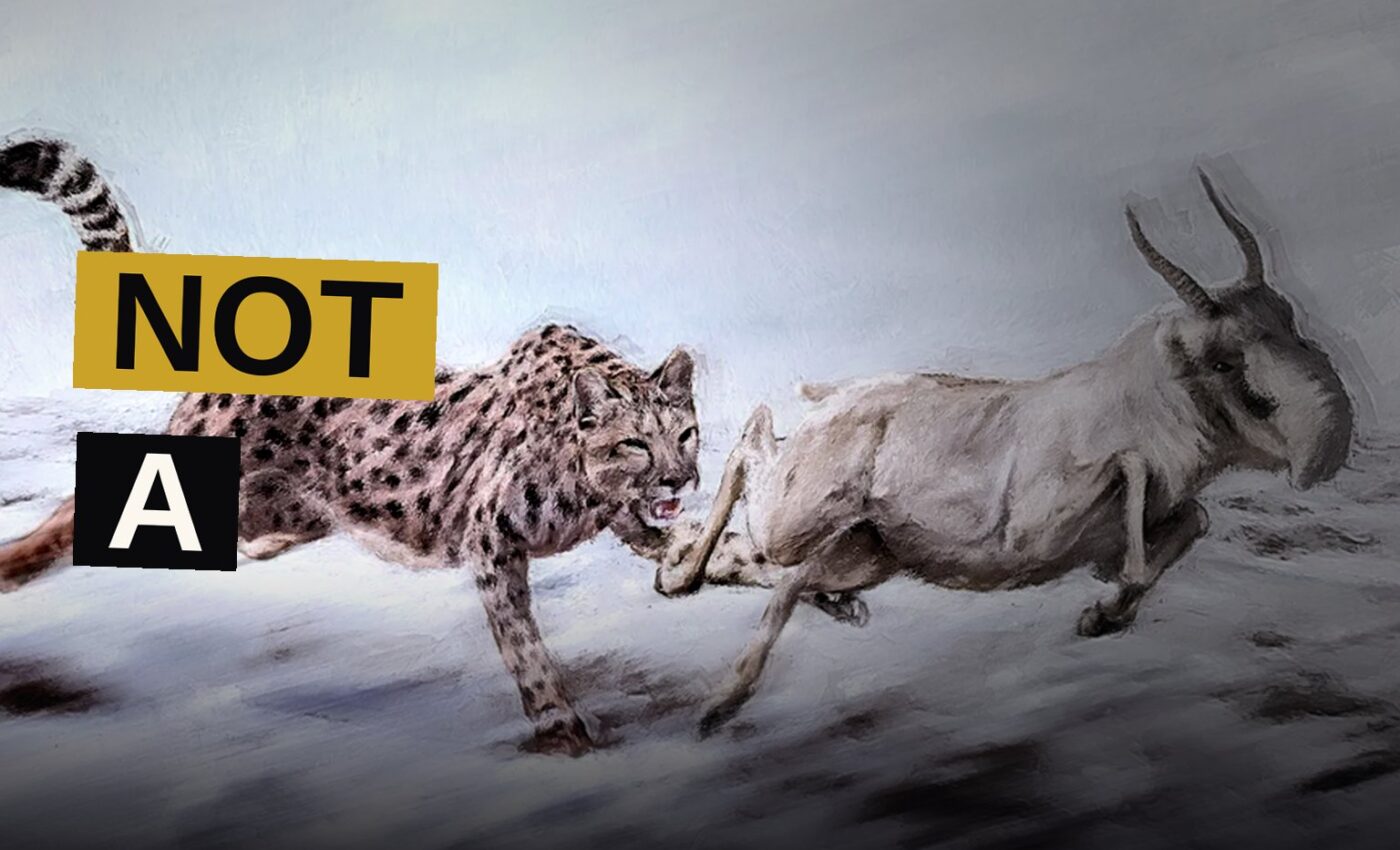
The American “cheetah” wasn’t a cheetah at all. New research shows the extinct predator known by that name was actually a close relative of the mountain lion, with a far more flexible way of life than researchers once thought.
A group of scientists led by researchers at the University of California, Santa Cruz, conducted an analysis of ancient nuclear genetic material and stable isotopes to examine Miracinonyx trumani, the creature commonly known as the American cheetah. Their work demonstrates that the animal was not a genuine cheetah but instead a close relation of the mountain lion, with northern populations seeming to depend heavily on fish for survival in Arctic regions.
Published on September 4, the research appeared in Current Biology and pushed back the known range of the species by roughly 20 degrees of latitude farther north than had been documented before.
Rethinking the American Cheetah
The predator known as Miracinonyx trumani was long a central figure in accounts of Ice Age North America, with researchers frequently citing it as a possible explanation for the remarkable swiftness of the American antelope.
The “ghosts of predators past” idea holds that an antelope gained great speed because it dwelt near a cheetah-like hunter able to chase at full velocity. In this account, its swiftness served as a defense against a hunter that eventually disappeared.
The genetic evidence now redraws the picture. Scientists have established that Miracinonyx trumani was a sister species to the modern mountain lion, splitting off from its lineage around 2.6 million years ago. That slender, “cheetah-like” build thus seems to be a plain instance of two distinct branches responding to similar forces by becoming alike.
A Sister Species of the Mountain Lion
At the core of the new findings is the genetic connection between Miracinonyx trumani and the mountain lion, which split from a shared lineage some 2.6 million years ago.
The division shows that the American cheetah’s form did not come from true cheetahs. It developed its own way, shaped by wide, open lands that favored swift motion. Nature tends to repeat its own patterns.
Molly Cassatt-Johnstone, a Ph.D. candidate in the Paleogenomics Lab at UC Santa Cruz and lead author of the study, described the ancient cats as highly flexible, much like mountain lions are across their range today. She pointed to broken genes tied to daily rhythms as evidence that the animals may have adapted to the extreme light cycles of far northern summers and winters.
What the Animal Looked Like
Scientists believe the adult Miracinonyx trumani weighed roughly 150 pounds, reached a height of about 3 feet, and had a body length of approximately 8 feet from head to the end of the tail. The animal’s slender build and elongated forelimbs likely aided its movement across the open landscapes of Pleistocene North America.
These cats looked a great deal like modern cheetahs, with a body shape that would be familiar to anyone who has seen one. However, fresh research points to a far more varied hunting style than that alone might suggest. Rather than being limited to running down prey on open ground, they appear to have been able to chase it over land while also holding onto it with powerful forelegs.
Genetic Clues to Arctic Survival
Researchers sequenced whole genomes from ancient remains that date back between 23,000 and 31,000 years to study how the species thrived across such different settings. The genomic data revealed traits that could have aided northern populations in handling the harsh Late Pleistocene environment.
The fossil specimens came from traditional lands within Yukon Territory, where they were gathered with due regard for the long-standing bond between local communities and their ancestral homelands.
The Sour Taste Discovery
The genetic research uncovered an odd characteristic: Miracinonyx trumani and all the cat lines examined carried a broken gene for sensing sour flavors.
Sour taste gene losses have not been recorded before in cats, and this is the first case of such a loss being documented. Cats are already well known for their lack of fondness for sweet flavors, which makes this discovery stand out. The gene losses in question have also been tied to very narrow diets in other species, much like similar cases found elsewhere.
A Tale of Two Diets
The species filled very different roles across its range.
On the temperate plains of Wyoming and Florida, Miracinonyx trumani hunted as a general predator. But in the Arctic Yukon, the situation changed entirely: there the cats probably preyed upon fish, including salmon, rather than hunting other land animals.
| Trait | Southern groups (Wyoming, Florida) | Northern groups (Arctic Yukon) |
|---|---|---|
| Land | Temperate plains | Arctic places |
| Food | General hunting on land | Fish such as salmon |
| Role | Hunting on land | Feeding on fish |
Professor Matthew Wooller, who co-authored the research and teaches in the College of Fisheries and Ocean Sciences at the University of Alaska Fairbanks (UAF), described the species’ enormous range stretching from the Arctic to the Lower 48. He framed the species as possessing exceptional abilities at both ends of its habitat, with entirely distinct food sources supporting those populations.
Low Genetic Diversity Before Extinction
These findings point to fresh evidence regarding the extinction of Miracinonyx trumani at the close of the Pleistocene. Scientists discovered a reduced genetic variety among creatures from both Wyoming and the Yukon.
These groups of ancient cats did not display any evidence of breeding closely with their close relatives or of sudden population crashes. The genetic record suggests instead a gradual decline that persisted from the early Pleistocene all the way through the late Pleistocene. That extended reduction could account for why fossils of the species are rare and why the cats became more vulnerable to extinction.
Beth Shapiro, who holds the position of professor of ecology and evolutionary biology at UC Santa Cruz and serves as co-director of the Paleogenomics Lab, is the senior author behind the research. She argued that low genetic diversity on its own did not doom the species. Instead, she pointed to Miracinonyx trumani, which endured for a very long time without showing the close-kin breeding patterns that usually precede a collapse. The decline came gradually, not suddenly, and Shapiro suggested that this slow rate may have left the species unable to keep up with the changing climate.
The True Story of the American Cheetah
The research findings point to the dangers of identifying vanished creatures just by what they look like. The scientists say the cheetah-like build of Miracinonyx trumani came about because two distinct lineages developed similar traits independently, rather than sharing a common ancestor.
This creature endured for a great span of years while its genetic variation remained limited, and it managed to adapt to harsh conditions stretching from the frozen north all the way down to the open plains of the south.
The animal’s ability to change was truly striking. The gradual downturn in numbers may have been what prevented it from adapting when the climate changed, according to the researchers. The American “cheetah” wasn’t a cheetah at all, and its true history is more complicated than the name would suggest.
Source: sciencedaily.com
Get the Notebook.
The day's best stories and every fresh verdict, in plain English, in your inbox by seven. One email a day, no more.