
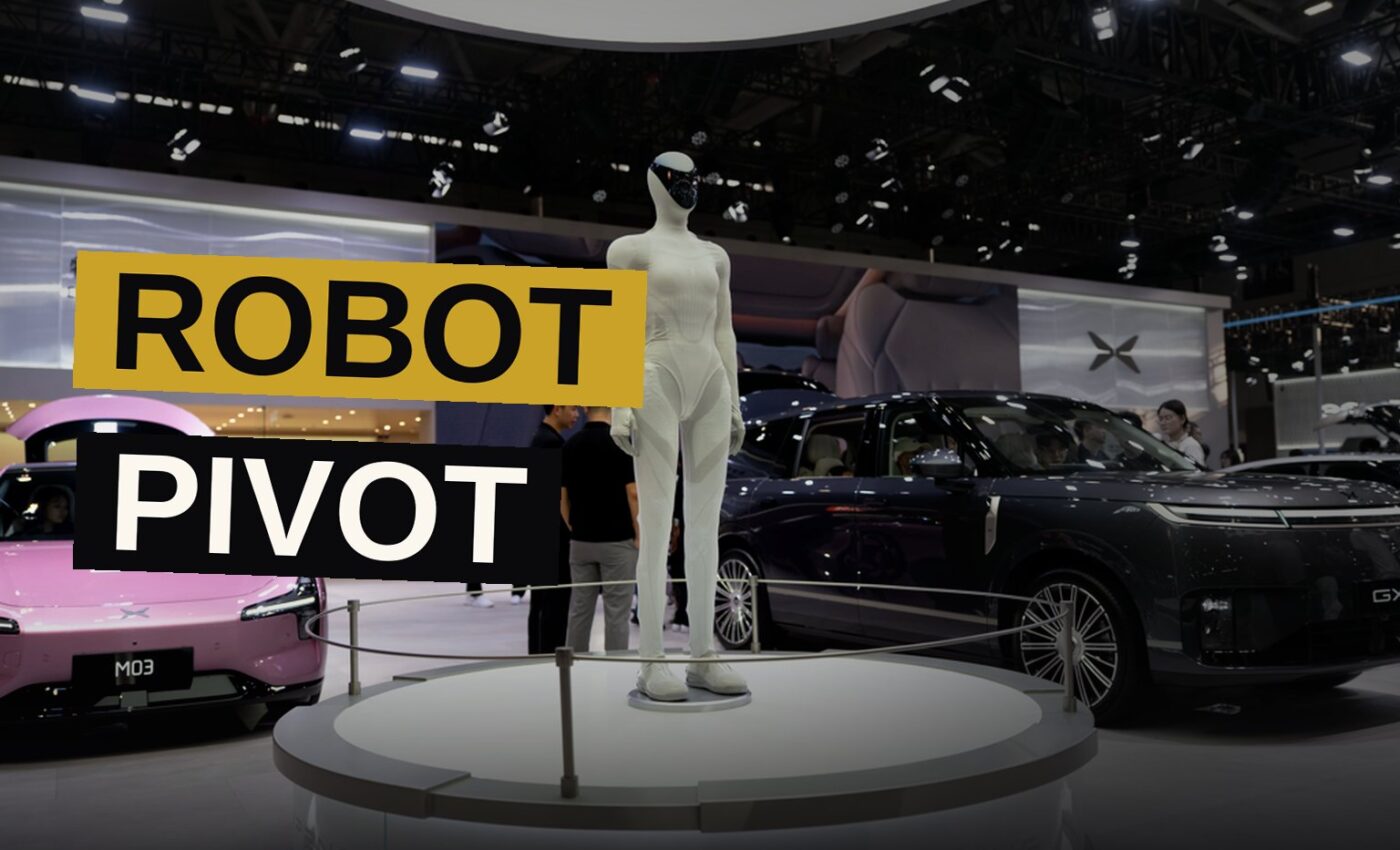
As the Chinese electric vehicle market slows, its manufacturers are changing course to concentrate on humanoids instead. This pivot follows electric vehicle sales in China heading toward what would be their weakest year since 2021.
Robotics is moving into the vehicle industry in China, with manufacturers entering the field of humanoid robots even as the electric vehicle market experiences intense competition and slowing growth. Xpeng and others have announced production plans for robots. The commercial worth of humanoids has been questioned, yet that has not stopped them from pushing forward.
Kevin Li, associate director at Counterpoint Research, said this was part of an effort to reshape “capital valuation narratives,”. He noted that the car companies are also seeking to build up their image as tech firms and create a second growth curve.
Xpeng Leads the Robot Push
This year, Xpeng’s stock has fallen by over 45%, putting it at the bottom of the pack among major EV companies. Sales declines have pushed BYD’s shares down by more than 13%.
According to Counterpoint, Chinese car makers accounted for more than half of the roughly 20 vehicle manufacturers globally that have entered the humanoid robotics field via in-house development, investment or incubation by August.
Nio’s investment unit has likewise put money into a number of humanoid robotics startups, among them LimX Dynamics and Acorn Robot, according to PitchBook data.
Geely, Xiaomi and Li Auto are also entering the robotics field, even though their approaches to it vary from one another.
The Business Case for Robots
The move into new areas comes as slowing growth and weak profits put pressure on China’s EV makers. The average profit margin in China’s vehicle building field stood at 1.5% in the first half of 2026, according to China Association of Automobile Manufacturers data cited by Counterpoint.
“Given the slowing growth and weakening profitability in the EV market—particularly domestically—it is a natural strategic move for EV companies to diversify into new applications such as robotics,” said Jing Yang, director of Asia-Pacific corporate ratings at Fitch Ratings.
“This allows them to pursue alternative growth drivers, achieve economies of scale for shared advanced technologies, and potentially improve profitability over the medium term,” she said.
Investors are not buying the story yet.
Last month, Xpeng sold shares worth $900 million to fund its robotics business, and the stock price dropped. The company says that was the biggest single round of funding in China’s “embodied” AI sector. Embodied AI is the term used for artificial intelligence connected to physical hardware.
The raise put the car company’s robotics unit at more than $6.3 billion. That is on par with the $6.5 billion estimated value for Xpeng’s EV business, according to Citi.
Comparing the Car Companies’ Robot Plans
| Company | Robot Plan | Key Detail |
|---|---|---|
| Xpeng | Mass production planned by end of this year | Can use 85% of its motors, chips and smart driving software for humanoids |
| BYD | Use in its own plants | Can deploy robots in its factories, per Counterpoint’s Li |
| Nio | Investment through its venture arm | Backed LimX Dynamics and Acorn Robot |
| Xiaomi | Testing at its plant | Started testing humanoid robots this year |
| Geely | Moving beyond cars | Could gain more over the medium-to-long term, per Counterpoint’s Li |
The Edge Over Tesla
Xiaoyi Lei, senior research analyst at Jefferies Hong Kong, says Chinese car companies share some similarities with how electric-car maker Tesla is building its Optimus humanoid in the U.S., even as their push into robotics carries its own distinct set of features.
She noted that Chinese car companies can now reuse much of their supply chain. Xpeng, for instance, can draw on 85% of its motors, chips and smart driving software for humanoid robots.
Before they leave the factory, the robots can start working straight away in the car companies’ stores and plants. She noted that this means the machines do not need to wait for customers to purchase them first.
Tuesday, Xpeng announced its intention to launch mass production of its robots by the end of the year, with production initially confined to its own retail outlets and corporate locations.
The firm intends to bring its robots to the wider market in China and beyond next year.
Lei pointed out that car companies already know how to manufacture items on a massive scale. She noted that building thousands of robots that function and can be repaired is something Chinese car companies handle daily, which they already do.
“Chinese players are the ones actually pushing it into daily use,” Lei said. She noted that using robots in their own operations makes it easier and cheaper for the car companies to gather data. That data is key for humanoid business success.
Xiaomi and BYD Take Other Paths
This year, a consumer electronics firm that only released its first electric car in 2024 began testing humanoid robots at its plant. That company is Xiaomi, which has made hardware for years before entering the automotive market.
Counterpoint’s Li noted that BYD can deploy robots in its factories. Still, he argued that Geely and Xpeng stand to benefit more from expanding past automobiles over the medium-to-long term.
Li pointed to Xpeng’s stronger focus on its physical AI plan.
The Road Ahead
| Step | When |
|---|---|
| Xpeng robot mass production begins | End of this year |
| Xpeng robots in its own stores and business places | End of this year |
| Xpeng robots go to wider market in China and other lands | Next year |
| Unitree shares debut in Shanghai | Last month |
| Humanoid field’s ‘ChatGPT’ moment | Likely a decade away, per Wang Xingxing |
Open Questions on Humanoids
It is still unknown whether humanoid robots will generate demand beyond the car companies’ own output. Lei stated that Jefferies has not yet seen any solid external orders from the car companies it tracks, nor has there been any clear word on outside buyers or robot revenue for next year.
Unitree, a leading humanoid company, saw its shares surge when they first traded on the Shanghai market last month. Since then, however, the stock has declined during 12 of the 16 trading sessions following its listing.
Founder Wang Xingxing has warned that building a real business could still take years. He said the humanoid field’s ‘ChatGPT’ moment is likely a decade away.
The process of borrowing car technology for robot use is often more complicated than it first appears.
“I would say the real challenge is how they are going to make the algorithm and software stack that is used to be applied to the smart driving system also viable to the humanoid scenario, which is more difficult and more challenging,” Lei said.
China’s electric vehicle manufacturers face serious pressure. They are placing their hopes on robots to create a second growth curve. The car market is losing momentum, and margins are narrowing.
Citi says Xpeng’s robotics unit is already worth close to the value of its EV business, but investors are not yet convinced by the story.
Whether these robots get past plants and stores into actual deliveries is something the next year will reveal. Orders placed outside their current limits have yet to be tested. The doubts about the technology itself are genuine.
The vehicle manufacturers keep pressing forward despite the doubts. Their supply chains, their construction expertise and the information gathered through years of their own research give them the foundation to pursue humanoids. The real test will be whether that foundation is sufficient to build a genuine commercial enterprise out of them.
Source: cnbc.com
Get the Notebook.
The day's best stories and every fresh verdict, in plain English, in your inbox by seven. One email a day, no more.