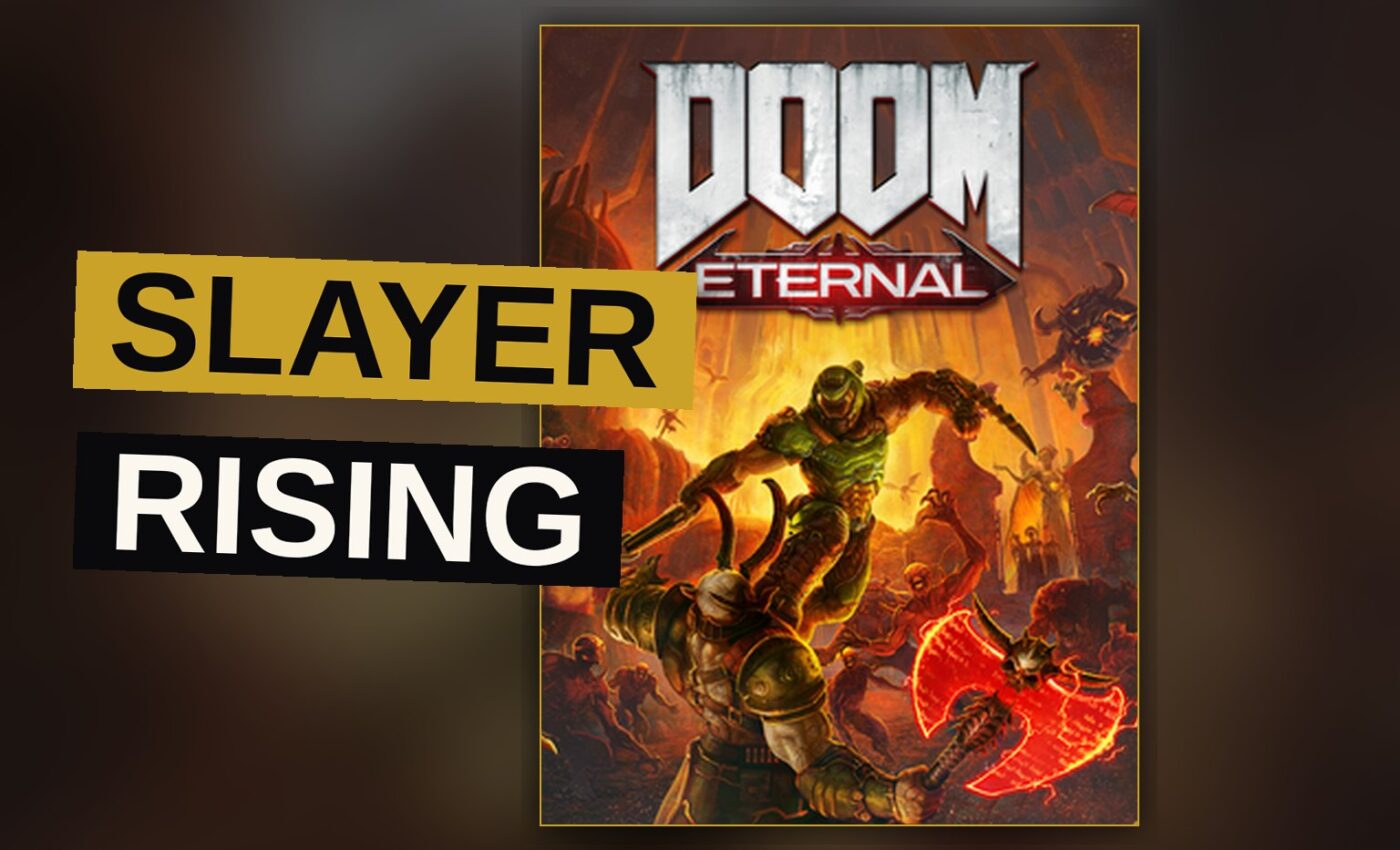
Doom Eternal puts a shotgun in your hands and a chainsaw on your hip, then dares you to stand still. You cannot. That is the whole game, and it is the reason the game works.
id Software’s 2020 sequel to Doom (2016) is a first-person shooter about ending a demonic invasion of Earth. It is the seventh game in the Doom series. You play the Doom Slayer, and the fight takes you from a ruined planet to the higher powers that let it burn. Bethesda Softworks published it across Google Stadia, Xbox Series X|S, PlayStation 4, PC, PlayStation 5, Xbox One and Nintendo Switch.
Trailer, via ベセスダ・ソフトワークス.
Earth Is Already Lost When You Arrive
The story opens after the damage is done. Demons have overrun Earth and wiped out 60% of the planet’s population. The Slayer returns with a satellite fortress and a list of three names: the Hell Priests, who serve the Khan Maykr. She is an angelic being willing to sacrifice humanity so her own race survives.
You hunt the priests one at a time. Each kill pulls the story deeper into a conflict between Heaven, Hell and an ancient pact that has fed on human souls for eons. It is a bigger, stranger frame than the 2016 game gave us, and it earns its scale by keeping the camera low and the pace high.
The Fantasy Combat Puzzle
id Software described the game as a “fantasy combat puzzle.” That phrase is doing real work. Players have to pick the right tool for each enemy’s weak point, and the game punishes anyone who defaults to one gun.
Resource management is the spine of it. Health, armor and ammo are not lying around in generous piles. You get them back by getting close:
- Health comes from staggering an enemy and finishing it with a Glory Kill.
- Armor comes from igniting enemies with the flamethrower.
- Ammo comes from the chainsaw.
That loop turns every fight into a decision about which resource you need next and which enemy you are willing to spend to get it.
Weapons, Weak Points and Sentinel Armor
The arsenal is large and each weapon has a job. The Super Shotgun carries a grappling hook that grabs enemies and slingshots the Slayer toward them, which is both a movement tool and an execution. Some weapons have secondary fire modes that change what they do. As you progress you earn points to upgrade weapons, and each weapon modification has a mastery skill unlocked by completing a specific gameplay challenge.
Throwables matter too. Grenades and ice bombs give you answers when the room fills up. Pickups grant buffs, including extra lives and a “berserker” mode that kills every demon in a single hit, bosses excepted.
Doom Eternal also adds platforming segments. The developers put them in to break up the pacing and make the non-combat stretches more engaging. They are the part of the game most likely to divide players, and they are also the part that keeps the campaign from flattening into one long arena.
Difficulty is not an afterthought. There are five levels. At the higher ones, enemies attack more aggressively and deal significantly more damage. In “Ultra-Nightmare” and “Extra Lives” modes, the Slayer dies permanently when his lives run out, and the campaign restarts. If you keep dying in the same encounter, you can respawn with Sentinel Armor, which significantly reduces incoming damage. That is a generous escape hatch, and it is the right one — the game would rather you keep playing than put it down.
Battlemode Sends Two Demons After You
Multiplayer is called Battlemode. One player controls the Doom Slayer. Two players control demons. The fight runs until the Slayer kills both demons or the demons kill him. id Software built the multiplayer in-house this time, unlike the 2016 game, specifically to connect it to the single-player campaign.
Early production on Doom Eternal began in 2017. A core goal was to fix what the 2016 game got wrong, add visual diversity and widen the gameplay. Mick Gordon composed the soundtracks. He and id Software later had a conflict that led both parties to sever their relationship.
Here is the running order of what the game asks of you, from first contact to the endgame:
| Stage | What changes |
|---|---|
| Opening campaign | Earth is overrun; the Slayer arrives with the satellite fortress |
| Priest hunts | Three Hell Priests, eliminated one by one |
| Mid-game | Platforming segments and weapon upgrades open up |
| Late campaign | The conflict between Heaven, Hell and the ancient pact surfaces |
| Multiplayer | Battlemode: one Slayer against two demons |
| Difficulty ceiling | Five levels, up to “Ultra-Nightmare” and “Extra Lives” |
What Holds Up and What Does Not
The combat loop is the best thing id Software has built. Doom Eternal refuses to let you turtle. Every defensive instinct you have — back off, heal, reload, repeat — is wrong here. The game forces you forward into the crowd, and the reward is that the crowd becomes your supply line. That is a genuine design idea, not a coat of paint on the 2016 game.
The platforming is the weak link. The stated reason for it is sound: break the pacing, make the quiet stretches matter. In practice it sits between you and the thing you came for. It is not bad enough to sink the campaign, but it is the section most players will remember as the toll they paid to get back to shooting.
Battlemode is a smaller success. Asymmetric multiplayer is hard to balance, and two demons against one Slayer is a narrow design. But building it in-house to tie it to the campaign was the right call, and it gives the game a second life after the credits.
The story is the most improved piece. Doom (2016) kept its mythology at arm’s length. Doom Eternal names the Khan Maykr, the Hell Priests and the pact that has been eating human souls for eons, and it commits to the scale. The 60% death toll is not decoration — it is the reason the Slayer’s anger reads as something other than posture.
What does not hold up is consistency. The game swings between taut arena combat and loose exploration, and the seams show. The buff pickups, the extra lives, the Sentinel Armor safety net — each one is defensible on its own, and together they soften a game that otherwise wants to be merciless.
None of that changes the verdict. Doom Eternal is a shooter with a real thesis about how you should play it, and the confidence to enforce that thesis. The platforming drags. The rest of it moves.
Get the Notebook.
The day's best stories and every fresh verdict, in plain English, in your inbox by seven. One email a day, no more.