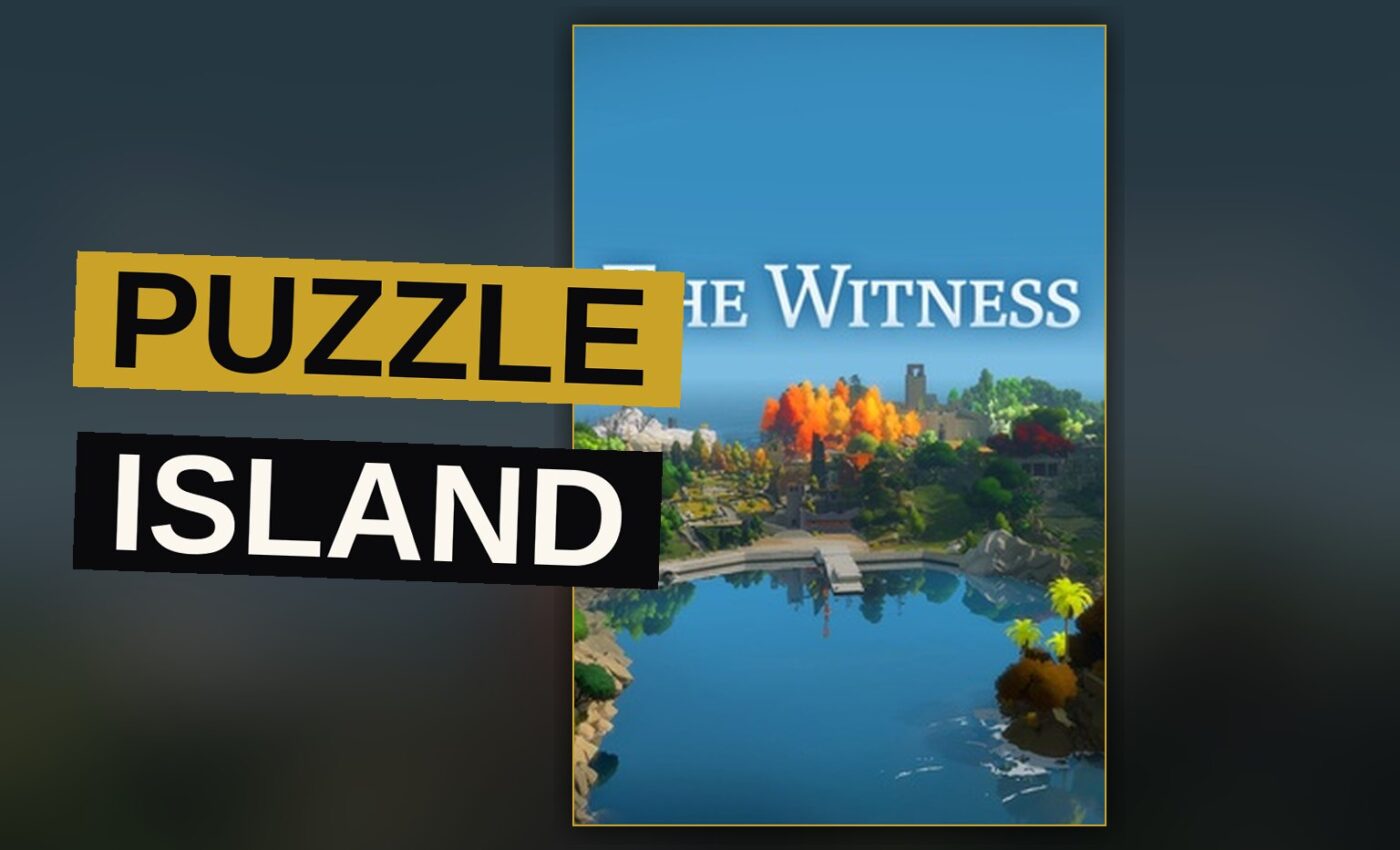
An island covered in puzzles asks almost nothing of the player except attention. That is the whole design of The Witness, released in 2016 for PC, PS4 and Xbox One. It is one of the smartest puzzle games in years, and one of the most demanding.
Trailer, via Jonathan Blow.
The Island Itself
The Witness drops the player on a brightly colored island with no instructions and no dialogue. There are no enemies, no inventory, no health bar. The only mechanic is a line drawn through a maze on a panel, and from that single idea the game builds hundreds of variations.
The island is broken into distinct zones, each with its own visual identity and its own twist on the maze format:
- A desert village of yellow stone and mirrored panels
- A wooded orchard where shadows carry the solution
- A swamp of reflections and half-submerged panels
- A bunker of red light and sound-based clues
- A mountain summit that ties the entire island together
Each zone teaches its own grammar of rules without a single line of text. The player figures out what a symbol means by trial, error and the slow click of understanding. That click is the game’s real reward.
Learning By Doing
The Witness never explains itself. It trusts the player to notice patterns, to test theories, to fail quietly and try again. This is either the game’s greatest strength or its biggest barrier, depending on temperament.
Some puzzles rely on color. Some rely on shape. Some rely on the landscape around the panel, which means the answer to a maze might be sitting in the trees behind it, not on the panel at all.
That last idea is the game’s boldest move. The world itself becomes a puzzle. Statues, shadows, rock formations, even the shape of a distant building can hold the key to a panel dozens of feet away. Once a player learns to look at the island itself rather than just the panels, The Witness opens up in a way few puzzle games manage.
Pacing and Friction
The difficulty curve is uneven. Some sequences click fast; others stall for long stretches with no clear next step. There is no hint system, no walkthrough built into the game, no concession to frustration.
That absence is deliberate.
The game wants the player stuck. It wants the silence of staring at a panel with no idea what it wants. For some players that silence is meditative. For others it is simply exhausting, and The Witness offers no relief valve for either camp.
Environment and Audio
The visual design carries a lot of the game’s mood. Bright, flat colors and clean geometry make the island feel like a diagram of itself, which fits a game built entirely from lines and shapes. The audio design is minimal by design: wind, footsteps, birds, and near-silence during puzzle-solving. There is no score pushing the player forward, no music cue signaling progress. The quiet becomes part of the puzzle-solving state, and after a few hours it starts to feel less like an absence and more like a deliberate choice.
Hidden throughout the island are audio logs and short environmental sequences, optional pieces that add context without ever explaining the mechanics. They function more as texture than as narrative, small human voices in an island that otherwise offers none.
A Loose Structure
There is no explicit level order, no forced sequence. The player is free to wander, to abandon a puzzle zone and return to it hours later. That freedom is part of the appeal, but it can also mean the difficulty spikes unpredictably depending on where a player chooses to go first.
| Zone | Core Mechanic | Difficulty |
|---|---|---|
| Village | Basic mazes | Easy |
| Orchard | Shadow-based clues | Medium |
| Swamp | Reflection-based clues | Medium-Hard |
| Bunker | Sound-based clues | Hard |
| Summit | Combined rules | Hardest |
That table is only a rough guide. The game does not present it this way, and the player is left to discover the shape of the difficulty curve on their own.
The Witness is not a game for everyone. It is slow, quiet, and often stubborn about giving up its secrets. But for players willing to sit with a problem, to walk the same path twice looking for something they missed, it delivers a kind of satisfaction few games manage. The island rewards patience more than skill, and attention more than speed.
Get the Notebook.
The day's best stories and every fresh verdict, in plain English, in your inbox by seven. One email a day, no more.