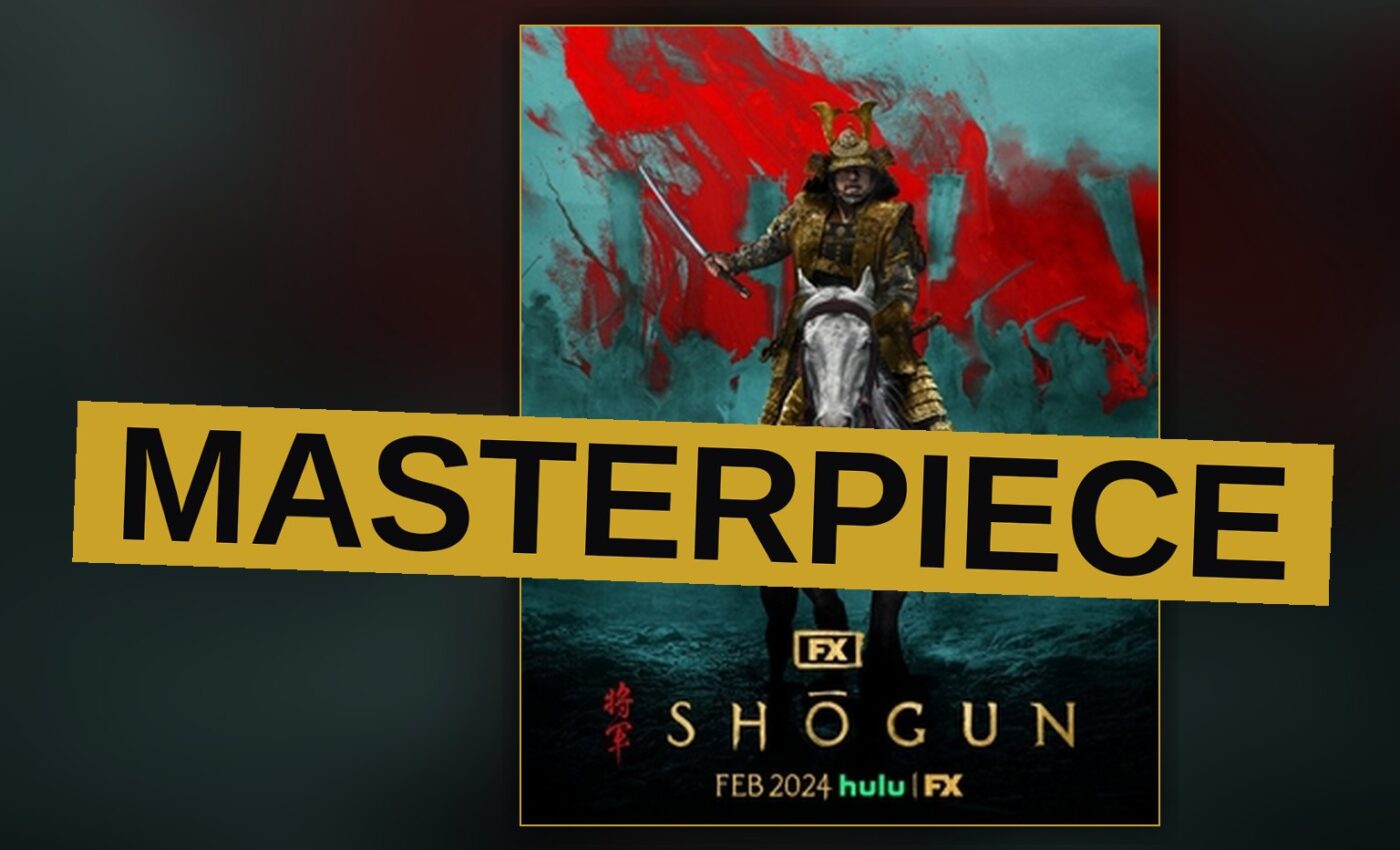
Shōgun arrives with the weight of a decades-old promise. The 1980 miniseries introduced many Western viewers to feudal Japan, but it was a product of its time, limited by budget and the conventions of network television. This 2024 series, created by Rachel Kondo and Justin Marks, is a different beast entirely. It is a meticulous, often brutal, and deeply humane adaptation of James Clavell’s novel, and it earns its place among the best television of its year.
Trailer, via FX Networks.
Blackthorne Lands in Japan
The story centers on John Blackthorne, an English pilot whose ship washes ashore in Japan in 1600. He is a man of his era: arrogant, filthy, and convinced of his own cultural superiority. But Shōgun is not his story alone. It belongs to Lord Yoshii Toranaga, a powerful daimyo on the brink of war with a council of regents who wish to see him destroyed. It also belongs to Toda Mariko, a Christian convert and translator who serves as the bridge between these two men.
The series does not rush. It spends its early episodes establishing the intricate political landscape, the weight of every bow, and the cost of every word. This is a show that trusts its audience to pay attention. The reward is a narrative that feels earned, where every betrayal and every alliance carries the gravity of real consequence. The production design is staggering; the armor, the castles, the calligraphy all feel authentic, not like costume.
Restraint as a Virtue
The performances are uniformly excellent. Hiroyuki Sanada anchors the series as Toranaga, a man who hides his calculations behind a mask of calm. His is a performance of immense stillness; every glance suggests a strategy. Cosmo Jarvis as Blackthorne initially plays the outsider with a bluster that slowly peels away to reveal a man genuinely humbled by a culture he cannot comprehend.
But the true revelation is Anna Sawai as Mariko. She is the soul of the piece, a woman caught between her faith, her duty, and her own sense of self. Her scenes, often quiet and confined, carry an intensity that rivals any battle. The series understands that violence is often less interesting than the threat of it, and it applies this principle to its dialogue as much as its action.
“This is a story about power, about the stories we tell ourselves to justify our actions.”
The action sequences, when they come, are swift and shocking. They are not choreographed ballets but chaotic, desperate struggles for survival. The show does not glamorize the sword; it shows the mess, the effort, and the sudden finality of death. This restraint extends to the pacing, which some might find slow. But the deliberate tempo is a choice, not a flaw. It builds a world so completely that the climactic moments land with real force.
Speaking in Subtitles
One of the most striking choices is the use of subtitles. Much of the dialogue is in Japanese, with English used only when Blackthorne is present. This is not a gimmick. It forces the viewer to experience the same disorientation that Blackthorne feels, to be constantly aware of the information he is missing. It also allows the Japanese characters to be fully realized, not just exotic figures speaking in translation.
The series is unafraid to show the brutality of the period. People are executed, punished, and humiliated with a matter-of-factness that is chilling. Yet it never feels gratuitous. The violence is always in service of character or plot, a reminder of the stakes in a world where honor is worth more than life.
Here are a few of the elements that make the series so effective:
- The script, which treats its source material with respect while streamlining it for modern audiences.
- The score, which uses traditional instruments to create a soundscape that is both alien and beautiful.
- The costume and set design, which create a world that feels lived-in and historically plausible.
- The ensemble cast, which has no weak links, from the major players to the smallest roles.
The Cost of Victory
The final episodes of Shōgun deal with the consequences of the choices made earlier. It is a story about endings, about the cost of victory, and about the men and women who are left to pick up the pieces. The series does not offer easy answers. Toranaga’s path to power is paved with sacrifice, and Mariko’s fate is sealed by her loyalty.
The show’s conclusion is not a happy one, but it is a fitting one. It honors the logic of its own world, where destiny is a heavy burden and honor is a cruel master. It is a rare adaptation that improves upon its source material by deepening its themes and trusting its audience to understand the complexities of a foreign culture without being lectured.
Shōgun is a monumental achievement, a series that demands patience and rewards it with a rich, immersive experience. It is a reminder that television can be art, that a story about a distant past can speak directly to the present. It is a slow burn, but the fire it builds is immense. This is not just a great historical drama; it is a great drama, period. It sets a new standard for the genre.
The series is a complete, self-contained narrative. It does not end on a cliffhanger, but rather on a note of quiet resolution. For those willing to engage with it on its own terms, it is an unforgettable journey. This is prestige television at its very best. I give it a score of 8.6/10.
Get the Notebook.
The day's best stories and every fresh verdict, in plain English, in your inbox by seven. One email a day, no more.