
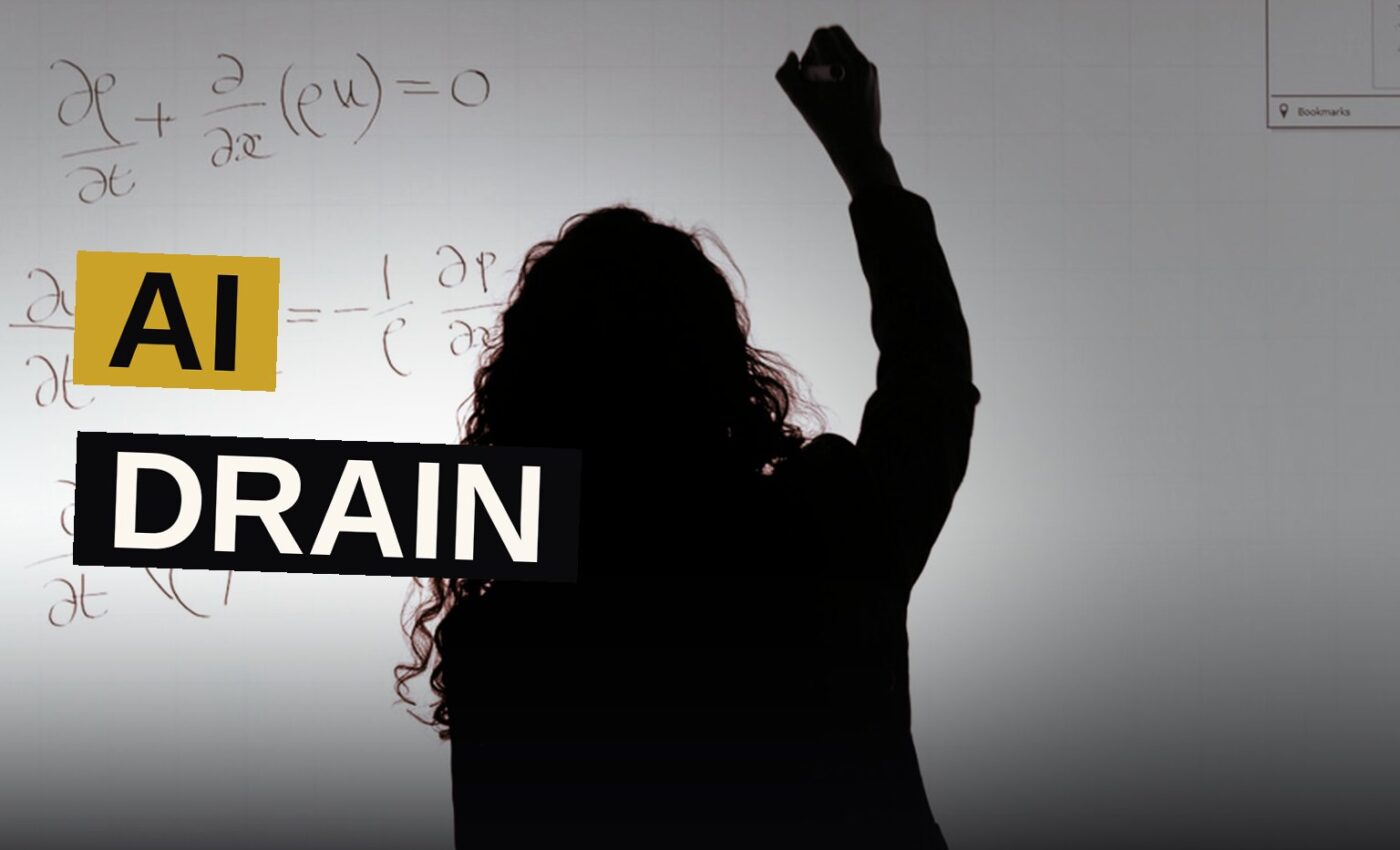
The UCLA professor Terence Tao, who is widely considered the best living pure mathematician, has issued a warning to his field. He says that artificial intelligence is solving mathematics’ most valuable open problems at a faster pace than mathematicians can keep up with when it comes to finding new ones worth solving.
Tao received the Fields Medal in 2006, and he has posted his argument on Mathstodon, a social network focused on mathematics. His claim does not concern proofs or papers. Instead, it concerns questions. He argues that the supply of good open problems — those unsolved questions that genuinely advance mathematics — is being depleted by AI tools capable of flattening them.
There is no limit to how many new math questions anyone can create. What matters is which ones are worth solving. The googol-th digit of pi remains an open question that nobody has worked out, but finding it would add nothing to what we know about mathematics as a whole. The real scarcity in the field is not the supply of problems, but the supply of problems worth devoting time and effort to.
“In short, the indiscriminate use of powerful solution-extraction tools can achieve the immediate short-term goal of solving problems at hand, but at the cost of sustaining the ecosystem for the next wave of progress, or in understanding the progress already obtained,” Tao wrote.
The Race That Worries Tao
Tao is describing something that has already occurred, not a hypothetical situation.
In May, an OpenAI model settled the Erdős unit-distance conjecture, a problem that had stood open for 80 years, concerning the maximum number of point pairs on a plane separated by exactly one unit. The work was independently confirmed by outside mathematicians, among them Fields medalist Tim Gowers.
The same week saw Anthropic researcher Levent Alpöge put the same problem through Claude Mythos, the published solution from the company’s unreleased top-tier model. He worked offline so the model could not copy OpenAI’. Anthropic engineer Sholto Douglas said the result was a “cute, simple proof,” shorter than OpenAI’s version. Mathematician Daniel Litt called it “a bit worse” than OpenAI’s, even though Mythos found OpenAI’s own solution on its own.
This week, Anthropic gave official form to a centuries-old argument. A short time afterward, OpenAI solved a 90-year-old question hours after another researcher put forward his own proof. The same researcher then joined forces with an Anthropic researcher on a shared work.
Tao’s concern is the speed and the incentive structure this creates. “We have now seen that even the rumor of someone working on a problem can trigger a massive amount of AI-powered effort to flatten it before the original research project has time to reach its full potential,” he wrote.
How Math Problems Used to Work
Mathematics has always had a “difficulty landscape.” Some questions are trivial. Some take real effort. Some are hopeless with current tools. Researchers study this landscape carefully before committing months or even years to a single problem.
Throughout history, new approaches have reshaped the terrain of what is possible. A fresh method can turn a difficult problem into something routine, but it almost always uncovers new ground that it cannot fully cover. The instrument that resolved one set of challenges pointed to others that remained beyond its reach.
Tao makes the case that AI disrupts this pattern. There is no clear point where a model’s capability ends. A tool capable of solving an 80-year-old problem may go on to solve the next one, and then the one after that. The boundary does not move outward the way it did with human methods. Instead, it simply gets used up.
The result, Tao argues, reverses centuries of open science.
A Timeline of Recent AI Math Wins
| Date | Event |
|---|---|
| May 2026 | OpenAI model disproves the Erdős unit-distance conjecture |
| May 2026 | Anthropic’s Claude Mythos independently solves the same problem offline |
| This week | Anthropic formalizes a centuries-old proof |
| This week | OpenAI cracks a 90-year-old problem hours after a human proof appears |
Tao’s Proposed Fix: “Analysis-Required”
Tao is putting forward a particular idea. He wants to mark certain problems as “analysis-required.”. Under his rule, a correct answer on its own carries little weight unless it is accompanied by reasoning that sheds light on neighboring problems.
The comparison drew upon food banks that would no longer accept any donation that was merely edible.
Tao said the other option would be to ban AI from mathematics altogether, and he described that course of action as “technically infeasible.”.
So far, no government has put the proposal into practice. Meanwhile, the way the major AI companies are acting suggests the labeling system itself might not work at all.
Why Speed Is the Problem
Why speed counts becomes clear in the unit-distance case. OpenAI published its disproof. Anthropic then sought to learn whether its own model could achieve the same thing. Alpöge put the problem through Mythos offline instead, to show the result had not been copied.
Tao makes the case that the competitive relationship between the two sides is harmful, and he frames it as a race dynamic.
- A researcher identifies a promising open problem and begins a long-term project.
- Word of the project leaks, or a lab independently targets the same problem.
- A frontier AI model solves it.
- The original research project’s full potential is cut short.
- The field gets an answer without the reasoning that a human solution would have provided.
The warning from Tao is that this chain of events does not happen just once. He wrote that a mere rumor is enough to set it off.
A plain answer, accurate though it may be, fails to capture the true purpose of mathematics. A proof that merely announces a result without offering any reasoning behind it is like a guide that points to a place but gives no directions. Such a proof delivers its message once. It offers no assistance in reaching any other destination.
This is the core of Tao’s “analysis-required” idea. The raw answer should count for little. What counts is reasoning that reveals something about nearby problems. A solution that explains its logic can be adapted, extended, and applied to other questions. A solution that merely states its conclusion is a dead end.
A problem that gets solved without reasoning behind it is useless to the next person who comes along trying to understand the subject. It fails to show the structure of the field. All it does is take one question off the list.
What the Labs Are Doing
Both Anthropic and OpenAI have devoted vast quantities of computation to tackling issues in mathematics and science. Their work has touched on quantum physics, applied mathematics, and medicine alike.
The number of truly hard questions in mathematics is limited. Scholars pick them with care, devoting months or years of work to a single problem. The discipline’s advance relies on their ability to select well. It relies on the difficulty landscape remaining visible and steady long enough for researchers to make sound judgments.
A model might crack a problem that seemed lost, while another fails on something that appeared simple. Neither outcome can be forecast with certainty. This uncertainty leaves researchers unable to say what knowledge will hold up when tested against a frontier model.
Tao drew attention to the rumor dynamic, noting that even the mere whisper of someone working on a problem can prompt a huge AI-driven push to crack it first. That early pressure flattens the original researcher’s project before it ever fully comes into its own.
A new development: AI alters the situation entirely. All that’s needed is a rumor. When a lab learns that a well-known mathematician is tackling a particular problem, it can feed that problem into its model. If the model delivers a solution, then the mathematician’s years of labor are rendered obsolete. The field receives an answer, but not the reasoning that would have come with the human approach.
Tao argues this ends up reversing centuries of open science.
The Difficulty of the Fix
The idea behind Tao’s “analysis-required” label sounds neat on paper. It alters how labs think about solving problems. Under this system, a lab only earns credit for a solution if it can offer genuine reasoning to back it up. That change makes the competition less appealing.
The label carries no power to enforce itself. It is a convention rather than a command. The contest over the distance between two points took place without a label attached. The ancient demonstration of a formal proof came into existence without a label. And the 90-year-old question was answered within hours of a person publishing their own solution.
Tao has argued against a ban on AI in mathematics, calling it “technically infeasible.”. Instead, he has suggested a labeling system for papers produced with AI assistance. That approach could work, but it requires coordination among researchers to agree on a common set of rules. At present, no such agreement exists.
What Happens Next
The warning from Tao is a summons to act, though it remains an idea without substance. It has not taken shape as policy within any organization. The “analysis-required” benchmark has not been embraced by any group. No research facility has announced its intention to respect such tags.
More of the same is what the near horizon holds. Research centers will keep throwing computation at well-known problems, and some will give way. The field will receive answers faster than it can generate explanations. The difficulty landscape will continue to shift without warning.
The real issue concerns the long-term viability of the system. Tao suggests that the present arrangement feeds upon the very ecosystem that generates the next round of advancement.
Tao’s warning deserves attention because it comes from someone who understands the field’s value structure better than almost anyone alive. He is arguing for a standard: a problem is only solved when the solution teaches something. A bare answer, however correct, is not enough.
The question now is whether the labs will hear him.
Source: decrypt.co
Get the Notebook.
The day's best stories and every fresh verdict, in plain English, in your inbox by seven. One email a day, no more.