
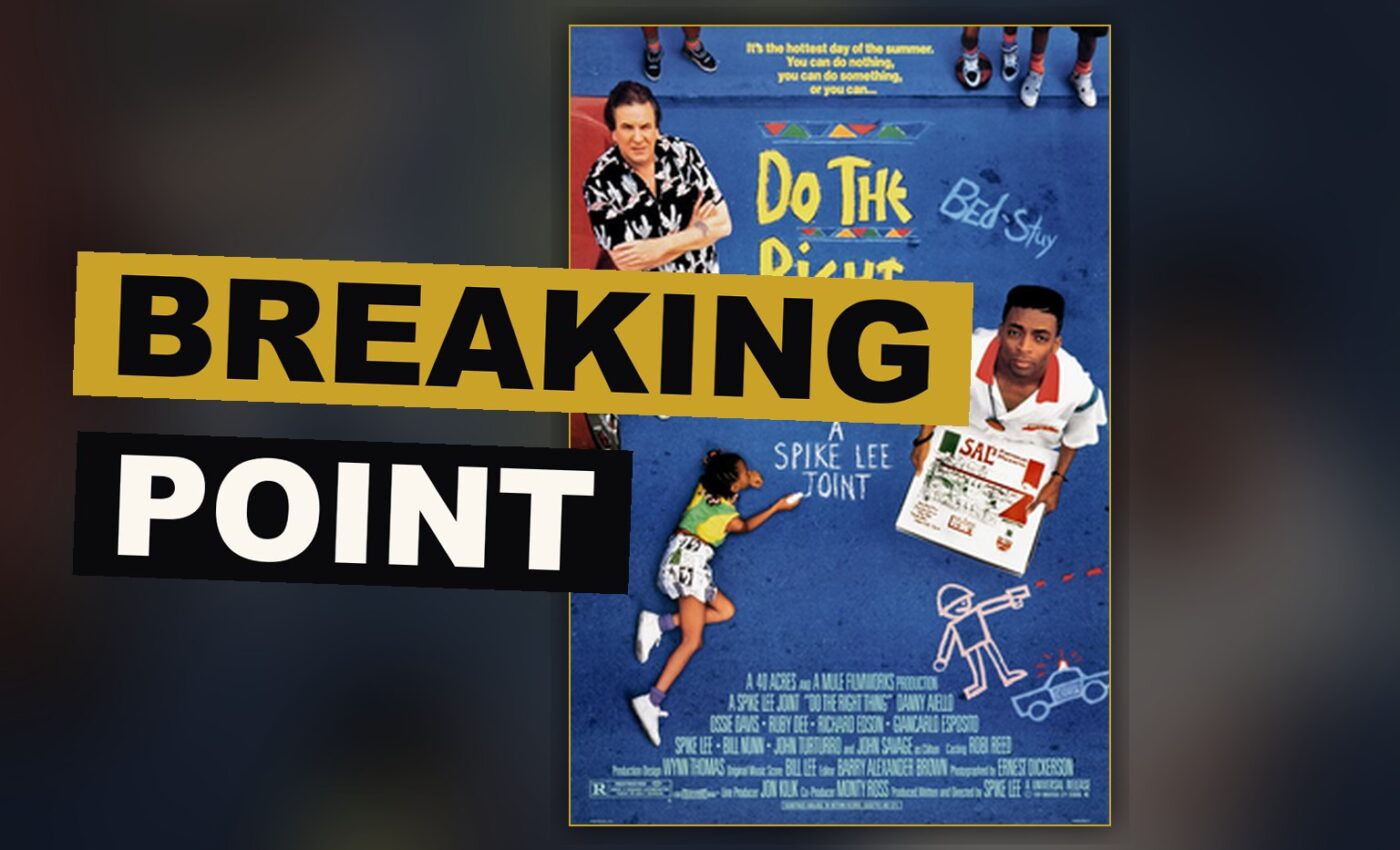
Do the Right Thing takes place on one Brooklyn block on the hottest day of the summer, and it is 120 minutes of watching a neighborhood come apart at the seams. Spike Lee produced, wrote and directed it, released it through Universal on June 30, 1989 after a Cannes premiere on May 19, and made $37.3 million on a $6.2 million budget. It is a comedy for most of its length. It ends in tragedy and violence, and it does not tell you what to think about either.
The Wall of Fame
Sal, played by Danny Aiello, is the Italian owner of a pizzeria in a Black neighborhood. Buggin’ Out, played by Giancarlo Esposito, notices that the Wall of Fame in the pizzeria has only Italian actors on it and decides that a pizzeria in a Black neighborhood should showcase Black actors. Sal disagrees. The wall becomes a symbol of everything the block has not said out loud, and the temperature does the rest.
Mookie
Lee plays Mookie, Sal’s delivery man, who spends the day walking between the two worlds the film is about. It is a deliberately small performance. Mookie is the film’s hinge, and Lee plays him as a man trying to get through a shift without taking a side, which is the one thing the day will not allow.
The Block
The ensemble is the film. Ossie Davis is Da Mayor and Ruby Dee is Mother Sister, the block’s conscience and its memory. Bill Nunn is Radio Raheem, whose boombox is the sound of the whole movie. John Turturro is Pino, Sal’s son, who hates the neighborhood and cannot leave it, and Richard Edson is Vito, the brother who does not. Martin Lawrence and Rosie Perez make their feature debuts. Every one of them is given a moment to speak directly to the camera, and those direct-address monologues are the film’s boldest device.
The Look
The film is noted for its color design, and rightly. The reds and oranges are the heat made visible, and the stylized cinematography tilts and tracks in ways that keep the block from ever feeling like a set. The music, which is part of the film’s argument rather than decoration, has been influential ever since.
Where It Falls Short
The comedy and the drama do not always sit together, and there are stretches in the middle where the film is a series of sketches waiting for the day to turn. Some of the characters are types rather than people. And the ending, which is the film’s whole reason for existing, has been argued over for decades precisely because Lee refuses to resolve it, and a viewer who wants resolution will leave angry.
The Verdict
That refusal is the point. Do the Right Thing is about a block where everyone is right and everyone is wrong and the heat makes it impossible to hold both thoughts at once. It was a major critical and commercial success, and it remains one of the essential American films about how a neighborhood breaks.
Get the Notebook.
The day's best stories and every fresh verdict, in plain English, in your inbox by seven. One email a day, no more.


