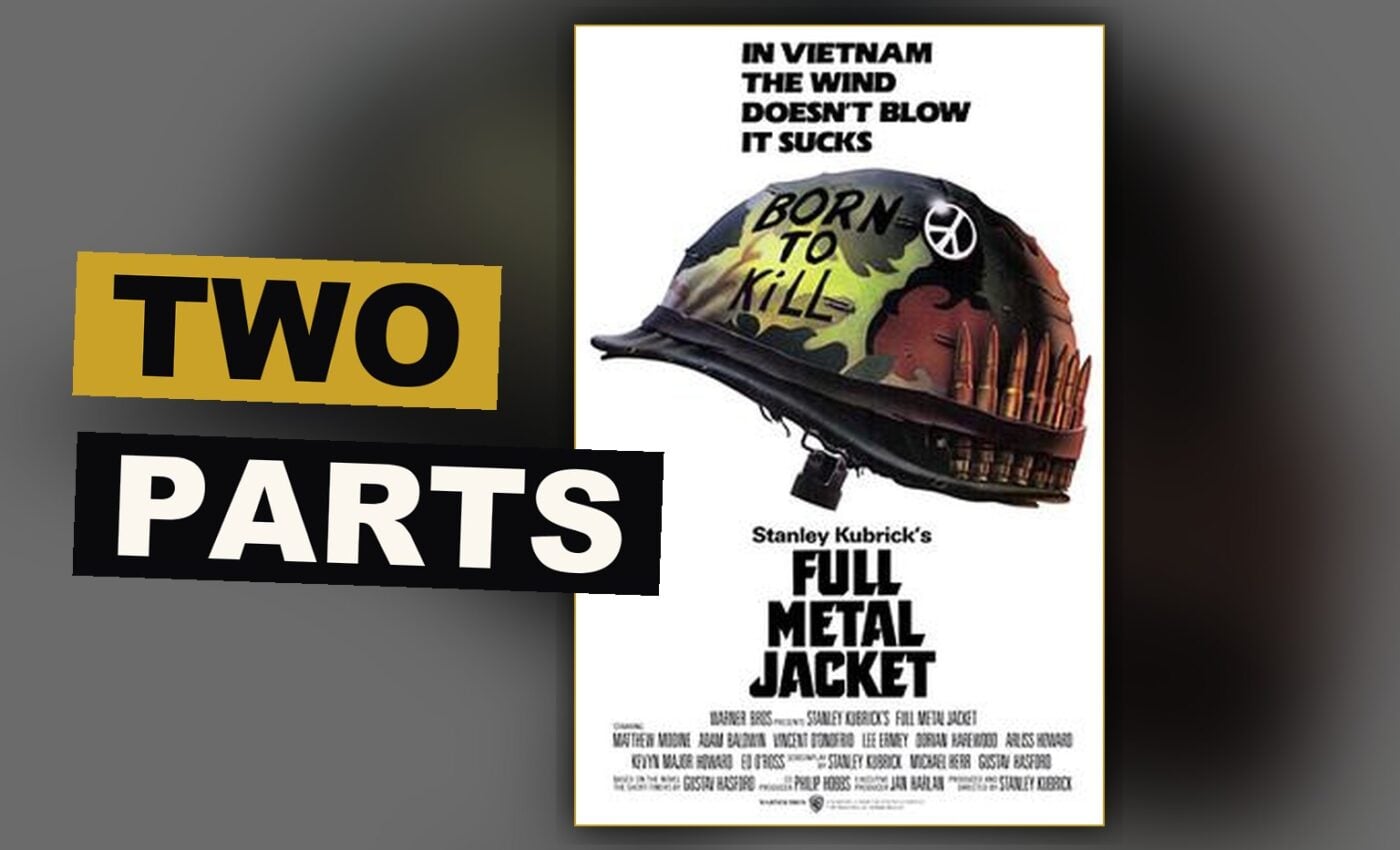
Full Metal Jacket splits itself in two, and both parts land like a fist. Stanley Kubrick’s 1987 film moves from a training camp to a ruined city during a major offensive of the war, and it never pretends the two settings share a mood. The joint between them is rough on purpose.
A Training Camp in South Carolina
The first part of the film belongs to a harsh sergeant and the young soldier he singles out for scorn. The sergeant’s insults come fast and without pause, a stream of contempt built to clear away a man’s old self before it builds him back up as a fighter. The young soldier’s change from a soft, scorned figure to something far more alarming is the film’s most complete piece of acting.
The film’s narrator, a private who takes the name Joker, watches this change with a kind of helpless understanding. The night scene that closes this part of the story is brutal and quiet at once, and it sets the terms for everything that follows: training does not just prepare men for war, it remakes them into something the war can use.
Streets of a Ruined City
The second part drops Joker into the war as a writer for a military paper, and the film trades camp order for open disorder. Kubrick films the ruined streets with a cold, plain manner, long shots that move across broken buildings and never let the killing feel distant. The men Joker joins talk in the dull, joking manner of soldiers who no longer expect to live.
A late scene, built around one soldier firing from cover, draws the film’s two parts together. The one firing turns out to be young, and the scene gives the viewer no relief once the danger passes. It sits there, plain and hard to watch, asking nothing of the audience but attention.
Kubrick’s Script and Cast
Kubrick directs from a script he wrote with two other writers, working from a novel about the same war. The talk in the film carries a rhythm unlike Kubrick’s other work, quick and cut short, built for men who talk to get through the day rather than to open up to one another.
Joker holds the film together as its point of view, but the sergeant and the young soldier own the first part of the story so fully that some critics have called the second part weaker by comparison. That view has some weight. Still, the break in tone is not a fault so much as the film’s whole point: the camp and the war are not the same story, and Full Metal Jacket refuses to smooth them into one.
Voices, Shots, and the Camera
The film’s sound work is worth separate note. Radio voices, gun fire and the sergeant’s shouted orders all sit at different levels, and the mix never lets the viewer settle. Kubrick’s camera stays steady even when the action does not, and that steady manner is where much of the film’s pressure comes from.
Below is a rough sense of how the film’s two parts break down on screen:
| Part | Setting | Central Figures |
|---|---|---|
| First | Training camp | Sergeant, young soldier, Joker |
| Between | Sleeping quarters, night | Young soldier, Joker |
| Second | Ruined city, during the war | Joker, fellow soldiers, one firing from cover |
Full Metal Jacket does not settle into one simple statement about war. It offers two studies, joined at a mark that still shows, and asks the viewer to sit with the trouble of that join. The work of the sergeant and the young soldier in the first part remains the film’s high point, but the picture’s whole shape, rough as it is, is what makes it last.