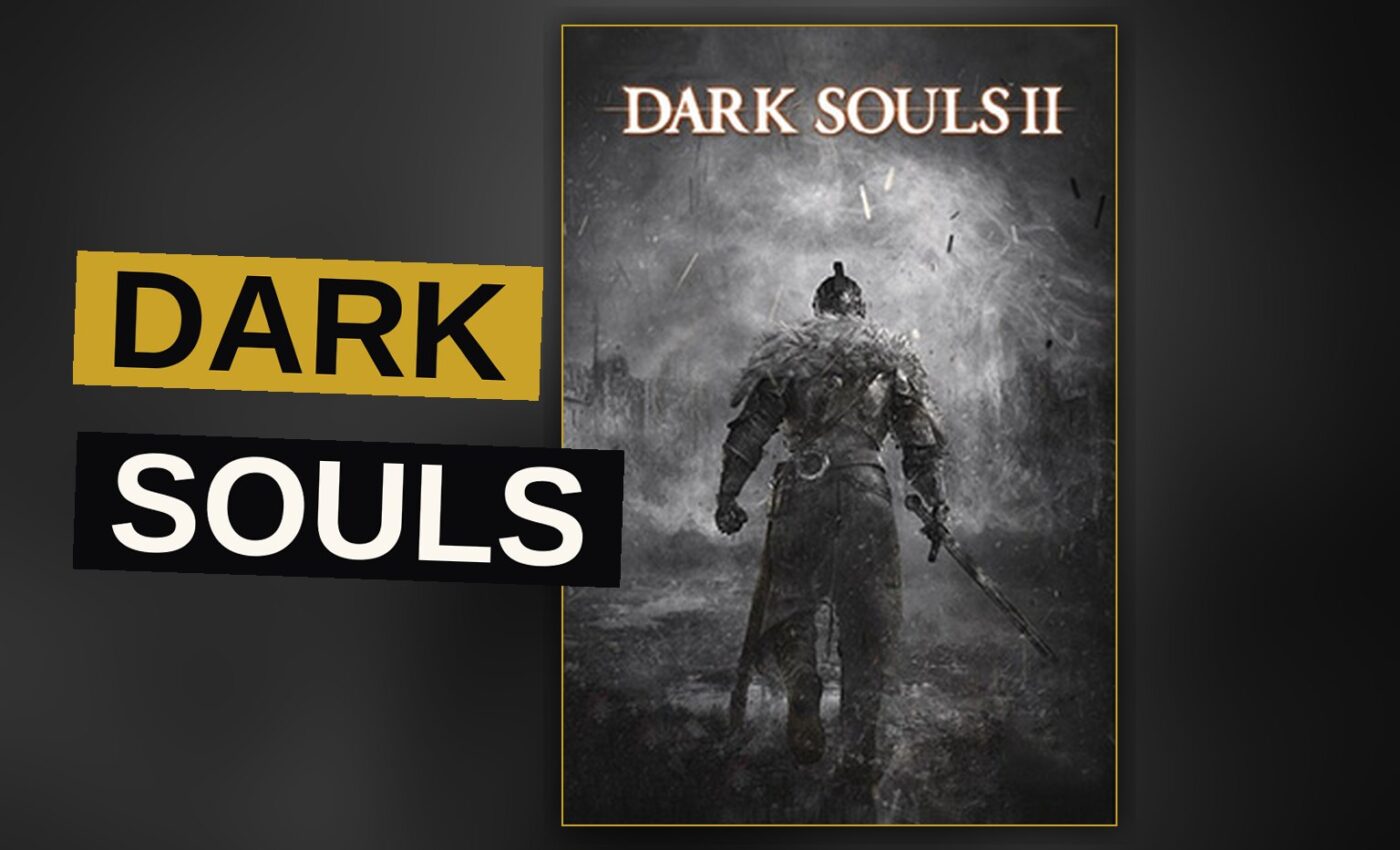
Dark Souls II is not the kind of game that greets you warmly. It opens with a woman’s voice asking you to seek souls, and then it drops you into a crumbling ruin called Things Betwixt, where a hag mutters about fate and a giant ogre waits in a cave to flatten you. This is a game that expects you to fail, to learn, and to come back angrier and more determined.
It is the direct sequel to Dark Souls, released in 2014 for PS3, PC, and Xbox 360. If you count Demon’s Souls as the series’ starting point, it is the third entry in FromSoftware’s punishing action-RPG line. It trades the tight, claustrophobic design of its predecessor for something broader, stranger, and occasionally unfair. But it is also a masterpiece of atmosphere and tension, a game that rewards patience and punishes greed with a consistency that borders on the cruel. It deserves its place beside the best of the genre, and it earns every point of its 9.0/10 critical score.
Drangleic and Its Secrets
The story of Dark Souls II is as oblique as you expect from the series. You are an Undead, cursed to lose your mind and your humanity, and you travel to the kingdom of Drangleic to break the curse. The game hands you almost nothing in the way of exposition. Characters speak in riddles, item descriptions carry the real lore, and the plot is a skeleton you have to flesh out yourself. That is not a flaw; it is a design choice. The game trusts you to piece together why the Emerald Herald guides you, what the King’s sin was, and why the land is rotting from the inside.
The world itself is the real protagonist. Drangleic is a patchwork of distinct zones: the sun-drenched but deadly Forest of Fallen Giants, the poison-soaked Earthen Peak, the gothic spires of Drangleic Castle, and the eerie, snow-blinded Eleum Loyce in the downloadable content. Each area has a visual identity, and the art direction is consistently strong.
The game runs on an upgraded engine, and while the PS3 version shows its age with muddy textures and occasional frame drops, the PC release runs at 60 frames per second and looks sharp. The lighting is the star. Torches matter here, and dark corridors feel genuinely oppressive when you cannot see what is coming.
The level design is more linear than the original Dark Souls, which had a sprawling, interconnected map that looped back on itself in clever ways. Drangleic is a series of spokes from a central hub, and you will fast-travel between bonfires from the start. That is a change, and it loses some of the wonder of discovery. But the individual zones are larger and more elaborate, with shortcuts that reward exploration and traps that punish carelessness. The game is not trying to be the same thing again. It is trying to be a bigger, more varied version of the formula.
Combat and Its Demands
Combat is the heart of Dark Souls II, and it is slower and more deliberate than the first game. Your stamina bar is smaller, your swings are weightier, and rolling costs more. That means you cannot spam attacks or dodge endlessly. Every action has a cost, and the game forces you to commit. Enemies are also less forgiving. They track your movement, they have longer reach, and they often attack in groups. The early game throws multiple foes at you, and the game’s infamous “gank” encounters — where you face three or four enemies at once — are a constant threat.
The game adds a new mechanic: the Adaptability stat, which raises your agility and makes your rolls more forgiving. It is a hidden tax on your build, and veterans found it frustrating that they had to invest points just to make dodging feel right. That is a fair criticism.
But once you understand the rhythm, the combat opens up. Weapons have unique movesets, dual-wielding is viable, and magic is powerful but requires careful management of spell uses. Bosses are the highlight. The Pursuer, a knight who appears repeatedly to hunt you, is a tense duel. The Looking Glass Knight lets another player invade as its summon. The Fume Knight, in the Crown of the Old Iron King DLC, is one of the hardest and fairest fights in the series.
The difficulty is real, but it is not arbitrary. The game gives you tools: summons, ranged attacks, and the ability to level up endlessly. It is never impossible, only demanding. The satisfaction of beating a boss after twenty attempts is the core of the experience, and Dark Souls II delivers that feeling in spades.
A Divided Legacy
Dark Souls II has a complicated reputation. Some fans consider it the weakest of the trilogy, pointing to its inconsistent level design and the reduction of the series’ signature interconnectivity. Others defend it as the most experimental and varied entry, with the best build diversity and the most replayable content. The truth is somewhere in between. The game’s director, Tomohiro Shibuya, and co-director, Yui Tanimura, had a troubled development, and it shows in places. Some areas feel unfinished, and the late-game difficulty spikes are sharp.
The Scholar of the First Sin edition, released in 2015, reworked enemy placements, added new NPCs, and expanded the story. That version is the definitive way to play, and it fixes some of the original’s problems. But the base game, as reviewed here, is still a strong experience. It is not the flawless masterpiece that Dark Souls was, but it is a worthy successor that stands on its own terms. It is a game about struggle, about the slow accumulation of skill, and about the quiet triumph of surviving another day in a world that wants you dead.
Sound and Fury
The audio design is excellent. The soundtrack, composed by Motoi Sakuraba and others, is sparse but effective. The boss themes are grand and orchestral, while the ambient tracks are low and droning. The sound effects carry the weight. Sword clangs, shield blocks, and the sickening crunch of a hit landing all feel physical. The voice acting is uneven, but the key characters — the Emerald Herald, the old hag, and the mysterious Aldia — deliver their lines with the right mix of melancholy and menace.
The game’s multiplayer is a mixed bag. Co-op is simple: you summon a white phantom, and you fight together. PvP is more complex, with a covenant system that lets you invade others or duel in arenas. The netcode is not great, and lag can ruin fights. But the invasions add a layer of tension that single-player games rarely match. You never know when a red phantom will appear, and the fear of losing your souls to a human attacker is real.
Key Facts and Numbers
- Title: Dark Souls II
- Developer: FromSoftware
- Publisher: Bandai Namco Games
- Platforms: PS3, PC, Xbox 360
- Release date: March 11, 2014 (North America)
- Score: 9.0/10
- Playtime: A first playthrough runs 40 to 60 hours, depending on how much you explore and how often you die.
- Difficulty: Expect to die hundreds of times across a full run.
- Bosses: The base game has roughly 30 boss fights, though counts vary by source.
- DLC: Three expansions were released in 2014: Crown of the Sunken King, Crown of the Old Iron King, and Crown of the Ivory King.
- Builds: Dozens of viable weapon and spell combinations, from greatswords to hexes to dual daggers.
The Verdict
Dark Souls II is a game of contradictions. It is bigger but less cohesive. It is harder but less precise. It is more varied but less memorable. And yet, it is still a game that demands to be played. The combat is deep, the world is haunting, and the sense of achievement is unmatched. It is not the best entry in the series, but it is an essential one. It is a game that respects your intelligence, punishes your mistakes, and rewards your persistence.
It is a flawed masterpiece of tone and tension. The game knows how to make you feel small. It knows how to make you afraid. It knows how to make you angry. And it knows how to make you victorious. That is a rare combination, and Dark Souls II pulls it off with confidence.
It is not for everyone. It will frustrate you. It will make you want to throw your controller. It will test your patience in ways that feel mean. But if you stick with it, if you learn the rhythms and the tells, you will find one of the most rewarding experiences in modern gaming. It is a game that asks for everything and gives back only what you earn. That is a fair trade.
Dark Souls II is a flawed masterpiece, and it earns its reputation. It is a game you will remember long after you have put it down. It is a game you will return to, again and again, to test yourself against its impossible challenges. It is a game that defines the genre it helped create. It is a game that deserves your time, your patience, and your respect. It is a game that is worth every death. It is a game that is worth 9 of 10.
It is a game you should play.
Get the Notebook.
The day's best stories and every fresh verdict, in plain English, in your inbox by seven. One email a day, no more.