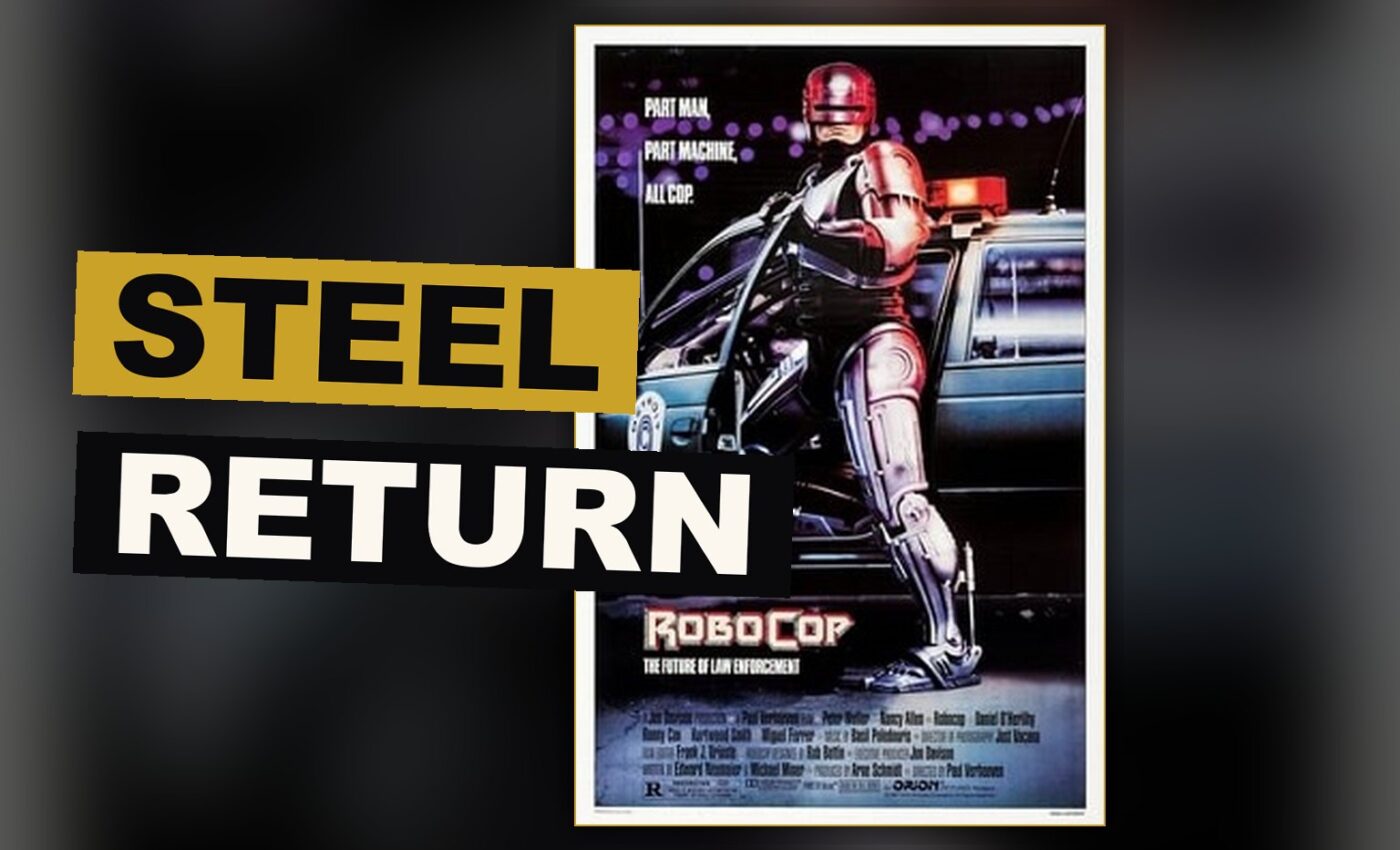
A police officer dies in the line of duty and returns as a machine. That’s the premise of “RoboCop,” Paul Verhoeven’s 1987 film, and it still holds up.
Setting the Scene
The story follows a police officer, killed and then rebuilt by a powerful company as an armored officer walking the streets of a fallen American city. He hunts down the men responsible for his death while pieces of his human past come back to him. Verhoeven directs with a keen, comic edge, taking aim at excess and consumer habits alike. Invented advertisements and news pieces break up the narrative, selling toys, cars and guns with the same cheerful tone. The humor lands because the film never gives a sign of a joke to its audience. It plays everything straight.
A Performance Under Steel
Peter Weller plays the lead with a rigid, careful bearing that makes the character’s gradual return of memory land as tragedy rather than novelty. The suit limits how he can move, and Weller uses that limit well. His performance carries much of the weight of a film that could have settled for spectacle alone.
The cast fills out a grim city, ruled by the company, on screen:
- The lead actor as the officer rebuilt as a machine
- His partner on the police force, loyal through every turn
- The leader of the gang responsible for his death
- An executive at the company guiding the true direction of events
- The engineer who first puts the idea forward
A Line Worth Noting
One moment shows the character’s cold presence before his humanity returns.
“Dead or alive, you are coming with me.”
Weighing the Result
The special effects, built with practical methods for their time, still show harm without looking dated. The sequences showing the armored machine move carry a rough charm of their own. The critique aimed at company excess and media noise from its time still reads as pointed today.
“RoboCop” works as both a forceful film and a study of the systems that produce harm. It’s rare that a film built on this much force carries this much heart.
The film holds up.
Verhoeven’s command of tone, Weller’s performance, and the willingness to turn a critical eye on the very world it entertains keep “RoboCop” lasting decades later.