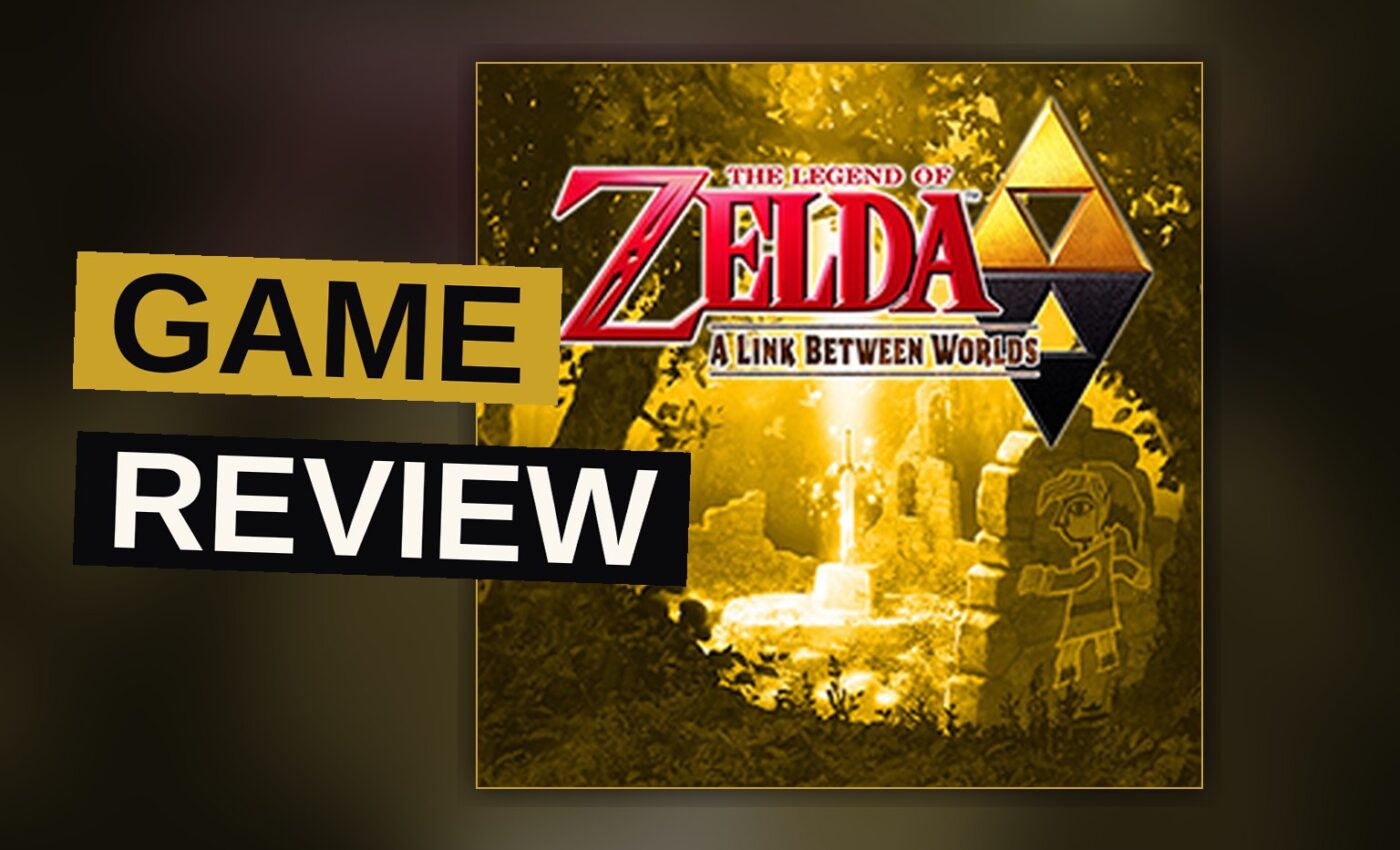
Nintendo took a real risk with The Legend of Zelda: A Link Between Worlds by breaking the series’ oldest habit. The 2013 Nintendo 3DS title lets players tackle dungeons in almost any order, and it hands them the tools to do it early. That change could have gutted the series’ sense of progression. Instead it produced one of the smartest adventure games Nintendo has made.
Trailer, via Nintendo of America.
Two Kingdoms, One Rift
A Link Between Worlds is an indirect sequel to A Link to the Past, set many years after that 1991 game. The same Hyrule returns, with new characters and new rules. Link sets out after the sorcerer Yuga captures Princess Zelda and escapes through a rift into Lorule, a parallel kingdom and Hyrule’s dark twin.
Yuga wants to kidnap the Seven Sages and use their power to resurrect the demon king Ganon. That premise is thin, and the game knows it. The pull here is not the plot. It is the two kingdoms laid against each other.
Lorule once held a Triforce. Its people destroyed it to stop their fighting over it, and the kingdom decayed into a ruined land. Princess Zelda rules Hyrule; her counterpart Hilda rules Lorule. The contrast in style and tone between the two maps does real work, and it gives the game a second world worth crossing into rather than a palette swap.
Ravio’s Bracelet
Shortly into the adventure, the merchant Ravio gives Link a magic bracelet. It lets him merge into walls as a 2D painting. That single mechanic carries the game.
Merging lets Link reach areas he could not otherwise touch and travel between Hyrule and Lorule. It turns walls from boundaries into routes. Puzzles built on the ability show up in dungeons and in the open world, and some of them lean on the 3DS’s stereoscopic 3D effect.
The 3DS hardware is used well beyond that trick. The top screen shows hearts, an energy gauge and an action icon. The bottom screen holds the map, Link’s position and his gear, and it switches to the world or dungeon depending on where he stands. The energy gauge governs item and ability use, draining on use and refilling over time. It is a quiet fix for a familiar problem: no more hoarding bombs for a boss you have not met.
Why the Open Structure Works
Most Zelda games lock their map behind story beats. A Link Between Worlds opens large parts of the world from the start. Dungeons can be visited in any order. That sounds like chaos. It plays like freedom.
The order below reflects how the game’s systems reward a player, not a fixed script.
- The wall-merge ability, because every route and puzzle runs through it.
- The energy gauge, because it decides when you can use your items at all.
- The magic bracelet from Ravio, because it unlocks the merge in the first place.
- The Lorule map, because it doubles the world without repeating it.
- The bottom-screen map and gear display, because it keeps the two kingdoms readable.
The risk in nonlinear design is a flat difficulty curve, and A Link Between Worlds mostly dodges it. Because you can enter dungeons in any order, the game trusts you to find your own wall. That trust is the point. It also means a player who pushes straight for the strongest tools can flatten the middle stretch, and the game rarely stops them.
Borrowed From 1991
A Link Between Worlds borrows openly from its 1991 predecessor. Items, enemies and audio tracks return. Hyrule and Lorule map onto A Link to the Past’s Hyrule and Dark World. Series creator Shigeru Miyamoto asked that the world and setting be based on that earlier game.
That could read as nostalgia mining. It does not, because the borrowing serves the new mechanic. Familiar enemies and items give the wall-merge puzzles a known vocabulary, so the game can spend its invention on the twist instead of teaching you what a bomb does.
Development was not smooth. Concept work began with a small team in 2009, after Spirit Tracks wrapped, and the wall-merge mechanic was prototyped in that phase. The project suffered setbacks and stopped entirely in late 2010 when core staff were reassigned. It restarted in 2011 and entered full production in 2012. The game was announced in April 2013 and released in Australia, Europe and North America in November, with Japan following a month later.
That history shows in the best way. This is a game built around one idea and stripped of anything that does not serve it.
What the 17th Zelda Gets Right
The Legend of Zelda: A Link Between Worlds is the 17th entry in the series, and it is the one that finally asked why the series had to be played in a set order. The answer: it did not. The wall-merge ability is the best single mechanic Nintendo has built into a Zelda game, and the two-kingdom structure gives it somewhere to go.
The weak points are real. Yuga is a serviceable villain rather than a memorable one, and the story of the Seven Sages exists mainly to move Link between dungeons. The nonlinear difficulty means the challenge curve bends to whoever is playing, which will bother some and delight others.
What matters is that the freedom is not a gimmick bolted onto a familiar game. It is the design. A Link Between Worlds takes the map players memorized in 1991 and makes them look at it again, then hands them a wall to walk through. Thirteen years on, that is still the rare remake-adjacent project that justifies its own existence.
Get the Notebook.
The day's best stories and every fresh verdict, in plain English, in your inbox by seven. One email a day, no more.