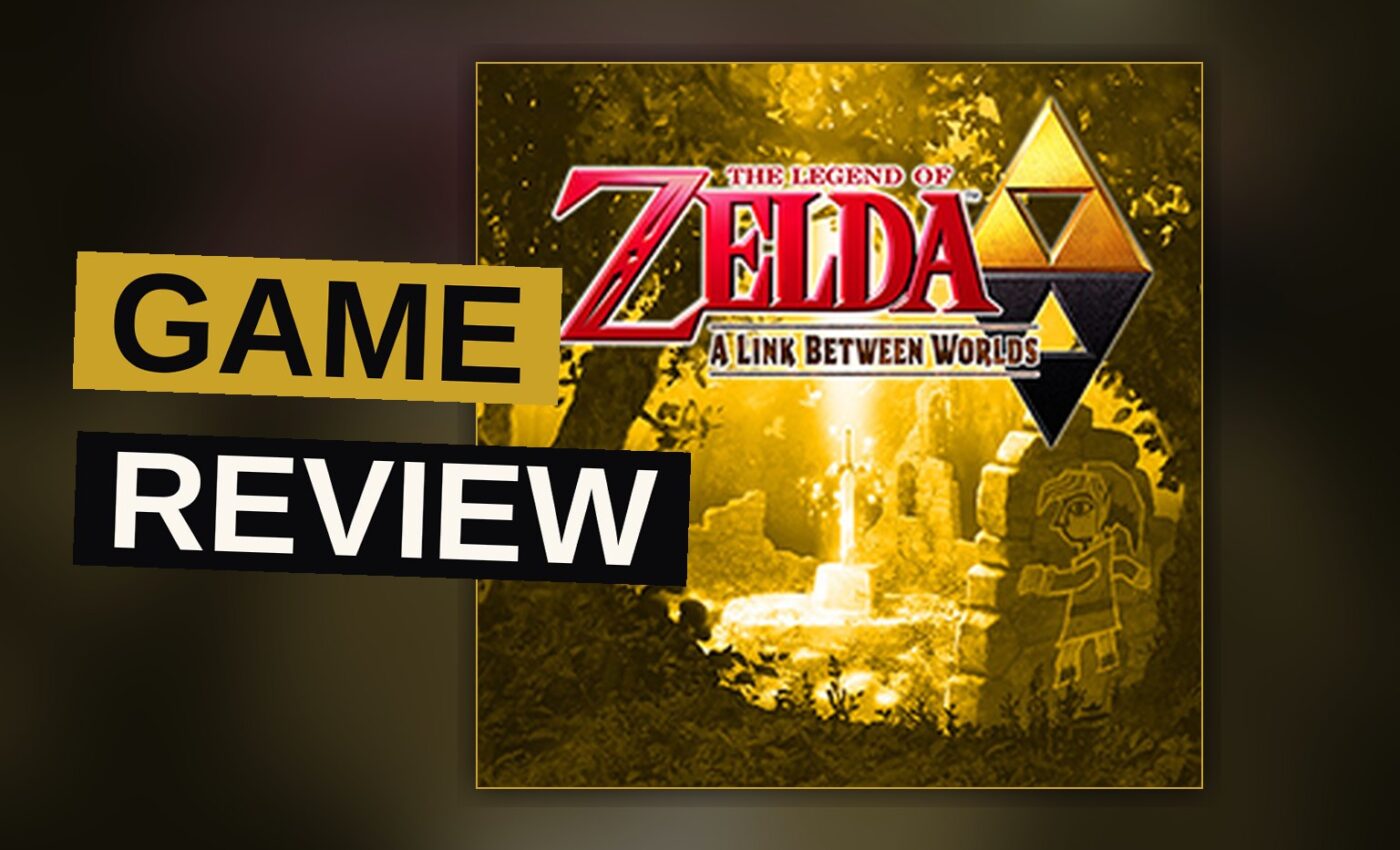
In 2013, Nintendo faced a puzzle. The Legend of Zelda: A Link Between Worlds had to honor a quarter-century of tradition while breaking the rules that tradition had set. The result is a game that feels both like a love letter and a heist. It steals the map of a classic, folds it in half, and hands it back to you with a grin.
The Legend of Zelda: A Link Between Worlds is a direct sequel to the 1991 Super Nintendo game A Link to the Past. It uses the same Hyrule, the same landmarks, the same music. But it refuses to play by the same rules. Where the old game locked its dungeons behind a strict order, this one lets you rent your gear and walk into almost any dungeon you please.
That single decision changes everything.
Trailer, via Nintendo of America.
Merging Into the Wall
The central trick of The Legend of Zelda: A Link Between Worlds is the ability to merge into walls. As a living painting, Link flattens himself against stone and brick, sliding along surfaces that were once just scenery. This is not a gimmick. It is the key to the entire game.
Every dungeon uses the wall mechanic in some way. You slip through cracks to reach switches. You walk along ceilings to cross gaps. You hide from enemies that cannot see a flat drawing. The puzzles are clever without being cruel. They ask you to think in two dimensions at once, and they reward you for it.
The wall merging also changes how you see Hyrule. The overworld becomes a network of hidden paths. A cliff face is not a barrier; it is a hallway. A brick wall is not a dead end; it is a staircase. The game trains you to look at the world differently, and that training pays off in every corner of the map.
Ravio’s Rental Shop
In The Legend of Zelda: A Link Between Worlds, you do not find items in dungeons. You rent them. A merchant named Ravio sets up shop in Link’s house and offers swords, bows, boomerangs, and bombs for a fee. If you die, you lose your rented gear and have to pay again to get it back.
This system is the game’s boldest move. It removes the classic Zelda structure of dungeon-by-dungeon item progression. Instead, you can tackle the game’s dungeons in nearly any order. You might enter the Tower of Hera with a fire rod and nothing else. You might save the ice dungeon for last and come in with everything.
The trade-off is that the game feels shorter and less mysterious than its predecessor. There is no moment of finding a hidden item that unlocks a new region. The world is open from the start, and that openness comes at a cost. Some players will miss the slow burn of discovery. But the freedom is genuine, and it makes the game replayable in a way the old titles never were.
Lorule and Its Princess
The Legend of Zelda: A Link Between Worlds splits its world in two. The light world of Hyrule is familiar ground, full of green fields and friendly towns. The dark world, now called Lorule, is a mirror image where the sky is purple and the people are desperate. You travel between them by merging into cracks in walls.
Lorule is not just a palette swap. It has its own story, its own characters, and its own sense of loss. The kingdom is dying because its Triforce has been destroyed. The princess, Hilda, is not a villain in the classic sense. She is a ruler who made a terrible choice to save her people. The game asks you to understand her, even as you fight against her.
The dual-world structure also gives the game its best puzzles. A wall in Hyrule might lead to a ledge in Lorule. A door in one world might be a dead end in the other. You are constantly flipping between the two, and the game never lets you forget that every place has a shadow.
Sound, Sight, and the 3D Effect
The Legend of Zelda: A Link Between Worlds runs on the 3DS, and it looks like a painting come to life. The colors are bright and saturated. The characters are small and expressive. The world is dense with detail, from the swaying grass to the glint of water. It is not a technical marvel by modern standards, but it has a charm that newer games often lack.
The music is a mix of old and new. The soundtrack reworks themes from A Link to the Past, and it adds new tracks that fit right alongside them. The dungeon themes are tense. The overworld themes are warm. The final boss theme is a storm. The audio does not just accompany the game; it carries the mood.
The 3D effect is worth mentioning. The game uses the 3DS’s stereoscopic display better than almost any other title. The wall merging looks especially good in 3D, with Link flattening into a surface that seems to recede into the screen. It is a small pleasure, but it adds to the sense of wonder.
A Thief Named Yuga
The plot of The Legend of Zelda: A Link Between Worlds centers on a thief named Yuga. He is a painter who turns people into portraits, and he is hunting for the descendants of the Seven Sages. Link must stop him, but the story takes a turn when Yuga succeeds.
The writing is a step up from many Zelda games. The characters have personality. Ravio is a cowardly merchant with a secret. Hilda is a princess with a broken heart. Even Link, who never speaks, feels more present because the game gives him choices about where to go and what to do next.
The ending is a twist that recontextualizes the whole game. Without spoiling it, the final act asks you to reconsider who the hero is and what the villain wanted. It is a rare moment in a Nintendo game where the story actually surprises you.
The Dungeons, Ranked by Feel
The dungeons in The Legend of Zelda: A Link Between Worlds are a highlight. Ten main dungeons sit before the final castle, and each one has a distinct theme. Here is how they land:
- The House of Gales is a tower of wind, with puzzles that push you across open rooms.
- The Dark Palace is a fortress of shadows, built around stealth and timing.
- The Swamp Palace is a ruin of water and mud, where the wall mechanic shines.
- The Tower of Hera is a vertical climb that tests your patience and your aim.
- The Ice Ruins are a cold maze with slippery floors and frozen enemies.
Each dungeon is built around the wall mechanic, but they vary the ways they use it. One dungeon might have you sliding along ceilings to avoid a giant eye. Another might have you merging into a wall to rotate a room. The puzzles are fair. They never require pixel-perfect timing, and they never hide the solution behind obscure logic.
The boss fights are solid. Each boss uses the dungeon’s central item in a clever way, and the final battles against Yuga are genuinely tense. The game does not overstay its welcome. It is shorter than many Zelda titles, but it is tight.
Final Score
The Legend of Zelda: A Link Between Worlds is not a perfect game. The rental system removes some of the joy of discovery. The world, while open, is smaller than it first appears. The difficulty is low for veteran players.
But the game succeeds where it matters. It takes the template of a beloved classic and rebuilds it with a new idea. The wall merging is a mechanic that feels natural and inventive. The freedom to choose your path is genuine. The story is a quiet gem.
It is a game that respects the past without being trapped by it. It is a game that trusts the player to explore, to fail, and to try again. It is a game that knows exactly what it wants to be.
The Legend of Zelda: A Link Between Worlds earns a score of 9.2 out of 10. It is a reminder that a great game does not need to be big. It just needs to be smart.
Get the Notebook.
The day's best stories and every fresh verdict, in plain English, in your inbox by seven. One email a day, no more.