
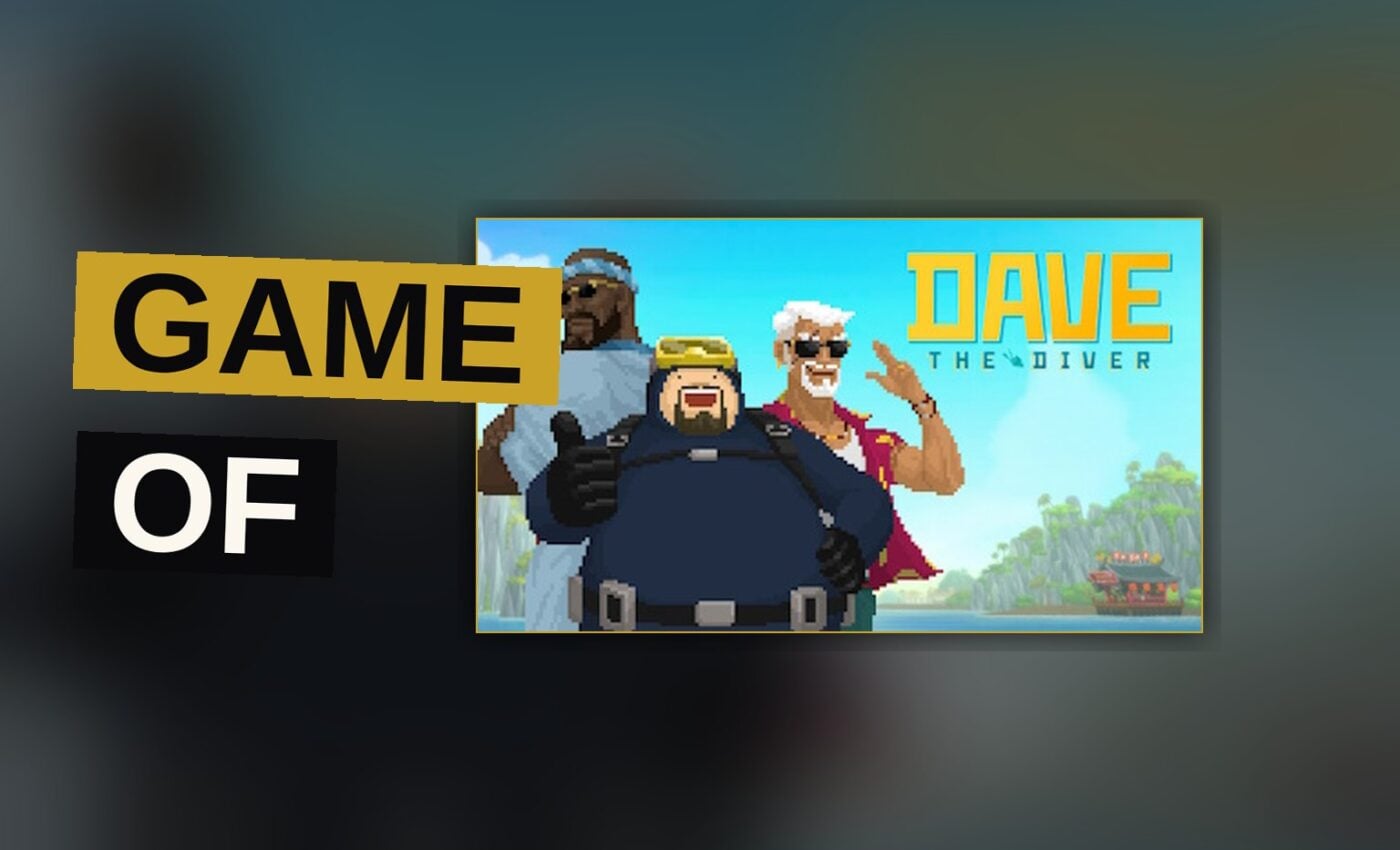
Dave the Diver asks players to spend their days spearing fish in the Blue Hole and their nights slicing them into sushi. It sounds like two games stapled together. It is not. Mintrocket built a single loop where every dive feeds the restaurant and every restaurant night funds the next dive, and that loop holds for dozens of hours.
The game launched on macOS and Windows in June 2023, after an early access run in October 2022. A Nintendo Switch version followed in October 2023. PlayStation 4 and PlayStation 5 arrived in April 2024, and Nintendo Switch 2, Xbox One and Xbox Series X/S in November 2025. Versions for iOS and Android came in September 2026. Across eight outlets, the critic aggregate sits at 9.3/10.
Trailer, via MINTROCKET.
Cobra, Bancho and the Blue Hole
The setup is brisk. Cobra, a former arms dealer, notices that the Blue Hole’s ecology and terrain shift every time he enters it. He sees money. He talks Dave, relentlessly optimistic, and Bancho, a sushi chef who works with rare sea creatures, into opening a restaurant beside the water.
Dave dives. Bancho cooks. The restaurant opens at night.
What starts as a business venture turns into something stranger. Archaeologist Bacon sends Dave into the Blue Hole’s interior, where he finds the descendants of an ancient Sea People living in the deep. Their village is under threat. Dave keeps diving, deeper, looking for a way to stop it. His encounters with the Sea People lead him to the mystery behind the random earthquakes.
Oxygen, Harpoons and Wasabi
The diving half is the tense half. Dave carries a harpoon gun for attacking and reeling in fish, plus guns, melee weapons, harpoon attachments and items he finds on each run. Oxygen is the clock. Aggressive sealife and obstacles drain it faster. Run out before reaching the surface and the session ends early, with only one gathered resource making it back.
Gold earned across the game upgrades Dave — more weight capacity, more oxygen, deeper dives. Later unlocks add fishing nets and drones. The Blue Hole’s terrain and ecology change between visits.
The restaurant half is the calm half, and it is not filler:
- Serving dishes to customers
- Pouring drinks
- Cleaning tables
- Topping up wasabi
Do it well and the restaurant earns gold and reputation, which unlocks recipes, upgrades and cosmetics. VIP guests appear with specific requests, and filling them opens up more of the game, including staff who work the floor for you.
Two Halves That Actually Talk
Most genre hybrids split cleanly in two. Dave the Diver does not. The fish you catch become the menu. The menu’s earnings become the equipment that lets you reach deeper water. The pixel art aesthetic keeps both halves visually consistent, and the side-on perspective serves the diving sections well.
The oxygen system is the sharpest design decision here. It turns every dive into a risk calculation — one more fish, or the surface. Losing a session’s haul because you pushed too far feels, to this reviewer, like the thing that makes the next upgrade feel earned rather than handed over.
Mintrocket keeps adding verbs without losing the thread. Nets, drones, new weapons, new depths. The game rarely repeats a trick long enough to wear it out.
Where It Slips
The restaurant shift can drag. Once the routine is learned, the evening service becomes execution rather than decision, and the wasabi and drink chores do not grow more interesting as the kitchen gets better. The diving half carries the tension; the cooking half carries the charm, and charm alone thins out over a long playthrough.
The story’s turn toward the Sea People felt late and fast to me. Cobra’s scheme, Bacon’s request and the village’s fate are strong material, but the game spends most of its time on fish and sushi before it commits to any of it. Players who came for the management sim may find the back third a different game than the one they signed up for.
Neither problem is fatal. Both are worth knowing before you start.
What Mintrocket Got Right
Dave the Diver earns its reputation by refusing to pick one thing. It is a fishing game, a restaurant sim and an adventure about a hidden civilization, and the parts feed each other instead of competing. The oxygen clock gives the diving real stakes. The upgrade economy gives the restaurant real purpose. The pixel art holds it together.
The 9.3/10 aggregate is not hype, in this reviewer’s judgment. It is what happens when a studio builds a loop tight enough that neither half feels like padding, then keeps feeding it new tools. The evening shift is the weakest link, and the story takes too long to arrive, but the core is strong enough to carry both.
Mintrocket made the rare hybrid where you never resent being pulled away from one half to play the other.
Get the Notebook.
The day's best stories and every fresh verdict, in plain English, in your inbox by seven. One email a day, no more.


