
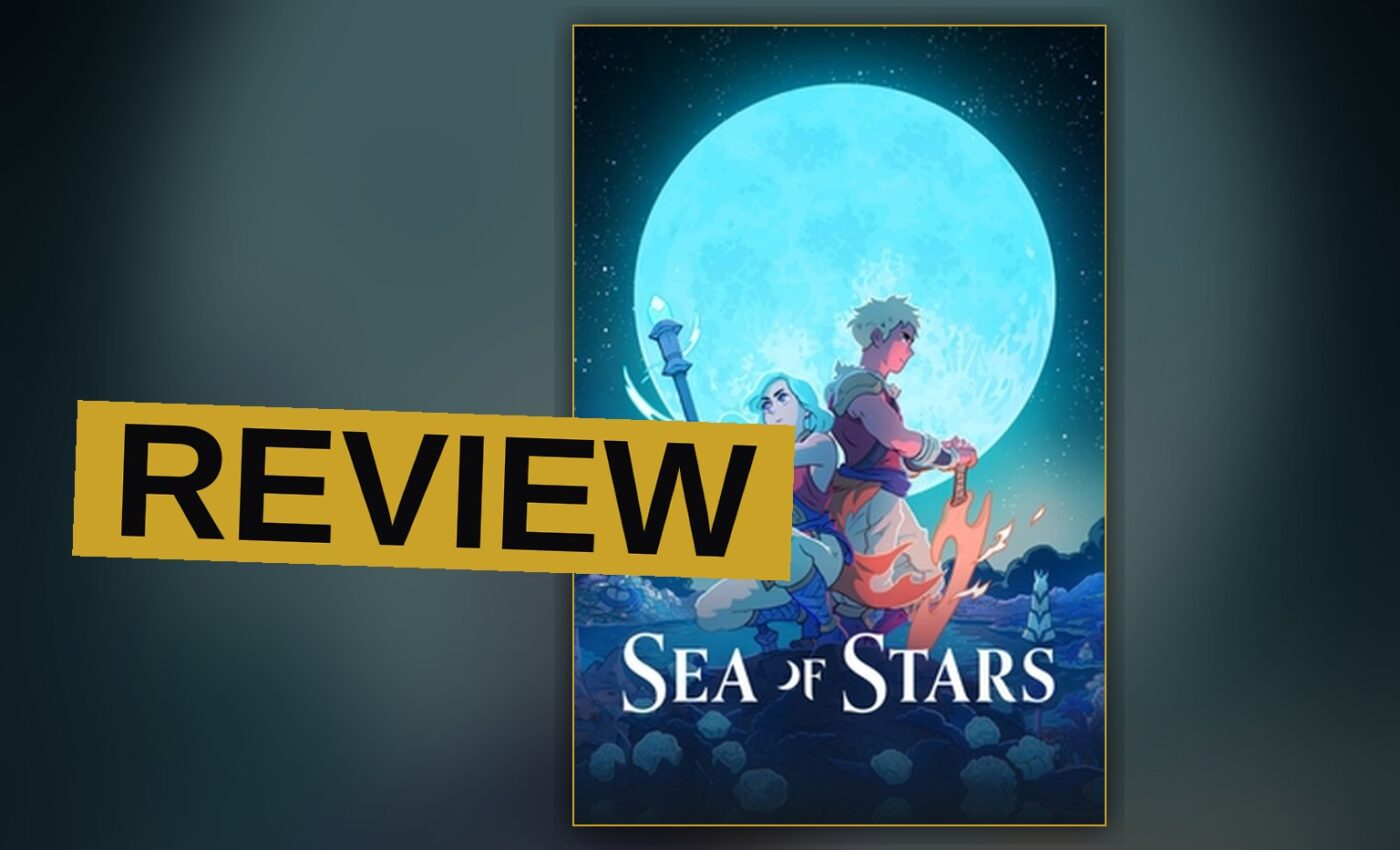
Sabotage Studio’s Sea of Stars opens on an archipelago in a fantasy world, and it never lets you forget that the ground under Valere and Zale’s feet is the same ground the studio built for The Messenger. The turn-based RPG was released in August 2023 for Nintendo Switch, PlayStation 4, PlayStation 5, Windows, Xbox One, and Xbox Series X/S. It carries the Sabotage touch through combat, storytelling, exploration, and the way a body moves through a world that only looks flat.
It is a game that knows exactly which Super Nintendo-era RPGs it grew up on. It just refuses to be a museum piece about them.
The studio’s own summary puts the aim plainly:
Sea of Stars aims to modernize the classic RPG in terms of turn-based combat, storytelling, exploration and interactions with the environment, while still offering a hearty slice of nostalgia and good old, simple fun.
Trailer, via Sabotage Studio.
Valere, Zale, and the Eclipse Magic
You pick one of two Solstice Warriors at the outset. Valere and Zale control the power of the sun and moon, and together they can perform Eclipse Magic, the only force capable of harming the Dwellers — otherworldly monsters made by a god-like alchemist called the Fleshmancer.
The other party members, up to two of them, follow your chosen lead. Their childhood friend Garl, a warrior-cook, joins early. So does Seraï, an assassin. The four of them track down the last known Dweller, the Dweller of Woe, alongside the other Solstice Warriors: Erlina, Brugaves, and Headmaster Moraine.
Then Erlina and Brugaves betray the group and summon a cult that serves the Fleshmancer. The acolytes use the monster’s remains to revive the Dweller of Strife. That turn is the spine of the story, and Sea of Stars treats it with the weight it deserves.
A World You Can Run, Swim, and Climb
The game world splits in two. There is an overworld map that shows the landscape scaled down, and there are navigable areas — forests, towns — rendered at something closer to realistic scale. Both use a fixed isometric view and two-dimensional pixel art.
The terrain is not a set of painted panels. Your characters run, swim, and climb it as if it were fully three-dimensional. That seamless traversal is the studio’s stated goal of integrating art and map design, and it works. You are not walking between screens. You are walking through a place.
In towns you talk to locals to procure items and services, solve puzzles, and run into enemies. Enemies sit at specific spots in the world and attack when you approach. Battles take place in fixed positions at those locations.
Turn-Based Combat With a Clock Running
Battles are turn-based, and there is no time limit on your turns. On each turn, one active party member takes an action: attack, use a unique ability, use an item, or use a special charged ability. Once a character acts, they cannot act again until everyone else in the active party has gone.
Enemies run on countdown timers. The timer counts down the number of player turns until that enemy can act, and multiple enemies can act on the same turn if their timers line up. That is the strategic and real-time element Sabotage built in — you are not just managing your own queue, you are reading theirs.
Co-op mode puts each player on one of the three characters. It is a small addition next to the campaign, but it changes how the turn order feels when someone else is deciding what Seraï does.
The Alchemists and the Hourglass
The back half of Sea of Stars goes cosmic. The party travels to Mesa Island and finds the home of an alchemist named Resh’an, who turns out to be the Fleshmancer’s rival and former associate.
The two of them created the elixir of life, which made them immortal. Over time the Fleshmancer turned cynical and misanthropic, and he made the Dwellers to spread chaos. Resh’an trained the first Solstice Warriors in response, and that started a conflict between the alchemists that spans countless parallel universes.
In each universe, the fight runs until the Dwellers grow into apocalyptic beings called World Eaters, or until the Solstice Warriors gain enough power to become guardian gods. Resh’an agrees to fight alongside the party but warns that he cannot engage the Fleshmancer’s creations directly. That leaves Valere, Zale, Garl, and Seraï to face the Dweller without him.
On the verge of losing, Seraï attacks the Dweller with Resh’an’s hourglass in desperation. Its power draws the Fleshmancer’s attention. The alchemist dismisses the Dweller, the acolytes, and Brugaves to his lair.
How Sea of Stars Compares
| Element | Sea of Stars | The Messenger (same universe) |
|---|---|---|
| Release | August 2023 | Sabotage’s first game |
| Story position | Set before The Messenger | Set later in the same universe |
| Combat | Turn-based, party of up to three | Not turn-based |
| Perspective | Fixed isometric, 2D pixel art | Not fixed isometric |
| Modes | Single player, multiplayer, co-operative | Not listed with co-op |
| Combat resource | How it works |
|---|---|
| Standard action | One party member attacks, uses an ability, uses an item, or uses a charged ability |
| Turn lock | A character cannot act again until all active party members have acted |
| Enemy timer | Counts down player turns until that enemy can act |
| Eclipse Magic | The only force able to harm the Dwellers |
What Actually Lands
The pixel art and the music are the parts that hold up under the most scrutiny. The fixed isometric view is a deliberate constraint, and Sabotage uses it to make scale legible: a town reads as a town, a forest reads as a forest, and the overworld reads as a map you are meant to plan across.
The seamless traversal is the real modernization. Older RPGs of this style moved you between discrete screens, and the seams were part of the texture. Sea of Stars removes them without removing the look. That is harder than it sounds, and it is the clearest evidence that the studio meant what it said about translating the feeling of those games rather than copying them.
The combat holds up too, though it is the safer of the two bets. Turn-based with no time limit is a comfort, and the enemy countdown timers add just enough pressure to keep you from auto-piloting. The charged abilities give each turn a second decision layered on top of the first. It is not a reinvention. It is a well-tuned version of a thing you already know.
Where the game asks the most of you is the plot. The alchemist backstory — the elixir, the immortality, the parallel universes, the World Eaters — arrives late and dense. It is ambitious, and it gives the conflict a scale the early hours do not prepare you for. Whether that lands depends on how much you want your fantasy RPG to explain its own cosmology.
The betrayal by Erlina and Brugaves is the sharper move. It comes from inside the group, not from the villain, and it reframes the Dweller of Woe fight as something other than a clean win.
What the Score Reflects
Sea of Stars is a confident game. It knows what it is borrowing and it knows what it is adding, and it does not confuse the two. The art and map design integration is the strongest argument for it — that is the part that will still look smart in a decade. The combat is excellent but familiar. The late-game cosmology is the part most likely to divide people, and it is also the part that gives the game its size.
An 8.9 out of 10 is the right number. This is not a game that reinvents the turn-based RPG. It is a game that shows how much room is left inside one when the people making it actually understand why the old ones worked.
Get the Notebook.
The day's best stories and every fresh verdict, in plain English, in your inbox by seven. One email a day, no more.


