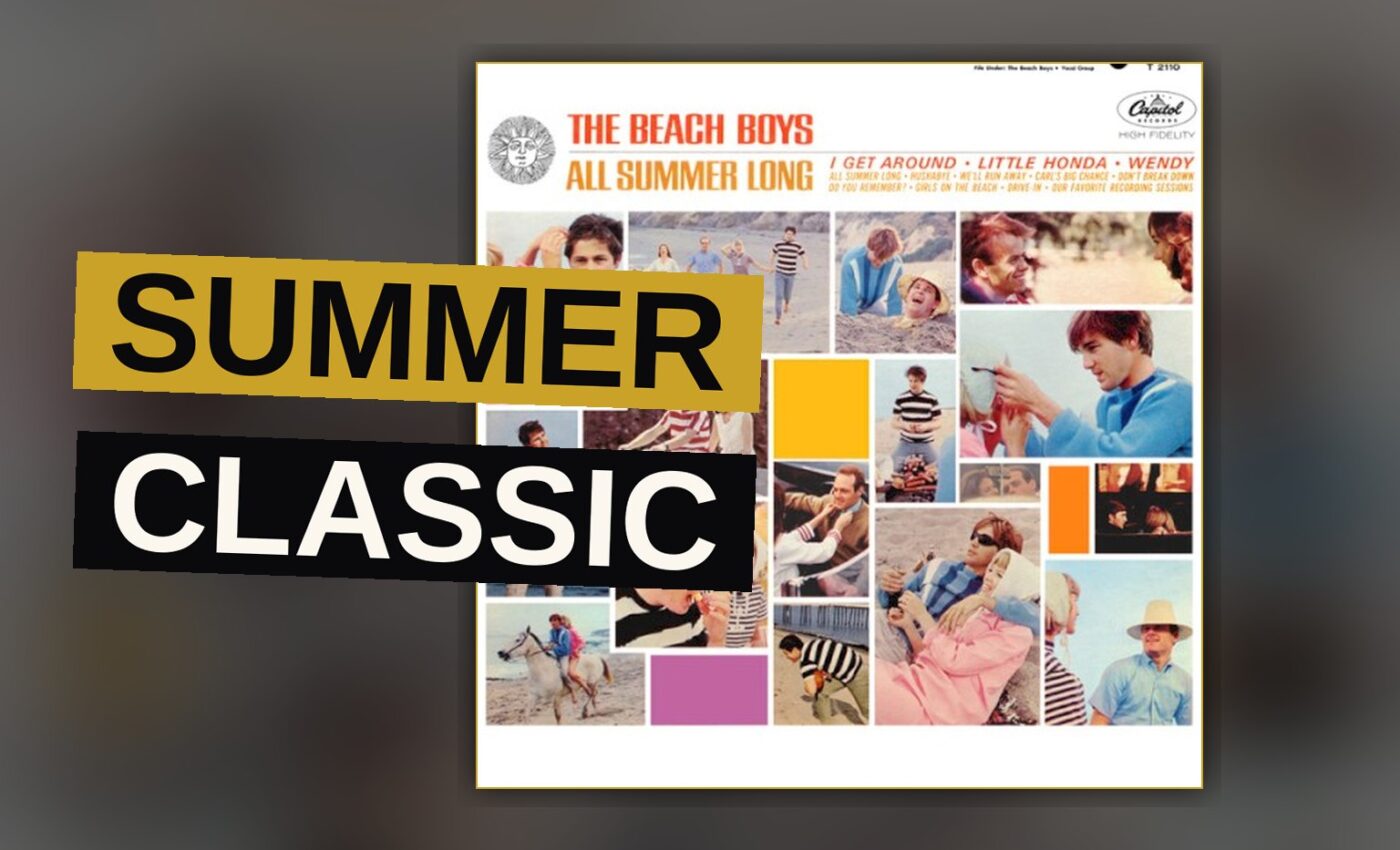
The Beach Boys returned in 1964 with All Summer Long, a short, sun-drenched record that tries to bottle the specific feeling of a California summer — the drive, the girls, the endless stretch of highway — while also pushing their harmonies into more sophisticated territory. It is not a concept album in the modern sense, but it has a tighter theme than their earlier work: this is a record about being young, restless and slightly in love, all set to a beat that never stops moving.
At 24 minutes across 12 tracks, it is one of their leanest efforts, but that brevity works in its favor. There is no fat to trim, no wandering instrumental that overstays its welcome. Every song serves the mood, and the ones that don’t quite land are over before they can drag. It is a record that understands the value of a quick, clean statement.
Opening With I Get Around
“I Get Around” opens the album, and it is hard to imagine a stronger statement of intent. The song is a tremendous ode to summer, the thrill of travel and taking trips up and down the strip, and it sets the pace for everything that follows. The harmonies are tight, the rhythm is relentless, and the chorus lands with the kind of confidence that suggests a band that knows it has found its voice. It is the sound of a group roaring into form, and it remains one of their defining moments.
The title track follows and does something slightly different. Where “I Get Around” is about motion, “All Summer Long” is about the feeling of the season itself — the heat, the haze, the sense that time is moving too fast. It is more reflective, a little wistful around the edges, and it shows a maturity that was not always present on their earlier records. The vocal arrangement is rich, and the lyrics carry a weight that the upbeat tempo might otherwise mask.
Hushabye and the Middle Stretch
“Hushabye” is a cover, but it feels entirely their own. The Beach Boys take the doo-wop original and soften it, stretching the harmonies into something almost lullaby-like. It is a gentle shift in tone after the two opening tracks, and it works because it shows range. This is not just a band that can do fast and loud; they can do tender too, and they do it without losing the summer atmosphere that holds the record together.
“Little Honda” is a different beast entirely. It is a straightforward, engine-revving ode to a motorcycle, and it is exactly as lightweight as that description suggests. The song is fun, but it is also the first sign of the car-and-bike filler that keeps the album from being truly flawless. It does not ruin the record, but it is the kind of track that feels like a placeholder rather than a statement.
The instrumental track that follows is similar. It is pleasant enough, but it does not add much to the overall arc. These two tracks are the weakest stretch of the album, but at under four minutes combined, they are easy to forgive.
“We’ll Run Away” is the surprise buried in the middle of the record. It is a beautiful, aching ballad about young love and the impulse to escape, and it is the kind of song that suggests the Beach Boys were capable of more than just surf and sun. The vocal performance is tender, the melody is gentle, and it stands out precisely because it is so different from the tracks around it. It is a quiet highlight, and it rewards repeated listens.
Wendy and the Back Half
“Wendy” brings the energy back up. It is a classic Beach Boys track in the best sense — catchy, harmonically rich and built around a story of teenage romance that feels both specific and universal. The production is clean, and the chorus is the kind that sticks in the head long after the record ends. It is one of the strongest songs here, and it is easy to hear why.
“Do You Remember?” is a short, nostalgic number that looks back at shared memories. It is not a major statement, but it fits the album’s theme of summer as a time to hold onto. It is the shortest track here, and it works as a brief pause before the record shifts into its final stretch.
“Girls on the Beach” is a slower, more atmospheric piece that leans into the dreamier side of the band’s sound. It is not as immediate as “Wendy” or “I Get Around,” but it has a mood that lingers. The harmonies are lush, and the lyrics capture a kind of adolescent longing that feels honest rather than manufactured. It is a solid mid-tempo track that adds texture to the back half of the record.
“Drive-In” is a light, playful number about a night at the drive-in theater. It is charming, but it is also the second track in a row that leans on a simple setting rather than a deeper idea. Like “Little Honda,” it is the kind of song that fills out the summer theme without pushing the band forward. It is not bad, but it is not essential either.
Recording Sessions and the Closer
“Our Favorite Recording Sessions” is an oddity. It is a track about making the record itself, a meta-commentary that feels ahead of its time in some ways but also slightly gimmicky in others. It does not have the melodic strength of the album’s best moments, but it is interesting as a glimpse into the band’s process. It is the kind of song that works better as a curiosity than as a lasting piece of music.
“Don’t Back Down” closes the album with a sturdy, determined track that brings the record full circle. It is not as explosive as the opening, but it is a fitting end — a song about standing your ground that carries the same restless energy that runs through the whole project. It is a strong closer, and it leaves the listener with the sense that the band is only getting started.
The Verdict
All Summer Long is one of the best records the Beach Boys made in their early period, and it is a clear artistic step forward. The harmonies are more refined, the songwriting is more personal and the album as a whole has a coherence that their earlier work lacked. It is not perfect — the filler tracks are there, and they are hard to ignore when you are looking at the track list as a whole — but the highs are high enough to carry the record.
The semi-autobiographical quality of the songwriting is a big part of what makes it work. These are songs about real feelings, real places and real experiences, and that gives the album a grounding that pure surf-rock pastiche never quite achieves. The band is not just celebrating summer; they are remembering it, and that slight distance makes the music feel more mature.
It is also a record that rewards attention to the running order. The sequencing is smart, moving from the explosive opener through the tender middle and into the reflective back half, and that flow makes the 24 minutes feel like a complete statement rather than a random collection of singles. The shorter tracks serve as breathing room, and the stronger ones benefit from the contrast.
There is a reason this record is remembered as a turning point. It is the moment the Beach Boys started to sound like the band they would become — not just a surf group, but a vocal group with real ambition and real range. All Summer Long is not their greatest album, but it is the one where they found their footing, and that makes it essential.
The record is not without its flaws, and the lightweight car-themed tracks are the clearest example of that. But those moments are brief, and they do not diminish the strength of the whole. This is a band at the top of its early game, making music that feels both of its time and ahead of it. The summer may end, but the record keeps its heat. Score: 9 of 10.
Key Facts
- Album: All Summer Long by The Beach Boys
- Release Year: 1964
- Total Running Time: 24 minutes
- Track Count: 12
- Length of “Do You Remember?”: 1:37
Tracks Worth Noting
- “I Get Around”
- “All Summer Long”
- “Hushabye”
- “We’ll Run Away”
- “Wendy”
- “Little Honda”
Get the Notebook.
The day's best stories and every fresh verdict, in plain English, in your inbox by seven. One email a day, no more.
- I Get Around2:10
- All Summer Long2:05
- Hushabye2:37
- Little Honda1:50
- We'll Run Away2:00
- Carl's Big Chance2:00
- Wendy2:20
- Do You Remember?1:37
- Girls on the Beach2:25
- Drive-In1:50
- Our Favorite Recording Sessions2:00
- Don't Back Down1:50