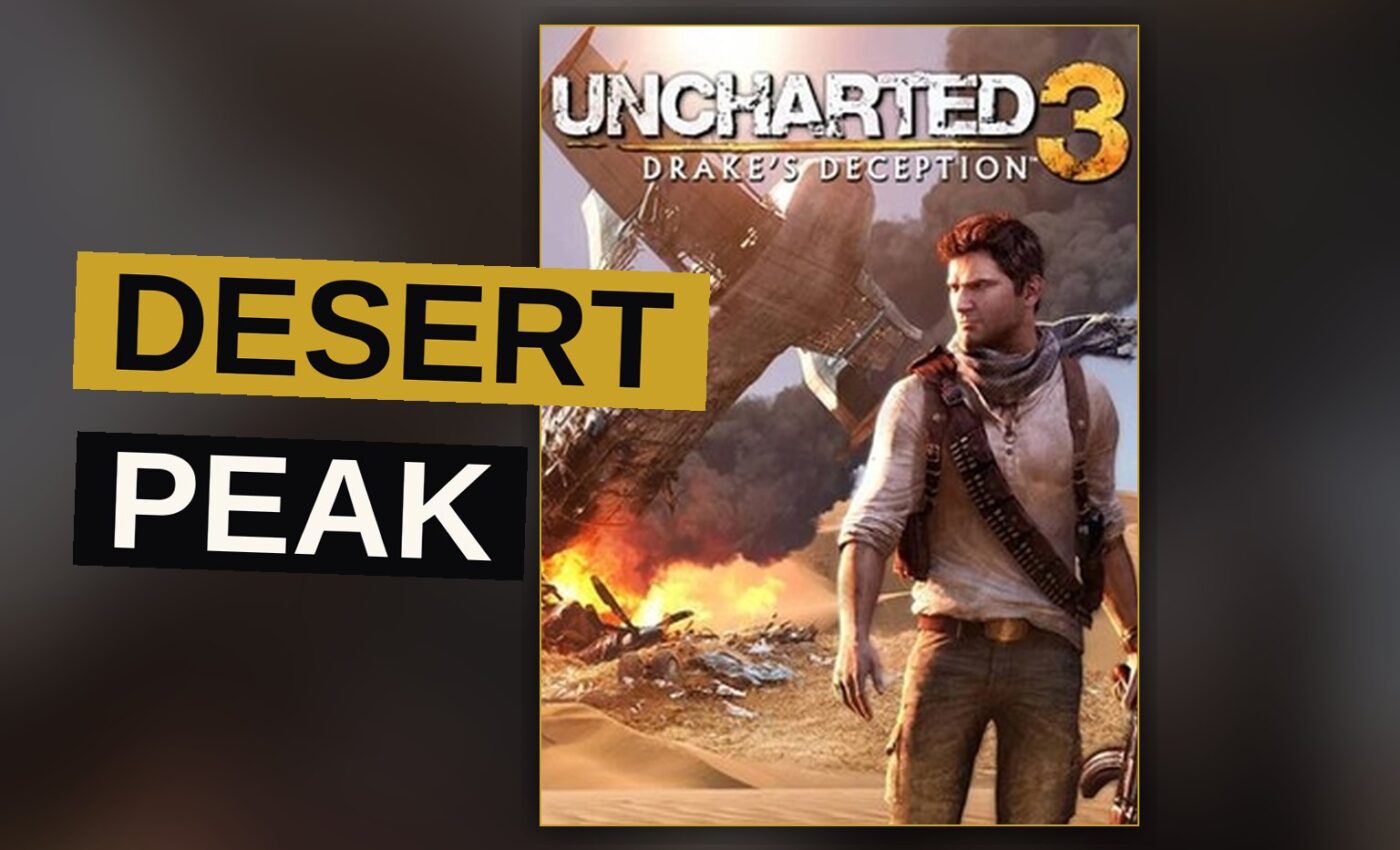
Uncharted 3: Drake’s Deception opens with a bar fight in London, and within ten minutes you are hanging off a moving truck, then a rooftop, then a plane. It is a game that never stops escalating, and it knows exactly how to keep you off balance. Naughty Dog’s 2011 PS3 exclusive is not just a sequel to Uncharted 2: Among Thieves. It is a statement.
The story sends Nathan Drake and his mentor Victor Sullivan across the globe in search of the lost city of Iram of the Pillars. The trail starts with a brass ring, leads through a Syrian desert, and ends in a hallucination-fueled walk through the Rub’ al Khali. It is ridiculous, and it is glorious.
Trailer, via PlayStation.
Cargo Plane Over the Desert
The plane sequence is the moment everyone remembers. Drake climbs onto the wing of a cargo plane mid-flight, fights soldiers in the open air, and survives the crash by clinging to a falling crate. It is absurd. It is also the purest expression of what this series does best: turning impossible action into playable spectacle.
The sequence lasts about fifteen minutes, but it feels like a single breath. The wind whips, the camera shakes, and the game never gives you a moment to think. When the plane tears apart, you are already moving to the next handhold. It is the kind of set piece that other games have tried to copy and failed to match.
Cruise Ship Sinking
The cruise ship is a different kind of thrill. Drake boards a luxury liner to chase Marlowe’s crew, and then the ship starts to capsize. The game turns the entire level into a physics puzzle. Rooms tilt, water floods in, and the floor becomes a wall. You are not just moving through a level; you are moving through a level that is actively trying to kill you.
It is slower than the plane sequence, but it is smarter. The game forces you to rethink how you move. A corridor you ran through five minutes ago is now a vertical shaft. The sinking ship is a masterclass in environmental storytelling.
Chateau Fire
The French chateau is the quietest of the big set pieces, and the most tense. Drake infiltrates a mansion to steal a key, and the place catches fire. The flames spread, block paths, and force you to move faster than you want. It is the closest the game comes to horror.
The fire is not just a backdrop. It is a mechanic. You can see it creeping across the ceiling, and you know the exit is going to close before you reach it. The chateau sequence is short, but it lingers.
Rub’ al Khali Walk
The desert is the emotional peak of Uncharted 3: Drake’s Deception. After the plane crash, Drake is alone in the Rub’ al Khali. No weapons, no allies, no map. Just sand and heat. The game strips away combat and platforming and lets you walk.
It is a long, quiet sequence, and it is the best part of the game. The visuals are stunning. The sand shifts, the heat shimmers, and the camera pulls back to show Drake as a tiny figure against an endless landscape. He is dehydrated, hallucinating, and barely holding on.
The sequence ends with a hallucinated conversation with Sully. It is a brief scene, but it adds depth to a character who is usually defined by wisecracks. For a few minutes, the game stops being a spectacle and becomes a character study.
Combat and Melee Upgrades
The gunplay is an improvement over Uncharted 2, but it is still the weakest part of the package. The cover system is sticky and reliable, but enemies are bullet sponges. Headshots are satisfying, but the game throws so many soldiers at you that fights can drag.
The melee system is the real upgrade. Drake can dodge, counter, and chain punches in a way that feels like a proper brawler. The hand-to-hand fights are fast and readable, and they break up the shooting nicely. The game also adds a throw mechanic, letting you toss enemies into each other or off ledges. It is simple, but it is fun.
Marlowe and the Story
The villain, Katherine Marlowe, is a member of a secret society that has hunted Drake’s family for generations. She is competent and cold, but she lacks the charisma of Uncharted 2’s Zoran Lazarevic. She is a threat, not a personality.
The real story is about Drake and Sully. The game reveals that Sully met Drake when Drake was a teenager, and that Sully has always been the closest thing Drake has to a father. The dynamic is touching, and it gives the action a stake. When Sully is captured, you believe Drake would risk everything to save him.
| Character | Role | Actor |
|---|---|---|
| Nathan Drake | Protagonist, treasure hunter | Nolan North |
| Victor Sullivan | Mentor, father figure | Richard McGonagle |
| Katherine Marlowe | Antagonist, secret society leader | Rosalind Ayres |
| Elena Fisher | Journalist, Drake’s estranged wife | Emily Rose |
| Chloe Frazer | Treasure hunter, Drake’s ally | Claudia Black |
Multiplayer and Technical Notes
The multiplayer is a surprise. Uncharted 2 had a solid competitive mode, and Uncharted 3 expands it with co-op adventure and arena modes, plus wider customization. The gunplay translates well, and the maps are well designed. It is not Call of Duty, but it is a fun distraction.
The technical performance is a mixed bag. The game runs at a mostly stable frame rate, and the draw distances are impressive. There are occasional texture pop-ins and a few dips during chaotic firefights. These are minor issues. The game is still one of the best-looking titles on the PS3.
The audio is excellent. The score, composed by Greg Edmonson, mixes orchestral swells with Middle Eastern instruments. The sound design is punchy, and the voice acting is top tier.
Comparing the Sequels
| Aspect | Uncharted 2: Among Thieves | Uncharted 3: Drake’s Deception |
|---|---|---|
| Best Set Piece | Train sequence | Cargo plane sequence |
| Story Focus | Drake and Elena | Drake and Sully |
| Combat | Solid, basic melee | Improved melee, more options |
| Visual Peak | Himalayan monastery | Rub’ al Khali desert |
| Multiplayer | Good foundation | Expanded, more modes |
Uncharted 3: Drake’s Deception is a game that knows exactly what it is. It does not reinvent the genre, and it does not need to. It takes the formula from Uncharted 2, polishes it, and adds enough new moments to justify the sequel.
The desert sequence alone is worth the price of admission. The plane crash is a moment that will be replayed for years. The story of Drake and Sully gives the action a heart that most shooters lack. The flaws are real: the combat can drag, the villain is forgettable, and the puzzles are trivial.
It is not the best game in the series, but it is the most ambitious. It is a technical marvel and a reminder that Naughty Dog was, at the time, the best studio in the world at making this kind of game.
Uncharted 3: Drake’s Deception earns a 9.3 out of 10.