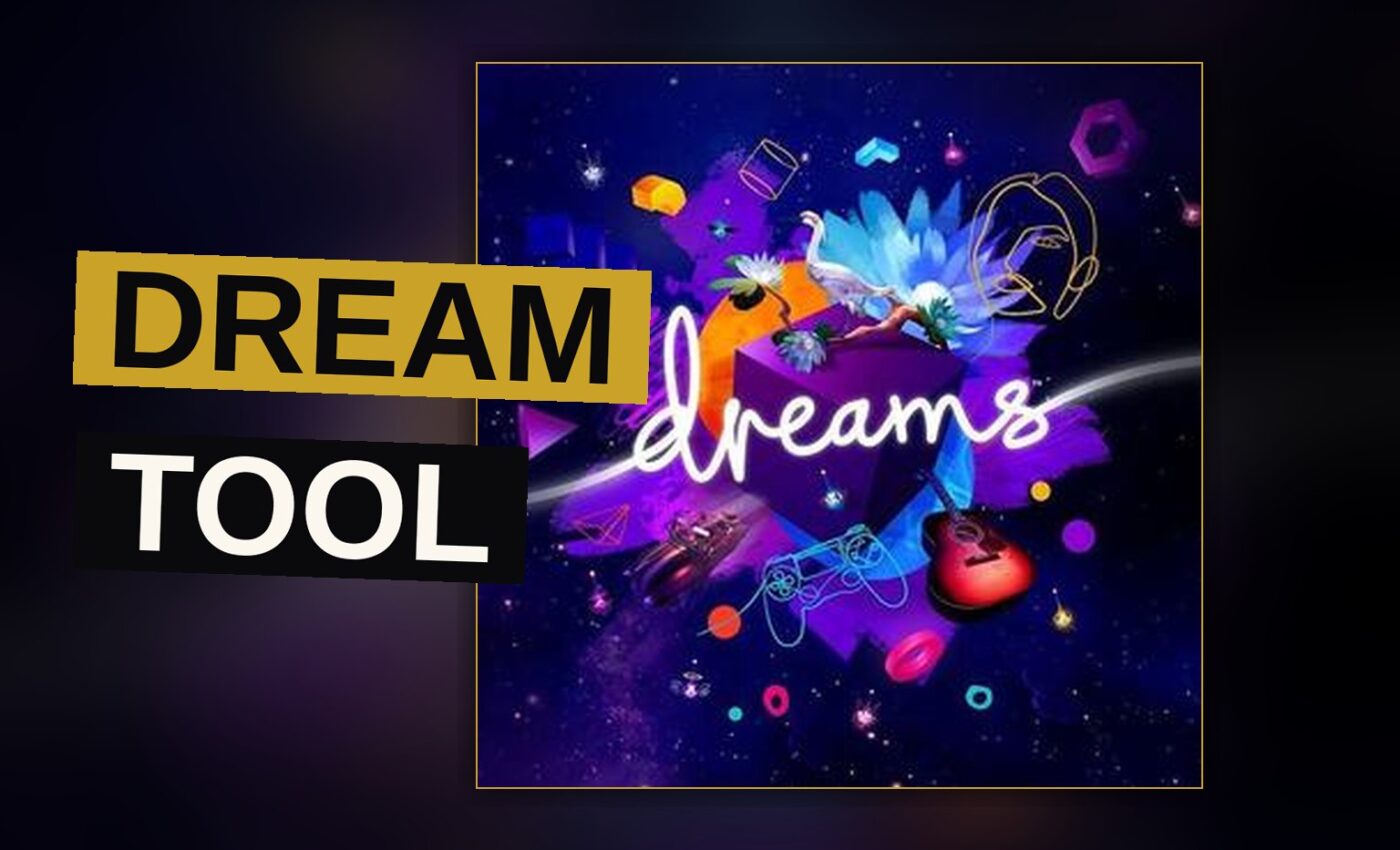
Dreams is a game that asks you to make games, and that single idea changes everything. Media Molecule’s ambitious creation suite for PS4 and PS5 is not a traditional game in any sense, and that is precisely its power. It is a toolbox, a canvas, and a distribution platform wrapped in one, and it works far better than anyone had a right to expect.
What Dreams Actually Is
Dreams hands you a world of infinite possibility and tells you to get on with it. The game is built around the act of creation, letting players sculpt 3D models, paint textures, animate characters, and program logic without writing a single line of code. The interface is daunting at first, but the game’s own tutorials are patient and thorough.
The result is a game that is less about playing and more about making. You can spend hours just fiddling with the sculpting tools, pulling and pushing digital clay into shapes that resemble nothing in particular. That is fine. Dreams does not judge your output, and the community is remarkably supportive of even the most amateur efforts.
Art’s Dream Campaign
Dreams ships with a story mode called Art’s Dream, and it is a strange, wonderful thing. It follows a jazz musician named Art through a series of surreal vignettes, mixing platforming, puzzle-solving, and rhythm sections. The tone shifts constantly, from melancholic to whimsical, and the whole thing feels like a playable art film.
Art’s Dream is not the reason to buy Dreams, but it is a solid showcase. It demonstrates what the tools can do when a professional team gets its hands on them, and it is a pleasant few hours. The platforming is serviceable, the puzzles are light, and the music is genuinely lovely. It is a proof of concept more than a masterpiece, and that is okay.
Creation Tools in Depth
The real meat of Dreams is in its creation tools, and they are astonishingly deep. The game gives you a palette of sculpting brushes, a timeline for animation, a gadget system for logic, and a sound editor that lets you compose music note by note. None of it is easy, but all of it is learnable.
Media Molecule has built an interface that works on a controller, which is a small miracle. You move a cursor with the analog sticks, and you can rotate, scale, and paint with the shoulder buttons. It is clumsy compared to a mouse and keyboard, but it is also surprisingly intuitive after a few hours. The game even supports the PlayStation VR headset on PS4, letting you sculpt in three dimensions, which is a thrill.
The logic system is where Dreams gets complicated. It is a visual scripting language, with gadgets that emit signals, detect collisions, and control cameras. It is powerful enough to build a full game, but it requires real patience. The community has produced tutorials that break it down, and the learning curve is steep but fair.
Community Creations
Dreams lives and dies by its community, and the community is extraordinary. Players have uploaded thousands of creations, from tiny sketches to full games, and the quality ranges from charming to jaw-dropping. You can browse a curated feed, follow creators you like, and remix anything you find.
The game’s search and discovery tools are decent, though not perfect. You can search by genre, popularity, or tag, and the game surfaces new content constantly. The best creations are genuinely impressive, like a full platformer with tight controls or a short film with voice acting. The worst are broken experiments, but even those are interesting to poke at.
Dreams also includes a “Dream Surfing” mode that plays through curated collections of creations, and it is the best way to find good stuff. Media Molecule’s team curates these lists, and they have good taste. You can spend an entire evening just bouncing between other people’s dreams, and that is the game at its finest.
Playing Other People’s Dreams
The games you play in Dreams are wildly varied. There are racing games, shooters, puzzle games, horror games, and platformers. Some are only a few minutes long, and some are sprawling epics that take hours to finish. The quality is inconsistent, but the sheer variety is a joy.
A few standout creations have become famous in the community. There is a remake of a classic arcade game, a clever puzzle game about perspective, and a horror experience that made me jump. None of them are as polished as a commercial release, but they have a handmade charm that is impossible to fake.
The controls for playing other people’s Dreams are also flexible. Each creation can define its own control scheme, and the game lets you remap buttons if you want. Some creations are janky, with awkward cameras or slippery movement, but that is the nature of user-generated content. You learn to be patient.
Performance and VR
Dreams runs on PS4, PS4 Pro, and PS5, and the performance varies. On a base PS4, the game can struggle with complex scenes, dropping frame rates and showing pop-in. On a PS5, it runs much smoother, and the load times are dramatically shorter. The PSVR support works best on PS4 Pro, where the resolution is acceptable, though it is not a system seller on its own.
The game’s graphics are charming rather than cutting-edge. The default look is soft and painterly, with a pastel palette that suits the game’s mood. You can push the tools to create more realistic scenes, but they come at a cost to performance. The audio is similarly flexible, with a built-in synthesizer and sample editor.
One technical flaw is the game’s memory limits. Each creation is capped at a certain amount of thermo, which limits how much you can put in a scene. Skilled creators learn to work around it, but it can be frustrating when you hit the ceiling. The game does a good job of explaining the limits, but they are still there.
How It Compares
Dreams is not for everyone. If you want a traditional game with a clear story and a defined ending, you will be disappointed. If you want a creative outlet that can absorb hundreds of hours, it is one of the best things you can buy. The tools are deep, the community is alive, and the possibilities are endless.
Media Molecule has built something genuinely new, and it is a marvel. The game rewards patience and curiosity, and it offers a creative freedom that no other console game matches. It is rough around the edges, but it is also a miracle of engineering and design.
- The sculpting tools are intuitive after a learning curve
- The logic system is powerful but requires dedication
- The community delivers a constant stream of new content
- The PSVR support adds a new dimension to creation
| Aspect | Dreams | Traditional Game |
|---|---|---|
| Core focus | Creation and sharing | Playing a designed experience |
| Content length | Endless user-generated | Fixed campaign |
| Learning curve | Steep | Gentle |
| Replay value | Infinite | Finite |
Dreams is a game that will keep giving if you give it time. It is not a polished AAA title, but it is something rarer: a genuine platform for creativity. It deserves your attention, whether you want to make something or just play what others have made.
The score is 8 of 10.