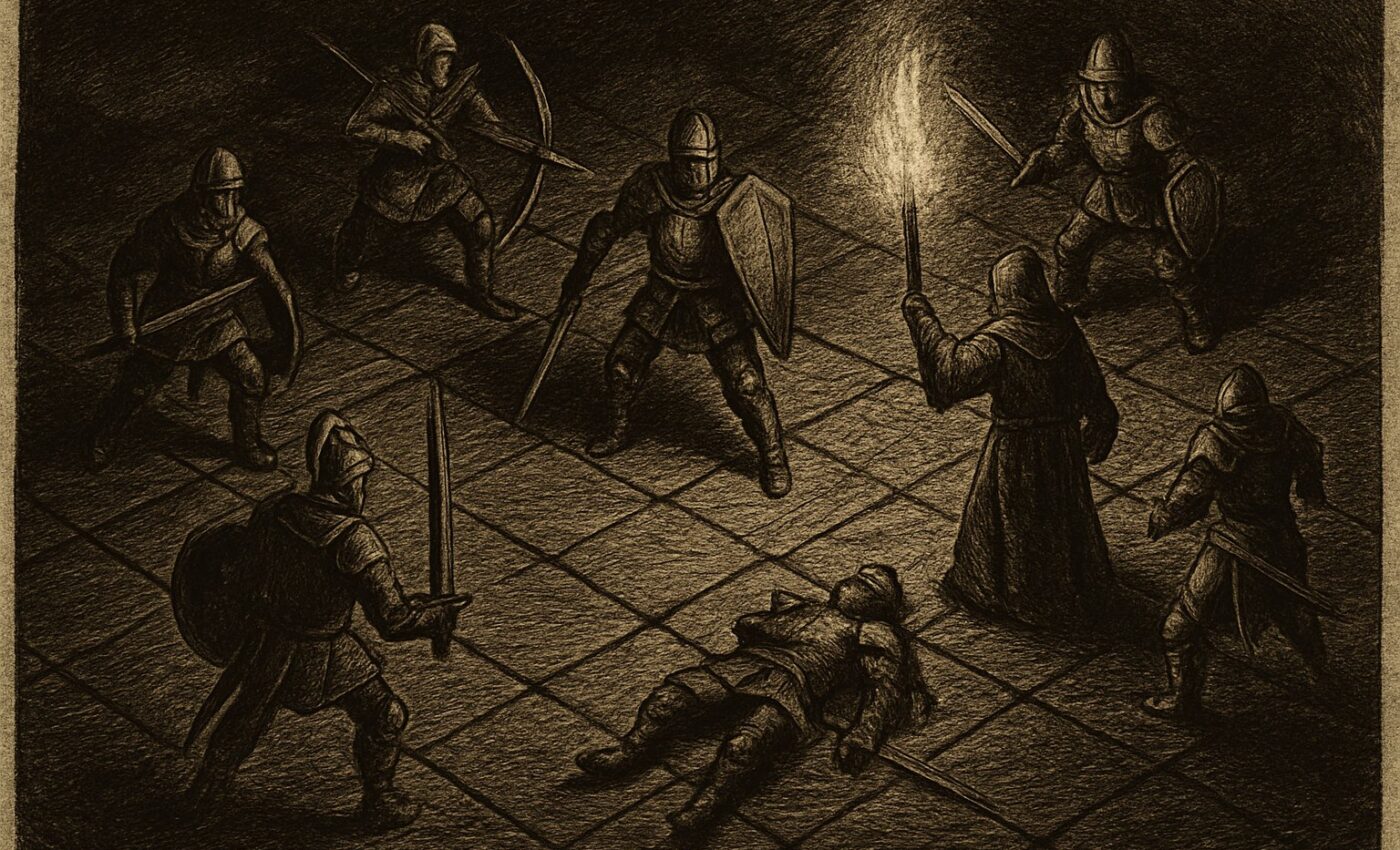
Tactics Ogre: Let Us Cling Together arrived on the Super Famicom in 1995 from developer Quest, and it remains the most demanding strategy role-playing game of its era. It is a 3D isometric tactical RPG built on hard choices, and it does not hold the player’s hand through any of them.
Denam Pavel and the Liberation Army
The game follows Denam Pavel, son of Abuna Prancet. After the Dark Knights Loslorien take Prancet and massacre his home town, Denam, his sister Catiua and his friend Vyce swear a vendetta. Denam leads the Liberation Army to free the oppressed nation of Valeria.
The setup is grim and political, not a chosen-one fantasy. Valeria has spent eighty years in strife among three ethnic groups. King Rodrick used the forbidden powers of the “Palace of the Dead” to dominate the people until Dorgalua of Bakram defeated him and took the throne. Dorgalua preserved the rights of the people and halted the internal struggles.
Then the entire royal family was lost to a string of accidents. With no living heirs, Abuna Brantyn, Heirophant Balbatos and Duke Ronwey fought for control. Balbatos and Brantyn stalemated.
Balbatos, Brantyn and the Stalemate
Their measures define the game’s moral weather. Balbatos pursued an “ethnic cleansing” policy and slaughtered thousands of innocent Walister and Galgastani. Brantyn took aid from the Dark Knights Loslorien of the Holy Lodis Empire. Neither man is a villain in a costume, and the game never lets Denam stand outside that rot.
The non-linear storyline branches toward eight possible endings. Choices between battles decide which one you reach.
Classes, Crafting and Safe Training
The systems are dense, and they are the point. The player starts with a band of troops, builds a small army, and fights many battles.
- Over six male character classes
- Six female character classes
- Three demi-human classes
- Individual equipment control for each character
- Recruitment of new characters
- Safe training locations to prepare the army
That last item matters more than it sounds. You can grind at safe locations before a storyline advance, which turns preparation into a decision instead of a punishment.
Eight Endings, One Army
The bird’s-eye isometric view keeps every unit readable, and the turn-based tactical battles reward positioning over raw numbers. Recruiting and equipping individual characters gives the army a texture most strategy games of the period never attempted. The game asks you to care about a roster, then asks you to spend it.
It is also slow. The opening hours demand patience, and the branching structure means a single choice can close off content you will not see without a second run. That is a cost, and Tactics Ogre charges it without apology.
The Remake and What It Fixed
Square Enix remade Tactics Ogre in 2010, directed by original artist Hiroshi Minagawa, with writer and designer Yasumi Matsuno and composers Hitoshi Sakimoto and Masaharu Iwata returning. Akihiko Yoshida supervised art direction, Tsubasa Masao redesigned many characters, and Alexander O. Smith and Joseph Reeder handled the English localization.
The remake added equipment crafting, the ability to revisit branch points, and multiplayer. Downloadable content built around the new systems shipped free in Japan and was bundled into the Western release.
Why the 1995 Original Still Holds
The 2010 version is the easier recommendation for a new player. The branch-point feature alone removes the fear that defines the original, and crafting smooths the equipment grind.
But the 1995 Tactics Ogre is the version that made the reputation, and the reason is structural. Eight endings, a war between ethnic groups with no clean side, and a protagonist whose vendetta sits inside a larger slaughter — that combination was rare then and is rare now. The remake improved the container. The original built the thing worth containing.
Play the original for the design, the remake for the comfort. Either way, Valeria is worth the campaign.
Get the Notebook.
The day's best stories and every fresh verdict, in plain English, in your inbox by seven. One email a day, no more.