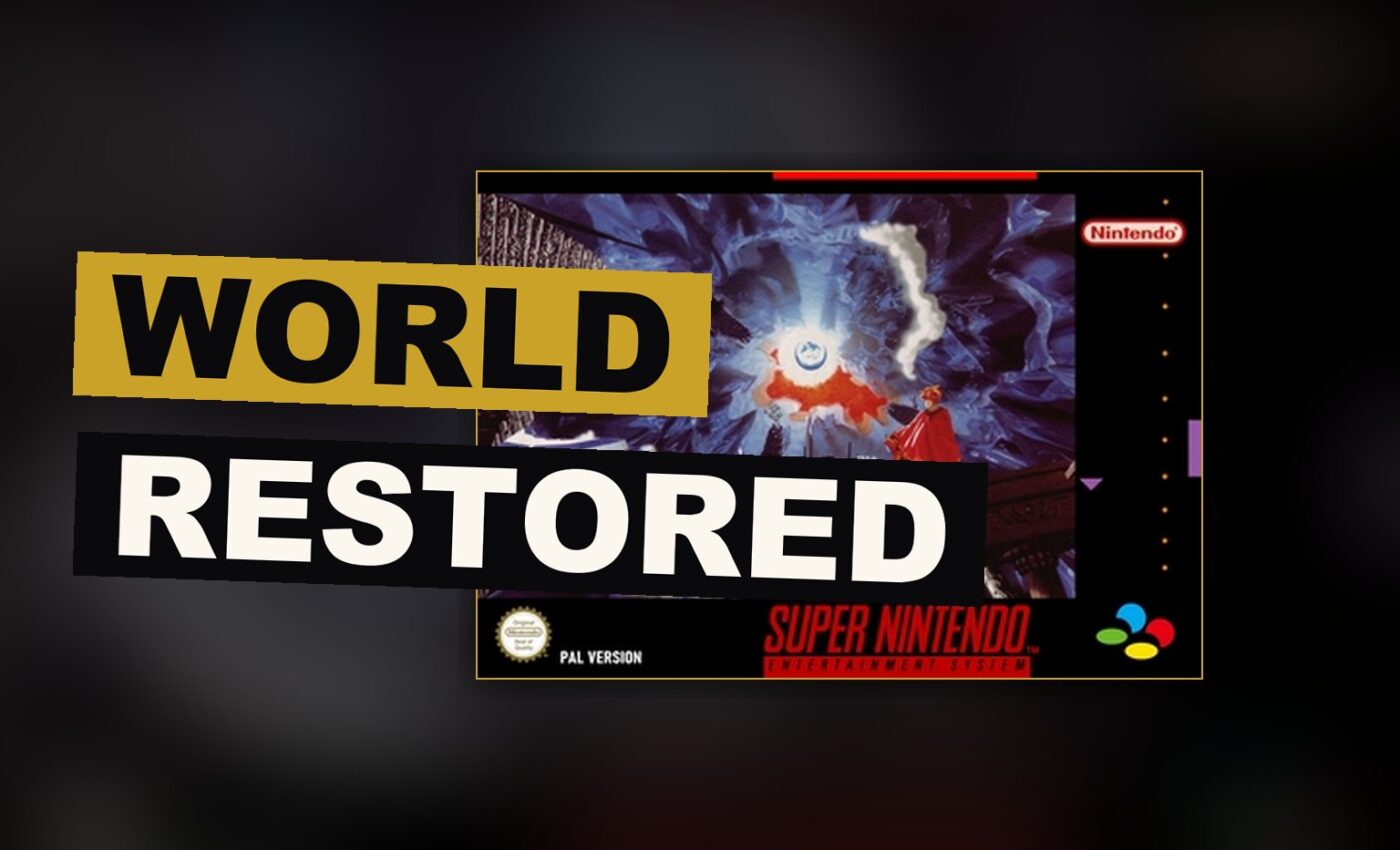
Terranigma never reached North America during its original run on the Super Nintendo. It did appear in an official English version in Europe. Decades later, the game still stands as one of the console’s finest quiet achievements. It asks a player to restore an entire world, one piece at a time, and it rarely wastes a moment doing so.
The Premise
The story begins with a boy who opens a forbidden box in a village set beneath the ground. That single act destroys the surface world above him. From there, Terranigma sends the boy above ground to restore continents, bring back species, and help bring back peoples from nothing at all.
The scale is the point. Few games from that time ask this much of a player’s imagination, and fewer still deliver on the promise. Each new continent the boy restores changes the land in a visible way, so the player watches the results of the story build up region by region rather than all at once.
That sense of watching a whole world come back to life, piece by piece, gives Terranigma a charm that many games from the same period do not attempt. It is a long game, and it asks for patience, but the payoff arrives again and again as new land opens up.
Fighting and Design
Terranigma moves fast. The hero strikes with his sword directly in front of him, with no pause and no separation between traveling the world and fighting through it. The pace holds steady across the game’s long run, and the difficulty grows without ever feeling cheap.
The fighting itself stays simple across the whole game, built around a few moves rather than long lists of commands chosen from menus. That simplicity keeps the pace quick even during the hardest parts near the end.
| Element | Terranigma | Other console games of its time |
|---|---|---|
| Fighting style | Direct, immediate strikes | Commands chosen from menus |
| World design | Regions restored one after another | A whole world laid out from the start |
| Story scope | Full restoration of a broken world | A single kingdom or party’s journey |
| Tone | Comic and sad, side by side | Mostly one mood throughout |
Sound and Look
The score changes as the boy’s progress unfolds. Early music in the village below ground sounds close and quiet. Once the surface world starts to return, the music opens up, growing brighter as fields, towns, and forests come back into view.
The look of the game follows the same arc. Settings appear bare and simple at first, then fill in with a level of detail that few games of that time attempt. Towns grow busier, forests grow thicker, and the color on screen grows richer as the story moves forward.
Terranigma moves between comedy and grief without warning, and it works. One town might offer a cheerful side story, jokes included, right before the game returns to themes of loss and destruction.
That variety gives Terranigma a mood rare among console games of its time. Few games manage both a joke and a moment of real sadness within the same hour, yet Terranigma does this again and again without the change ever feeling forced.
“Terranigma moves between comedy and grief without warning, and it works.”
That balance is part of why players who finish Terranigma tend to speak of it as a game that earns a lasting place among the best of its console.
Final Word
Terranigma is not without faults. Its closing part narrows into a simple path to the credits after a much wider opening, and the pacing there feels rushed compared to everything before it. But few games on the Super Nintendo handle story, pacing, and design with this much control at once.
Terranigma earns its place as one of the console’s essential games. It succeeds by taking on a massive idea — restoring a broken world — and never losing sight of the boy at the center of that story.