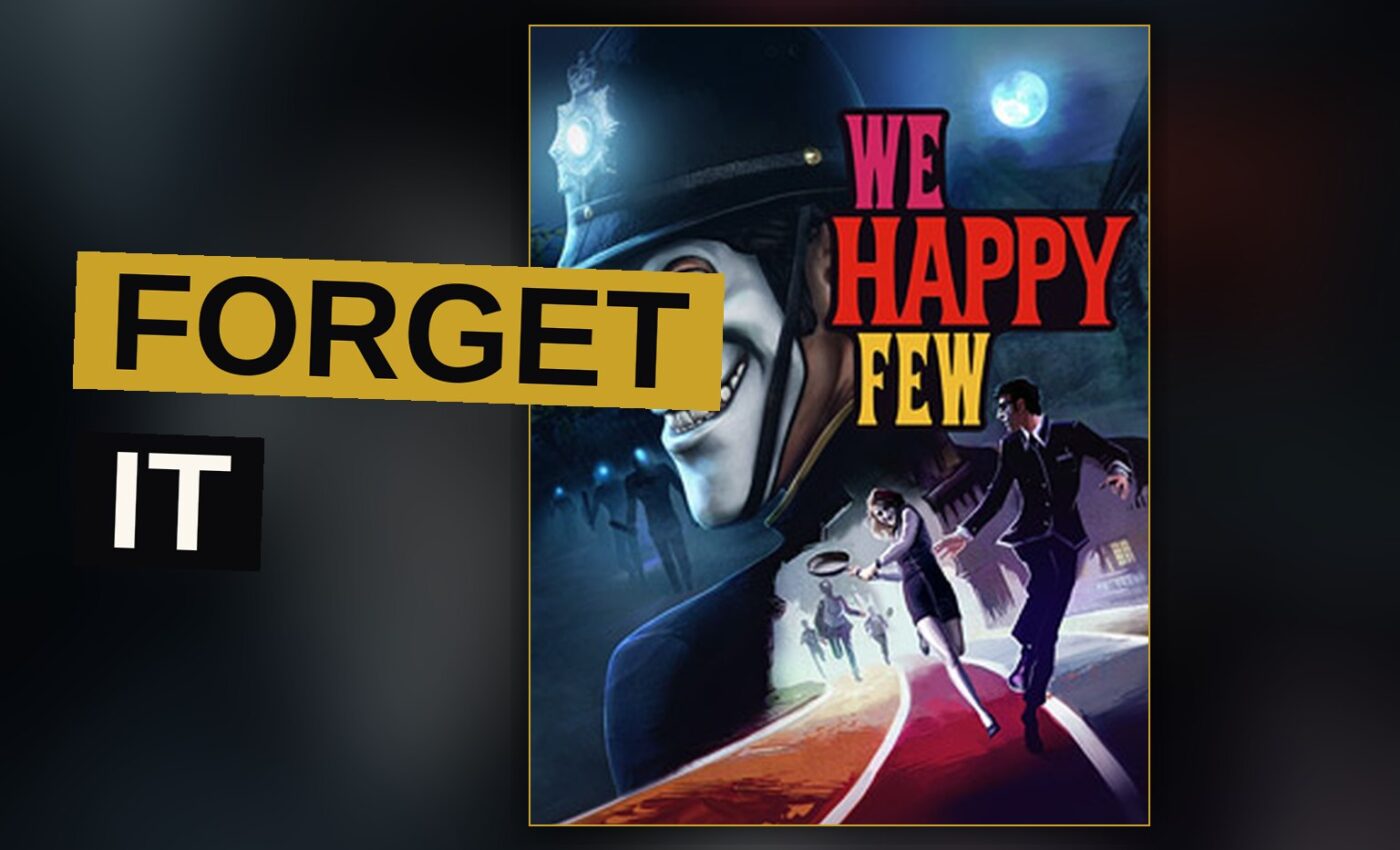
We Happy Few wants you to be happy. It hands you a drug called Joy, a white mask fixed into a smile, and a town that would rather forget than grieve. Then it asks you to stop taking all of it. Compulsion Games built a striking dystopia and buried it under survival mechanics that fight the story at every turn.
Wellington Wells and the Very Bad Thing
The game is played from a first-person perspective and mixes role-playing, survival and light roguelike elements. It takes place in a retro-futuristic version of the mid-1960s, after an alternative World War II. You control one of three characters, each trying to finish a personal task while escaping the fictional city of Wellington Wells.
That city is a crumbling dystopia on the verge of collapse. Its people lean on a hallucinogenic drug that keeps them blissfully unaware of the truth, easy to manipulate and short on morals. The drug is called Joy. It is dispensed in pill form and laced into the food supply.
The setting earns its keep. Franklin D. Roosevelt is assassinated in 1933, Senator Huey Long becomes President, Japan never attacks the United States, and the United Kingdom faces Germany alone. The Battle of Britain is lost. The Germans occupy the country.
Wellington Wells did what the game first calls a “Very Bad Thing,” which drove the Germans to leave the island. Guilt over it led to Joy. By the 1960s the town’s isolation has produced Tesla-styled weapons, portable power cells and automated security systems. Residents wear white “Happy Face” masks, built to mold the wearer’s cheekbones into a permanent smile. It is a fine, ugly idea.
Arthur, Sally and Ollie
We Happy Few splits into three acts with three playable characters, each with separate skills and separate reasons to run.
- Arthur Hastings is well-balanced, good at running and blending in.
- Sally Boyle is built for sneaking and crafting chemical concoctions.
- Ollie Starkey is the fighter, able to craft powerful explosives.
Arthur works as a censor at Wellington Wells’ Department of Archives, Printing, and Recycling. He finds a news clipping of himself and his older brother Percy after World War II. He can take his Joy, which ends the game, or refuse it and try to remember Percy. The second path sends him to an office party where his boss, Victoria Byng, and his co-workers eat a rat they hallucinate as a candy-filled piñata. He is called a Downer, chased by two constables, and ends up in the Garden District among the Wastrels.
The reveal underneath it all holds up. Wellington Wells handed over every child under 13 to the Germans in exchange for its freedom. The German tanks that threatened the town were papier-mâché dummies. The populace could have resisted and did not. That is the story the game should have trusted.
Where the Systems Get in the Way
It doesn’t, not for long enough. We Happy Few uses procedural generation to build the layouts of some parts of the world at the start of each playthrough, and the seams show. Each act gives you a main goal and a run of main quests, plus optional side quests for extra rewards. Objectives pay out skill points you spend on a skill tree, with each character carrying a special “Super-Duper” branch that strengthens their weaknesses by leaning into them.
You collect melee weapons, items, food and wealth. Items craft into lockpicks, healing balms and other tools. Food and water maintain nourishment and thirst, and staying fed improves certain attributes while hunger and thirst drag them down. You also have to let your character rest, or their fighting suffers. Underground safe houses called Hatches offer some relief.
None of this is broken. It is just thin next to the premise, and the procedural sprawl dilutes the paranoia the developers were clearly reaching for. The moral choices carry real weight and change later parts of the game, which is the right instinct. The moment-to-moment loop rarely rises to meet them.
Release and the Long Wait
The road here was long. An early access version arrived on Windows in 2016. The full game reached PlayStation 4, Windows and Xbox One in August 2018. The Kickstarter that started it all came earlier still, and the gap shows in a game that feels assembled from two different ambitions.
| Version | Platform | Release |
|---|---|---|
| Early access | Windows | 2016 |
| Full release | PlayStation 4, Windows, Xbox One | August 2018 |
The developers said they wanted a story with strong narratives, gameplay built on a sense of paranoia, and decisions set in moral gray areas. Two of those three land. The middle one does not.
What Holds and What Doesn’t
We Happy Few is worth playing for Wellington Wells itself. The masks, the Joy-laced food, the dummy tanks, the children traded for freedom — that is world-building with a point, and it earns the comparisons the developers drew from Brazil, Nineteen Eighty-Four, Animal Farm, Fahrenheit 451, Brave New World and the MaddAddam trilogy. The three characters give the story three angles on the same guilt, and Arthur’s arc in particular carries the weight the premise demands.
What keeps it from being more than a curiosity is the game wrapped around that premise. The survival systems are obligations, not choices. The procedural generation makes the city feel assembled rather than designed. The skill trees and “Super-Duper” branches are busywork dressed as depth.
This is a 6.3 of 10. A game with one of the best settings of its year and one of the more ordinary loops to move through it. Play it for the town. Tolerate the rest.
Get the Notebook.
The day's best stories and every fresh verdict, in plain English, in your inbox by seven. One email a day, no more.