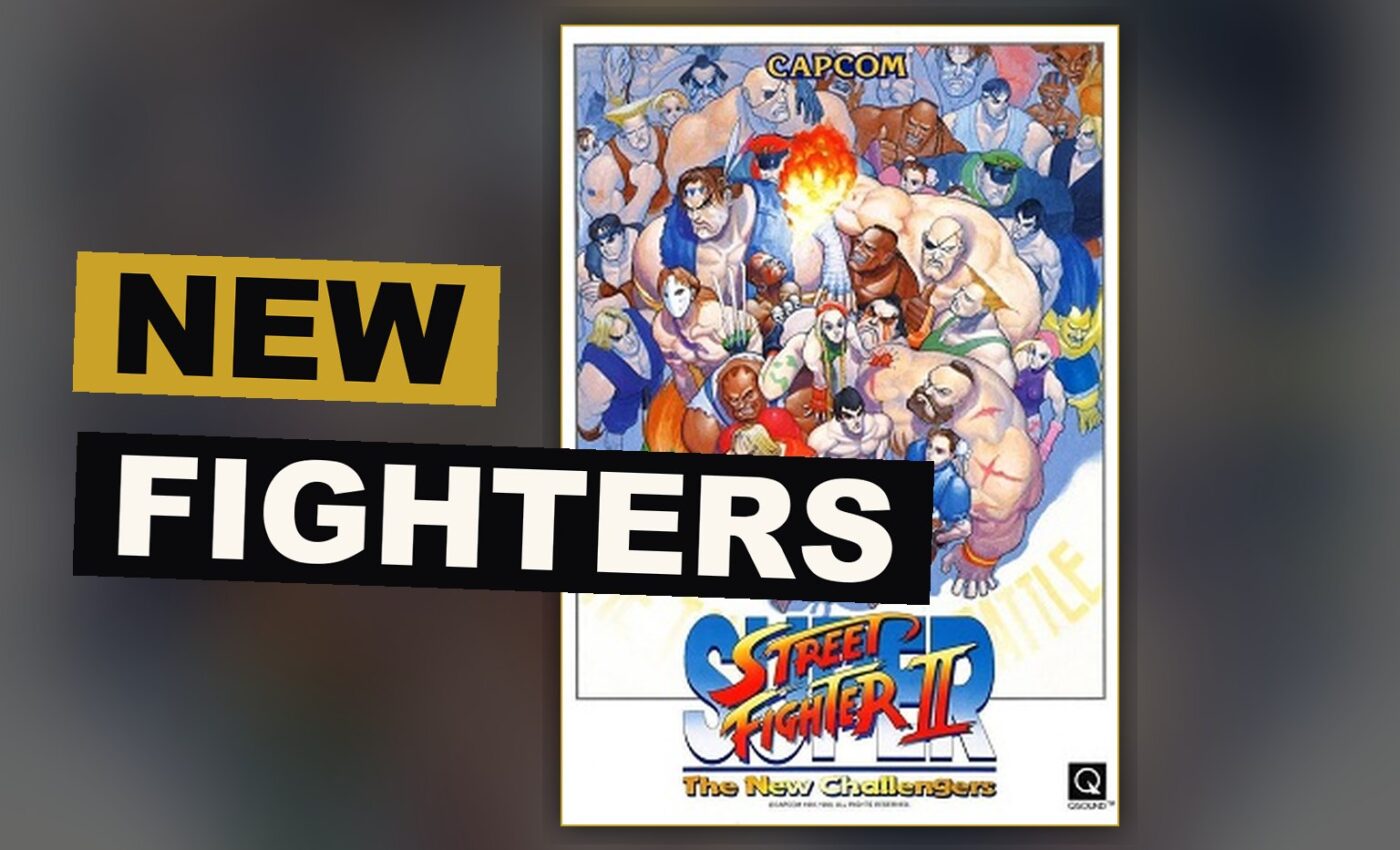
Super Street Fighter II landed on the Super Nintendo Entertainment System in 1994 as a home conversion of Capcom’s arcade fighter, and it is the version most players of the era actually owned. The arcade original, Super Street Fighter II: The New Challengers, hit in 1993 on Capcom’s CP System II hardware, the first game in the series built for that board. The home port cuts corners on graphics and sound. It keeps the fighting intact.
Four New Challengers Join the Roster
The arcade game was the fourth entry in the Street Fighter II sub-series, following Street Fighter II Turbo in 1992. It tightened the balance of the existing cast and added four fighters: Fei Long, Cammy, T. Hawk, and Dee Jay.
Cammy is a 19-year-old special forces agent from England with a past tied to M. Bison. T. Hawk is a Native American warrior from Mexico whose ancestral homeland was taken by Shadaloo. Dee Jay is a kickboxing musician from Jamaica looking for his next song. Fei Long is a Hong Kong movie star who wants to test his martial arts against real opponents, modeled on Bruce Lee.
All twelve World Warriors return from the earlier Street Fighter II games. Many of them got new techniques to adjust the overall balance. The Fire Hadōken, later renamed Shakunetsu Hadōken in the Street Fighter Alpha series, went to Ryu. Ken picked up a flaming Shoryuken. Zangief got the Atomic Buster. M. Bison added the Devil Reverse.
Balance, Speed, and the Arcade Board
The CP System II hardware gave the arcade version more sophisticated graphics and audio than the original CP System used by previous Street Fighter II releases. That gap is where the console port makes its concessions. The home version does not match the arcade on either front.
What it does carry over is the play. The fighting runs largely the same as the original, including the new game modes and the selectable game speed brought over from Turbo. That speed option matters more than it sounds. It lets a player set the pace of a match instead of accepting a fixed one.
The single-player structure runs a set order. Eight opponents are chosen at random, then the four Grand Masters arrive in sequence.
| Stage | Opponent |
|---|---|
| 1 | Random opponent |
| 2 | Random opponent |
| 3 | Random opponent |
| 4 | Random opponent |
| 5 | Random opponent |
| 6 | Random opponent |
| 7 | Random opponent |
| 8 | Random opponent |
| 9 | Balrog |
| 10 | Vega |
| 11 | Sagat |
| 12 | M. Bison |
The random draw is the part that keeps the early run from going stale. You cannot rehearse a fixed path through the first eight fights. The Grand Masters, by contrast, are fixed, and they are where the difficulty actually lives.
What the Conversion Gives Up
The conversion is a trade, and the trade is legible. Graphics and sound take the hit against the arcade board. Game-play stays close to the original. For a console owner in 1994, that was the right way to cut it.
Consider what the alternative would have been. A port that chased CP System II visuals on 16-bit hardware would have had to cut frames, characters or modes to get there. Capcom did not do that. The roster is complete. The modes are complete. The speed selector is present.
The cost is visible in the presentation, and it is a real cost. Anyone who played the arcade version first will notice it immediately. But the thing you do with a fighting game — pick a character, read an opponent, land the special — survives the trip intact. The Fire Hadōken still comes out. The Atomic Buster still lands.
How It Sits in the Street Fighter II Line
Super Street Fighter II was followed in 1994 by Super Street Fighter II Turbo, a fifth version of Street Fighter II that further balances the characters and adds features. That is worth naming plainly, because it shapes how this game should be judged.
This is not the final word on Street Fighter II on the Super Nintendo Entertainment System. It is the fourth pass, and a fifth was already coming. A player deciding between them in 1994 had a real choice, and the later release had the stronger claim on balance.
What this version has is the newcomers. Fei Long, Cammy, T. Hawk and Dee Jay debut here, and they are the reason the game still gets picked up. Cammy in particular arrived with a backstory tied directly to M. Bison, which gave the series a character it would keep using for decades. Fei Long’s Bruce Lee lineage is open about what it is doing. Dee Jay and T. Hawk are thinner, but they fill out the select screen.
Ranking What Actually Matters
Ranking what matters here, in order:
- The fighting system, carried over from Turbo with the speed selector intact.
- The four new characters, who are the actual reason to play this version over its predecessors.
- The rebalanced returning roster, which fixes problems that had built up across three prior releases.
- The single-player structure, with its random draw and fixed Grand Masters.
- The presentation, which is the one place the port clearly loses to the arcade.
The presentation sits last on purpose. It is the most visible difference and the least important one. A fighting game lives on its matchups, not on its sound chip, and Super Street Fighter II understands that. The 16-bit conversion keeps what the game is for.
Our verdict is that Super Street Fighter II holds up as the most complete Street Fighter II package on the Super Nintendo Entertainment System at the time it shipped. The graphics and audio concessions are real and worth naming. They are also the only thing standing between this port and the arcade original, and they do not touch the part of the game you spend your time in.
The newcomers carry it. Cammy, Fei Long, T. Hawk and Dee Jay give the game a reason to exist beyond another balance pass, and Cammy’s link to M. Bison gives the series a thread it would pull on for years. That is the detail that matters most in this package, more than any of the technical comparisons.
Get the Notebook.
The day's best stories and every fresh verdict, in plain English, in your inbox by seven. One email a day, no more.