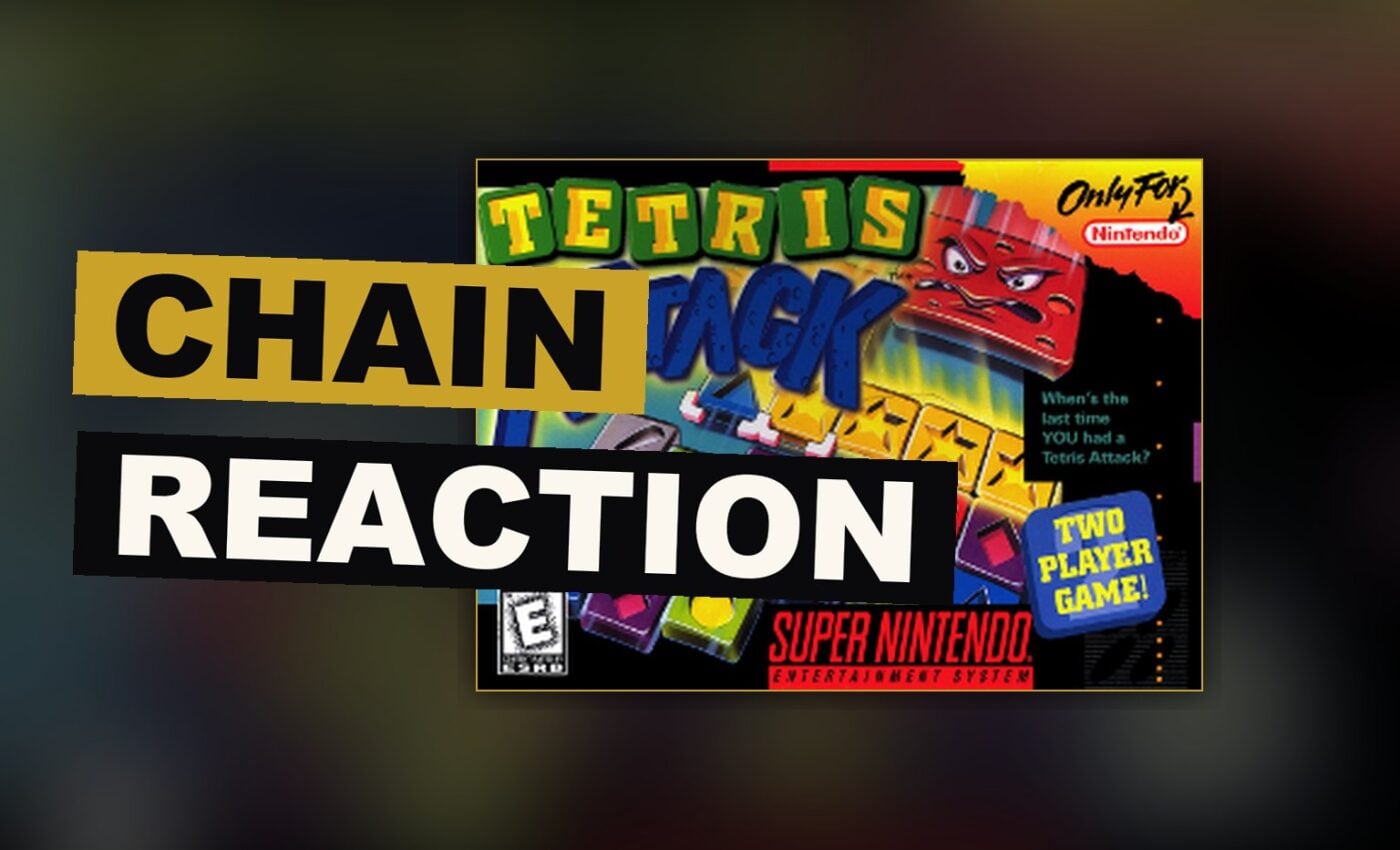
Tetris Attack is a 1995 Super NES puzzle game developed by Intelligent Systems and published by Nintendo, known in Japan as Panel de Pon, and the first thing to say about it is that it has nothing to do with Tetris. The name was a marketing decision. The game is its own thing, and its own thing is one of the finest puzzle designs ever made.
The Panels
Blocks of colored panels rise steadily from the bottom of the playfield. You control a cursor two panels wide and swap adjacent panels horizontally. Line up three or more of the same color, vertically or horizontally, and they clear. The stack keeps rising. If it reaches the top, you lose. That is the entire rule set, and a child can learn it in a minute.
The Depth
The genius is in what the rules allow. Clearing panels drops the ones above, and if those form a new match, that is a chain. Clearing more than three at once is a combo. Chains and combos send garbage blocks to your opponent in multiplayer, and the skill ceiling, which involves setting up chains in advance and swapping panels while they fall, is as high as any competitive game on the system. Watching an expert play Tetris Attack is watching someone think three moves ahead in real time.
Yoshi’s Island
The Western release dressed the game in the world of Yoshi’s Island. Bowser and his minions have cursed Yoshi’s friends, and Yoshi has to defeat each of them in a puzzle duel to lift the curse, then face the minions and Bowser himself, with any freed friend selectable for the final matches. It is a thin story and a charming coat of paint, and it made the game accessible to players who would never have picked up a Japanese puzzle title.
The Modes
A time attack, an endless mode, a stage clear mode, a puzzle mode with fixed boards to solve in a set number of moves, and two-player versus. The puzzle mode is a hidden gem, turning the swap mechanic into a set of logic problems. The versus mode is where the game lives, and it is as good as the SNES had.
The Game Boy Version
A Game Boy release followed a year later, and it is faithful within the limits of a monochrome screen. The colors matter in this game, so the handheld version is a compromise. It is still Tetris Attack, and still worth carrying.
Where It Falls Short
The single-player story is short and the AI opponents, once understood, can be beaten with a single reliable trick. The name confused players then and confuses them now. And the game’s depth is invisible to a casual player, who will see a simple match-three and stop before the chains reveal themselves.
The Verdict
Tetris Attack is a masterpiece hiding under a borrowed name. It is fast, deep, fair and endlessly replayable, and its versus mode is one of the best two-player experiences on the console. The score below is not a consensus. It is this paper’s own, and we will defend it.
Get the Notebook.
The day's best stories and every fresh verdict, in plain English, in your inbox by seven. One email a day, no more.