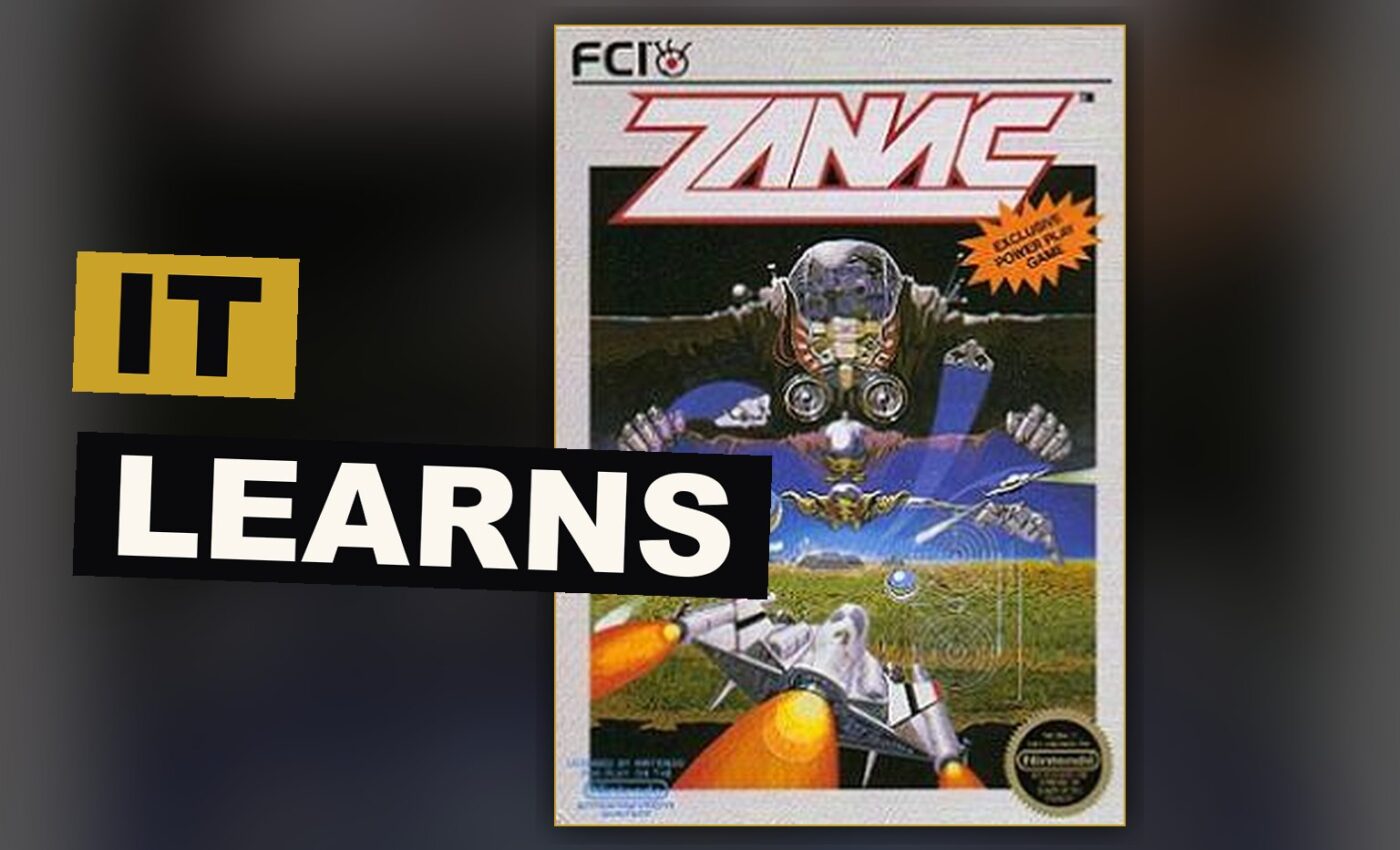
Zanac opens with a problem it never bothers to explain. A machine called the System was built millennia ago by an unknown alien race, and it holds boundless wisdom and knowledge alongside vast destructive potential. Mankind tried to open it, failed, and the System spread across space, wrecking every form of life it touched, including the human race. The fix, according to the game’s own framing, is one starfighter. The AFX-6502 Zanac, the most advanced ship ever produced, gets launched on a desperate run at the heart of the System.
That is the setup. What follows is one of the sharper shooters of its era, a game that has aged better than its premise has any right to.
A lone ship against the System
Zanac was developed by Compile and published in Japan by Pony Canyon and in North America by FCI. It came out for the MSX computer, the Family Computer Disk System, the Nintendo Entertainment System and the Virtual Console, and it was later reworked for the MSX2 as Zanac EX and for the PlayStation as Zanac X Zanac. The core team included Masamitsu “Moo” Niitani, Koji “Janus” Teramoto and Takayuki “Jemini” Hirono. All three went on to make similarly built games, among them The Guardian Legend, Blazing Lazers and the Puyo Puyo series.
The player flies the AFX-6502 Zanac through twelve levels, across planets, space stations and outer space, against the armada that makes up the System’s defenses. Shoot enemies and projectiles, pile up points, stay alive. You start with three lives. Get hit and you lose one, respawn on the screen, and lose every power-up you had collected. You get a brief window of invincibility when you reappear, which is the only mercy the game offers in that moment.
Adaptive difficulty that actually does something
What separates Zanac from the stack of shooters of its time is its adaptive artificial intelligence. The game adjusts difficulty automatically based on how the player is performing — skill level, rate of fire, and the current defensive status of the ship. It has been praised for that system, and it deserves the praise. Most shooters of the era set a difficulty and let you deal with it. Zanac watches you and responds.
That cuts both ways. Push hard, upgrade your cannon, and the game pushes back. The result is a shooter that rarely settles into a comfortable rhythm, which is the point.
Eight weapons and a main cannon
The player operates a rapid-fire main cannon, upgraded by collecting power-ups from blue boxes that drop periodically from the top of the screen. As the cannon’s power level climbs, the number of bullets fired and their speed increase. Separate from the cannon is a specialty weapon, and there are eight of them, each tied to a differently numbered power-up. Collect a numbered power-up that matches your current weapon and it upgrades. Collect a different number and you switch weapons outright. The eight specialty weapons range from directional bullets to shields to indestructible options.
- Rapid-fire main cannon, upgraded through blue box power-ups
- Eight specialty weapons, each tied to a numbered power-up
- Directional bullets
- Shields
- Indestructible specialty options
Losing a life wipes all of it. That is the tension the game runs on: every death costs you not just a life but the entire build you had assembled.
Twelve levels and a continue option
The run ends when all lives are gone or when you clear the twelfth and final area. The player can earn 1-ups by racking up high point scores, and there is a continue option that restarts the game from the level where you lost your last life. Those two systems matter more than they sound. A shooter this punishing without a continue would be a wall. With one, Zanac stays a challenge you can keep chipping at.
The music matches the pace of the play, which sounds like faint praise until you sit with it. A fast shooter with a soundtrack that lags behind it feels broken. Zanac’s does not lag.
The game is known for its intense and fast-paced gameplay, level of difficulty, and music which seems to match the pace of the game.
Where the premise goes
The System is described as figuratively similar to Pandora’s box. Open it correctly and you get untold wisdom and technology. Open it wrong and you get almost unlimited destruction. Mankind opened it wrong. Then mankind figured out how to access the knowledge inside properly, but could not shut down the expansion, because the System’s tactical systems are too vast and its defenses are built to destroy and overcome entire fleets.
So the plan is a single ship slipping through. The AFX-6502 Zanac fights its way to the heart of the System and shuts it down. That is a thin story even by the standards of its time, and the game does not pretend otherwise. The plot exists to justify the twelve levels. It does that job and stops.
What holds up and what does not
The adaptive AI is the reason to play Zanac now. It is not a gimmick bolted on for a back-of-the-box line. It changes how the game plays from run to run, and it is the mechanic later shooters kept borrowing without always getting right. The eight specialty weapons give the game real variety inside a single run, and the power-up loss on death gives every hit weight.
The weaknesses are structural. Twelve levels is a long commitment for a game this hard, and the continue option softens that only so much. The plot is forgettable, a Pandora’s box sketch that the game never returns to once the shooting starts. And the difficulty curve, tuned to the player, can turn on someone who is simply having a good run — the better you play, the more the game asks of you, which is thrilling until it is exhausting.
The verdict on Zanac
The verdict here is that Zanac earns its reputation as one of the stronger shooters of its era. It is fast, it is hard, and its best idea — a game that watches how you play and answers — still holds up decades on. It is not the deepest or the most beautiful shooter of its generation, and its story is filler. But the systems underneath it are smart, and smart systems age better than spectacle.
Get the Notebook.
The day's best stories and every fresh verdict, in plain English, in your inbox by seven. One email a day, no more.